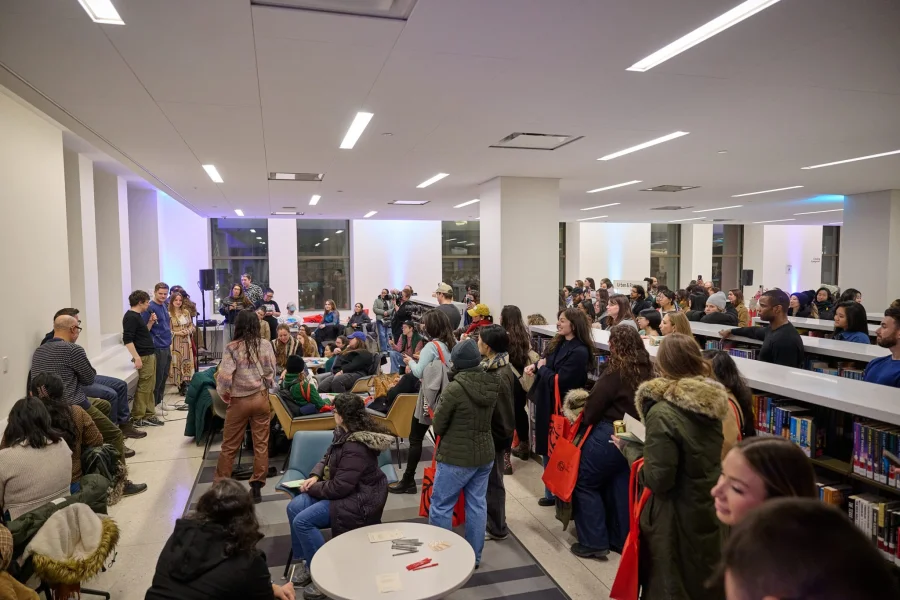
On one of the coldest nights of New York's winter, the line outside the New York Public Library snaked along the block. No concert. No restaurant opening. Just hundreds of strangers who had come to sit in silence — read for 20 minutes, then turn to someone they'd never met and talk about a book.
So many people showed up that the library hit capacity. Staff had to turn the rest away.
A library queue that looked like a sneaker drop
The event itself was almost absurdly simple: read silently for 20 minutes, then discuss your book with a stranger. No panels, no authors, no screens. Just attention, shared in a room full of people.
The demand told a bigger story. Even Brian Bannon, the library's chief librarian, was caught off guard by the subzero crowd.
Why curiosity is becoming the new third space
Sociologists have long described a "third place" — the informal public ground between home and work where community happens. For decades, that ground was the coffee shop or the bar. Coffee shops gave young adults somewhere to work. Bars gave them somewhere to socialize.
But those spaces are built around consumption or performance. What the NYPL queue revealed is a different kind of draw: a space built around curiosity.
When coffee shops became offices and bars became stages
The old third places have quietly changed function. Coffee shops turned into remote offices, occupied by laptops and calls. Bars demand social energy that feels exhausting after a day of digital interaction. Neither offers what the line outside the library promised: quiet presence, with an easy, structured reason to connect.
Loneliness and digital fatigue are reshaping how people spend free time — and the reading event tapped directly into that shift.
Who showed up — and what they were looking for
Bannon described the queue as a line of 20-somethings. This is the generation that grew up online, that socializes through screens, and that reports some of the highest levels of loneliness.
The format matters. Talking about a book gives strangers a shared subject — a low-stakes bridge into conversation that doesn't require being witty or outgoing. Curiosity becomes the entry point; connection is the byproduct.
'I thought maybe there was a sneaker sale' — what the librarian saw
"It was one of those subzero nights," Bannon told Fortune. "I thought maybe there was a sneaker sale."
Instead, "it was a line of 20-somethings waiting to get into the library."
The image is perfect in its inversion of expectations: the coldest night, the most crowded room, the most unexpected draw.
What this quiet revolution really means
The success of the event suggests that young adults aren't rejecting social spaces — they're rejecting the terms of the old ones. Bars reward performance. Coffee shops reward productivity. A silent reading room rewards nothing but showing up with a book.
That may be exactly why it worked. The event created a social situation with no social pressure, a crowd with no performance required. In an age of constant self-presentation, that is a rare and powerful offer.
Confirmed facts vs what remains unclear
Confirmed: The silent-reading-then-discussion format; a subzero night; hundreds in line; the library reached capacity and turned people away; Bannon's surprise at the crowd.
Unclear: The exact date and turnout figures, the event's name, and whether it was a recurring program or a one-off. Repeating the event may or may not reproduce the same demand.
What is clear is the sentiment: people showed up in uncomfortable cold for a few minutes of shared quiet. That is a signal, not a stunt.
The risks of treating curiosity as a cure
It would be easy to romanticize one cold night as a social breakthrough. The honest view is more cautious. A capacity crowd at a novel event doesn't yet prove a durable movement — novelty draws crowds everywhere.
There's also a structural concern. Libraries are chronically underfunded public institutions, not hospitality businesses. If they become the new third place, they'll need public support to match their new role. Loneliness is a public health crisis; a reading event is not a cure, just a bridge.
A wider turn toward slower, shared attention
The NYPL queue fits a broader pattern in how people are rethinking social life: less performative, more purposeful, slower in pace. The desire isn't to watch — it's to participate without being on display.
Reading with strangers sits at the center of that shift. It combines the private pleasure of a book with the public comfort of shared presence. That combination is precisely what digital spaces struggle to offer.
What readers can do now
You don't need to wait for a library event to try this. Check your local library's programming calendar — many now run silent reading nights and book-centered meetups. If none exist, consider starting one with friends or a local bookstore.
The format is simple: set a time, read quietly, then talk about what you read. The barrier to entry is a book and 20 minutes of stillness.
What could come next
If the NYPL response is any guide, libraries will likely expand this kind of programming — and capacity will keep being an issue. Expect more events built around shared attention, from reading circles to guided curiosity sessions, as institutions respond to the loneliness epidemic.
The more interesting question is whether other third places follow. The line in the cold proved there is real demand. The next step is building the supply.
Our Take
One line outside a library is not proof of a solved problem. But it is proof of an appetite — young people willing to brave freezing weather for connection that doesn't feel like a performance.
That matters beyond libraries. Every generation finds its own version of the third space. If this generation's version is built on curiosity and quiet rather than alcohol and noise, that isn't a retreat from social life. It's a redefinition of it — and one worth paying attention to.
Frequently Asked Questions
What is a "third space"?
The "third place" is the informal public space between home (first place) and work or school (second place) where community life happens. Historically, these have been coffee shops, bars, parks, and libraries. The NYPL silent reading event represents an emerging type of third space built around curiosity rather than consumption.
Why did people line up outside the New York Public Library in the cold?
They came for a simple silent reading event: read for 20 minutes, then talk about your book with a stranger. On a subzero winter night, the library reached full capacity and had to turn people away — a response that surprised even the chief librarian.
How is the loneliness epidemic changing social spaces?
Digital fatigue and isolation are pushing people away from high-pressure social formats like bars and networking events. Instead, many seek low-stakes, purposeful connection — spaces where conversation happens naturally around a shared activity, like reading, rather than being the entire point of showing up.
Are libraries becoming the new social hubs?
There's growing evidence of demand. The NYPL event drew hundreds of 20-somethings on one of the coldest nights of winter, and organizers had to turn people away. But libraries face funding pressures, and one successful event doesn't guarantee a permanent shift — it signals an opportunity, not yet an established trend.
# [NEWS_SCHEMA] { "@context": "https://schema.org", "@type": "NewsArticle", "headline": "Subzero Nights, Silent Pages: Curiosity Is Becoming the New Third Space", "description": "Hundreds lined up in subzero NYC cold to read silently at the New York Public Library — proof that curiosity is becoming the new third space.", "image": "Young adults in winter coats queue outside a grand public library at night, warm light spilling from the entrance", "datePublished": "2025-02-10T08:00:00+05:30", "dateModified": "2025-02-10T08:00:00+05:30", "author": { "@type": "Person", "name": "Maya Krishnan", "url": "", "sameAs": [] }, "publisher": { "@type": "Organization", "name": "The Newsroom Desk", "logo": { "@type": "ImageObject", "url": "" } }, "mainEntityOfPage": { "@type": "WebPage", "@id": "" }, "articleSection": "Culture & Society", "keywords": ["curiosity-driven third spaces", "loneliness epidemic", "New York Public Library", "silent reading", "digital fatigue", "third places"] } # [SOURCES] Fortune — Original reporting featuring comments from NYPL Chief Librarian Brian Bannon (direct article link not provided in research brief)