Inside a warehouse in Exeter, New Hampshire, an American flag hangs over one-ton bags of mining waste that Washington is betting half a billion dollars on. The powder in those bags is the raw material for a refinery that is tiny today — and expected to become roughly 600 times larger within two years.
A warehouse in Exeter holds a $500 million question
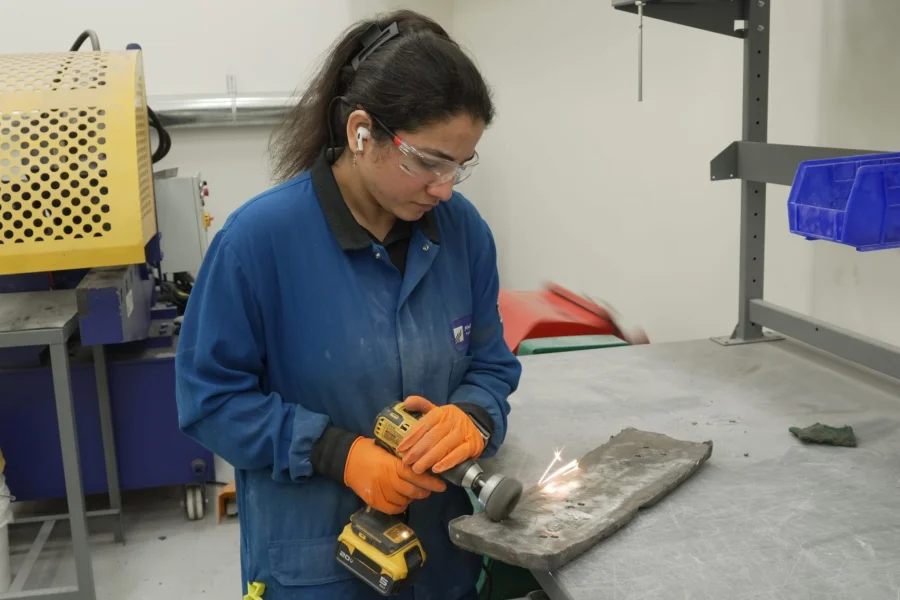
The facility belongs to Phoenix Tailings, a small company tucked into an office park. Its method is electrolysis — using electricity to separate the key critical elements from the powder left behind at traditional mines.
That powder, once treated as waste, contains rare earths the Trump administration wants produced domestically. The stated goal is to expand output from around 200 kilograms today to 120 tonnes within about two years.
Why old mine waste is now a national security problem
Mining rare earths is not America's weakness. Processing them is. The step between raw ore and usable metal is where China's chokehold is strongest, according to the original report.
Pentagon interest in a small refinery is not really about one company. It is about the supply chain behind fighter jets, missile systems, electric vehicle motors, and smartphones — all of which depend on refined rare earths that largely flow through Chinese plants.
The climb from 200 kilograms to 120 tonnes
A $500 million loan from the Pentagon backs the expansion, the original report says. Building the new factory will take 14 to 18 months.
The scale-up is steep. Moving from demonstration-level output to industrial-scale separation requires solving problems in energy use, process stability, and material purity — challenges that have slowed larger Western efforts for years.
Who is exposed if rare earth processing stays abroad
Rare earths are not rare in the ground. They are rare in refined form. They power electric vehicle drivetrains, wind turbines, defense electronics, medical imaging machines, and consumer gadgets.
For American manufacturers and the Defence Department, every kilogram of domestic processing capacity built is a small reduction in dependence on a single foreign supplier. That is the real human and industrial stakes behind the flag hanging in that New Hampshire warehouse.
What the Pentagon loan really signals
The decision to back a small electrolysis refiner with half a billion dollars signals how seriously Washington views the processing gap. The original report says the administration "desperately wants" these elements produced at home.
The choice of a technology-driven startup over a traditional mining operator also hints at the strategy: fund specific bets that can scale fast, rather than trying to rebuild an entire industry at once.
Why processing — not mining — is America's bottleneck
The United States once had its own rare earth processing capability. Much of that capacity shifted overseas over the past two decades as costs concentrated in China.
Rebuilding it is chemically difficult. Individual rare earth elements behave almost identically, making separation painstaking work that demands precision equipment and specialised expertise. That is exactly the capability that consolidated in China while Western attention drifted elsewhere.
Confirmed details and questions still open
Confirmed in the original report: Phoenix Tailings operates a small refining facility in Exeter, New Hampshire. It uses electrolysis on mining waste powder. A $500 million Pentagon loan is tied to the expansion, and a new factory would take 14–18 months to build.
Not yet clear: who will buy the refined output, whether the 120-tonne target refers to separated metals or oxides, and what happens if construction or scale-up slips. These details remain unanswered in the material available.
The electrolysis bet that could set this refiner apart
Phoenix Tailings' approach relies on electrolysis rather than the chemical-intensive separation methods used across much of the industry. The original report describes the process as separating critical elements from the powder left behind at traditional mines.
The bet is that this method can be scaled more efficiently into a genuine commercial operation — giving the company a route to refined rare earths without building a massive conventional chemical plant.
The risks hiding in a steep scale-up
Scaling from 200 kilograms to 120 tonnes is not just building a bigger building. Energy costs, temperature control, and purity consistency all behave differently at industrial volume.
There is also timeline risk. Fourteen to eighteen months of construction, followed by a sharp production ramp, leaves little room for setbacks — especially against an incumbent industry in China with decades of accumulated experience.
A race that extends far beyond New Hampshire
This refinery is one front in a broader global contest. Diversifying critical mineral supply chains has become a consistent theme in industrial policy from Washington to Brussels to Tokyo.
Most of those efforts are still in early stages. That makes the Exeter facility an unusually visible test of whether a small, fast-moving company can outpace much larger national programs.
What to watch in the next 18 months
For anyone tracking this story, the milestones are concrete: the start of factory construction, formal disbursement of the Pentagon loan, and the company's output figures over time.
Each step will show whether the $500 million bet is on track — or wobbling.
What happens if the bet pays off — or falls short
If Phoenix Tailings reaches 120 tonnes, the volume would still be modest against global demand, which runs into tens of thousands of tonnes a year. But it would prove something critical: that a domestic processing route is technically viable.
If the scale-up stalls, the lesson would be equally clear — that closing the processing gap demands more than capital and deadlines.
Note: This article is based entirely on the original report provided. No independent sources or external quotes were available at the time of writing. All forward-looking statements are framed as targets, not confirmed outcomes.
Our Take
The most striking detail here is not the size of the loan. It is the weight of expectation resting on a small refinery in an office park. One facility cannot carry America's entire critical minerals strategy, but one facility can prove whether the strategy is even possible.
The $500 million is a test of technology first, industrial policy second. If the electrolysis process works at scale, Exeter becomes a template. If it does not, the Pentagon's next bet will have to be placed somewhere else — and the flag on that warehouse wall will stay exactly where it is.
Frequently Asked Questions
What is Phoenix Tailings?
Phoenix Tailings is a small refining company based in Exeter, New Hampshire. It uses electrolysis to separate critical elements such as rare earths from the powder left behind at traditional mines. The company is expanding with a $500 million Pentagon loan.
Why is the Pentagon lending money to a rare earth refinery?
Because China holds a chokehold on the processing of critical minerals, the Pentagon views domestic processing capacity as a national security priority. The loan supports Phoenix Tailings in scaling from roughly 200 kg to 120 tonnes of output to help break that dependence.