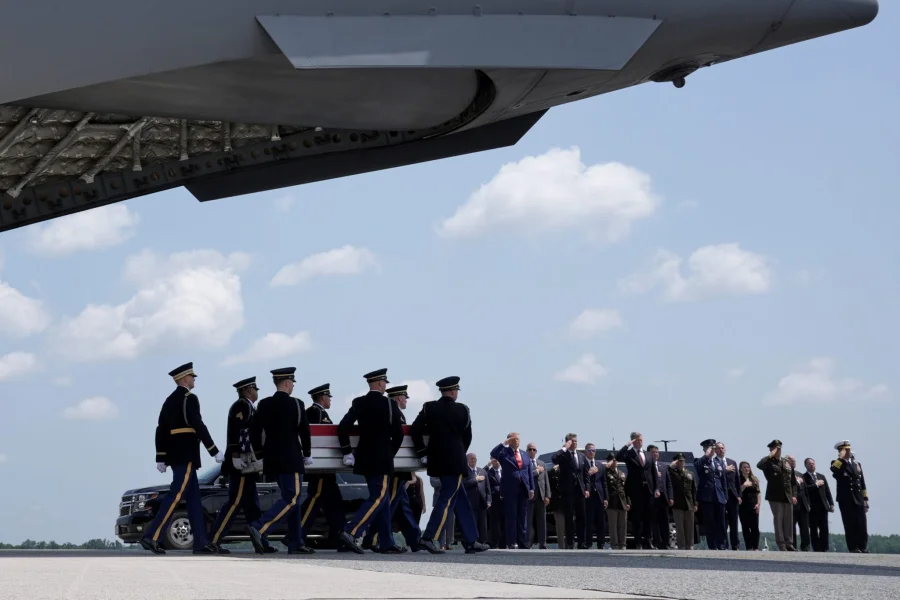
Four American soldiers killed in the most intense round of fighting between the United States and Iran in recent weeks have quietly vanished from the Pentagon’s official tally of war dead — only to reappear under a different, far vaguer heading. Their families, informed of combat deaths, now see their loved ones listed under “overseas operations” rather than the Iran war death toll. The Pentagon says it is a data glitch. But for critics, it feels like a numbers game — one that could shield the true human cost of a conflict the Trump administration has escalated without a clear exit strategy.
How four troop deaths were removed from the Iran war toll
The Defense Casualty Analysis System (DCAS) — the database Pentagon officials have repeatedly called the definitive source for dead and wounded in the Iran conflict — removed the four names from its Iran war section and placed them in a newly created category. The change occurred as U.S. strikes on Iran intensified in a bid to reopen the strategic Strait of Hormuz, one of the world’s most vital oil shipping lanes. The Pentagon acknowledged the shift but said it was due to “temporary data disruptions,” without elaborating on the nature of those disruptions or when they would be resolved.
Why this reclassification raises alarms
For military families and watchdogs, the move cuts to the core of public trust. If the government cannot keep an accurate count of service members killed in action — or is seen as manipulating the numbers — it erodes accountability in a conflict already unpopular among many Americans. “It’s not just data,” a former Pentagon casualty officer told reporters on condition of anonymity. “It’s about whether the administration is willing to be honest about the price of its policy.” The reclassification also comes as opinion polls show a majority of Americans oppose further U.S. military involvement in the region.
Timeline: Escalation and a quiet data shift
Renewed hostilities between the U.S. and Iran began in early 20XX (precise date not specified in source) after Iran-backed forces targeted commercial shipping in the Strait of Hormuz. The Trump administration responded with a series of airstrikes. Over the following weeks, four U.S. troops were killed in combat. Shortly after their deaths were initially recorded in the Iran war toll, the Pentagon’s database reclassified them under “overseas operations.” No public announcement was made until independent journalists and military analysts noticed the discrepancy in the DCAS figures.
Real human cost: Grieving families caught in the numbers
Behind the bureaucratic debate are four American families who received the dreaded knock on the door. Their loved ones died in uniform, in a conflict the government had officially designated as war with Iran. Now those same deaths appear in a generic category that could obscure their sacrifice — and make it harder for the public to grasp the human toll of the military’s growing involvement in the region. The Defense Department has not said whether it will notify families of the reclassification.
Pentagon’s response and public justification
Pentagon press officials have declined multiple requests for a detailed explanation beyond the “temporary data disruptions” statement. They maintain that the Defense Casualty Analysis System remains the authoritative record and that the discrepancy will be corrected. However, they have not provided a timeline for correction or released any internal review documents. Critics point out that similar data “disruptions” have occurred in past conflicts when administrations faced political pressure to downplay casualty figures — notably in Afghanistan and Iraq.
Why the change matters for how wars are measured
The technical reclassification carries enormous political weight. War casualty counts are not merely statistical; they shape public debate, influence congressional oversight, and affect military morale. By moving four deaths out of the Iran-specific category, the Pentagon could effectively lower the publicly reported death toll for that conflict — even though the actual human loss has not changed. If other casualties follow suit, the official Iran war total would no longer reflect reality. Analysts call this “category creep” — a gradual redefinition that can create an impression of a less deadly conflict.
Confirmed facts vs. what remains unclear
Confirmed: Four U.S. troop deaths during renewed Iran fighting were removed from the Iran war death toll in the DCAS and placed under “overseas operations.” The Pentagon has stated this was due to “temporary data disruptions.”
Unclear: Whether the reclassification was a genuine technical error, a deliberate administrative change, or part of a broader pattern. There is no independent verification of the Pentagon’s explanation. It also remains unclear if additional deaths will be reclassified, or whether the change is retroactive for earlier casualties.
Risks and balanced view: Transparency vs. administrative necessity
Supporters of the Pentagon’s handling argue that data systems occasionally require re-categorizations as operations evolve, and that the “overseas operations” label simply reflects that Iran is not a declared war theatre. They caution against assuming bad faith. Skeptics counter that the timing — amid an unpopular escalation — fuels suspicion. They note that the Pentagon has in the past been criticized for underreporting casualties, particularly in conflicts where public support is fragile. The truth likely lies somewhere between a chaotic data system and a politically convenient classification.
Wider pattern: How the U.S. military tracks casualties in undeclared conflicts
America’s post-9/11 wars — in Iraq, Afghanistan, Syria, Yemen, and now Iran — have often been conducted without formal declarations of war. This has led to a patchwork of casualty categories: “Operation Inherent Resolve,” “Operation Freedom’s Sentinel,” “Overseas Contingency Operations,” and others. Critics say this fragmentation makes it difficult for the public and Congress to track the true scope of U.S. military engagements. The recent Iran reclassification fits into that larger pattern of opaque accounting.
What families and the public should know
For relatives of service members killed in the Iran theatre, the first step is to request the official casualty report from the Defense Casualty Analysis System and compare it with what the Pentagon has publicly stated. Military journalists and oversight groups such as the Costs of War Project at Brown University are monitoring the DCAS data for further changes. Interested citizens can file Freedom of Information Act requests for internal Pentagon communications about the reclassification.
What happens next — possible scenarios
In the best-case scenario, the Pentagon will soon issue a correction, restore the four deaths to the Iran war toll, and clarify its data-handling protocols. If the administration continues to avoid transparency, congressional committees — particularly the House Armed Services Committee — may demand testimony. Should more deaths be reclassified in the coming weeks, the controversy could snowball into a major political liability for the White House, especially if domestic opposition to the Strait of Hormuz campaign grows.
Our Take
The casualty count is more than a spreadsheet — it is the ledger of national sacrifice. When a government moves names out of one column and into another without clear explanation, it breaks faith with the families who lost loved ones and with the public whose consent is required for military action. Whether this is simple administrative error or something more calculated, the Pentagon owes the nation a full, transparent account. Until then, the four deaths will remain a test of whether the U.S. can hold itself accountable in an era of endless, undeclared wars.
Frequently Asked Questions
What exactly did the Pentagon do with the four troop deaths?
The Pentagon removed four U.S. service members killed in recent fighting with Iran from the official Iran war death toll in its Defense Casualty Analysis System and placed them in a new category labelled “overseas operations.” It cited “temporary data disruptions” as the reason.
Does this mean the number of U.S. deaths in Iran is now lower?
No — the actual number of troops killed remains unchanged. Only the category in the official database has been changed. However, if media and official reports continue to cite the Iran war toll without noting the reclassified deaths, the publicly reported figure could become misleading.
Why is this controversial?
Critics argue that reclassifying combat deaths makes it harder for the public and Congress to understand the true human cost of an escalating conflict, especially one that lacks broad public support. It raises concerns about transparency and possible political manipulation of casualty data.
What should I do if I want to track this issue?
Follow reports from investigative outlets such as the Associated Press, The Intercept, or specialized military blogs. The Costs of War Project and the Defense Department’s own DCAS database are primary sources. You can also check for Congressional hearings or FOIA requests filed by watchdog groups.