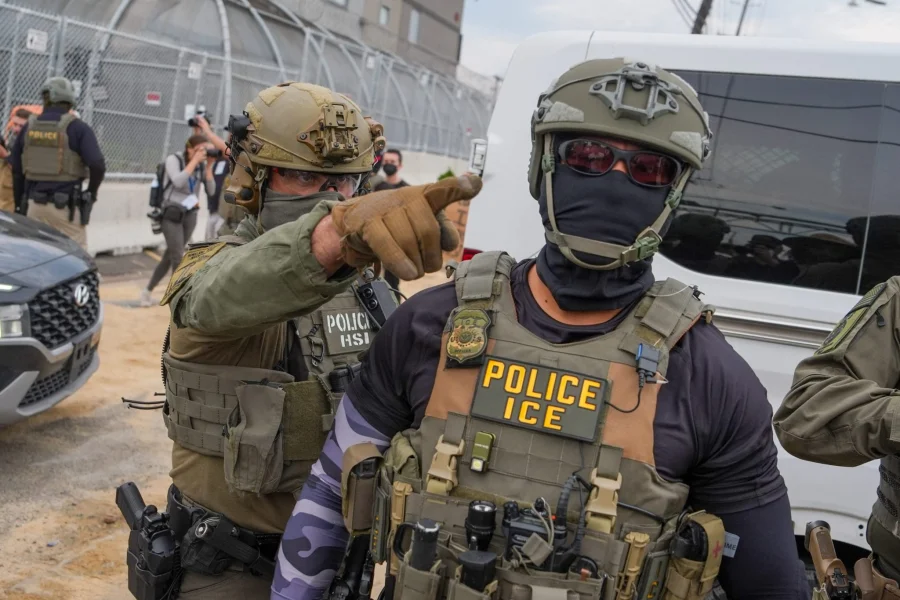
A device built to deliver an electric shock from a police officer's hand is already inside an American public school system — and now federal immigration enforcement wants millions of dollars' worth of the same technology. Documents published this week by the Department of Homeland Security show ICE preparing to spend up to $20 million on gloves called G.L.O.V.E., which stands for Generated Low Output Voltage Emitter. Months earlier, in May 2025, the city of Omaha awarded its police department $65,924 for 40 units destined for public schools. The overlap raises urgent questions for parents, students and officers alike.
ICE's $20 Million Shock Glove Procurement, Explained
The plans surfaced in DHS documents published this week, with AP News first reporting the story. ICE is preparing to equip officers with gloves capable of delivering electric shocks — a significant expansion of the technology's federal footprint.
Procurement on this scale typically signals a formal rollout rather than a small pilot. Yet the documents do not publicly clarify every detail of how the gloves would be used, who would train officers, or when deployment would begin.
Why Shock Gloves in Schools Raise Deeper Questions
The Omaha connection is what makes this story harder to ignore. A purchase approved in May 2025 funnelled $65,924 into 40 G.L.O.V.E. units for the Omaha Police Department — equipment tied to public schools.
Electric shock devices in a school setting sit at the intersection of student safety, policing power and parental trust. The dollar figure is modest next to ICE's $20 million plan, but the symbolism is not. Any shock-based tool in a hallway where children learn reshapes the conversation about school policing.
From DHS Documents to Omaha's May 2025 Purchase
The timeline bridging local and federal use is surprisingly short. In May 2025, Omaha city documents awarded police funding for 40 shock glove units. The department's official statement begins: "These gloves are being purchased for schools..." — though the fuller rationale was cut short in the original report.
This week, DHS documents outlined ICE's intention to spend up to $20 million on the same technology. The documents also indicate the gloves have already been deployed by law enforcement officials around the country, positioning Omaha as part of a broader pattern rather than an isolated experiment.
Students, Parents and Officers: Who Feels the Impact
For students, the presence of shock-capable gloves changes the texture of school discipline. For parents, it raises questions they may never have expected to ask: When can these be used? What triggers a shock? Who decides?
For officers, the devices offer an apparent alternative to other physical interventions — but they carry reputational and legal weight too. The emotional core of this story is not abstract. It plays out in corridors where children in Omaha walk between classes every day.
The Official Record: What Has Actually Been Said
Official details remain thin. The DHS documents confirm procurement intent, and the Omaha city records confirm the school purchase and its funding amount.
The partial quote from Omaha documents — "These gloves are being purchased for schools..." — signals an official rationale, but the complete justification has not been made public. Neither agency has, in the published record, detailed use-of-force protocols, training standards or safeguards. That absence of detail is itself newsworthy.
How the G.L.O.V.E. Technology Fits Into Less-Lethal Policing
G.L.O.V.E. belongs to a broader category of less-lethal tools — equipment designed to subdue without firearms. Its defining feature, based on the name, is a generated low output voltage emitter built into a glove.
Unlike a taser that must be aimed and fired, a glove-based system is contact-based and hands-on. That distinction matters: it operates at close quarters, in the space where verbal commands fail and physical restraint usually begins. Supporters would argue it offers a controlled alternative. Critics would question what happens when judgment fails in that same close space.
The Verification Gap: Confirmed Facts vs What Remains Unclear
Confirmed: ICE plans to spend up to $20 million on G.L.O.V.E. gloves, according to DHS documents published this week and first reported by AP News.
Confirmed: Omaha awarded its police department $65,924 for 40 units in May 2025, with documents indicating school use. Reported but not independently verified: claims that the devices have been deployed by law enforcement nationwide.
Unclear: the manufacturer's identity, ICE's deployment timeline, safety testing data, training requirements and the full text of Omaha's stated rationale for the school purchase.
The Safety Debate: Benefits vs Risks
Seen from one angle, the gloves represent an effort to give officers a graduated response — something between harsh physical force and lethal weapons. From another, they introduce a shock delivery system into environments where restraint and de-escalation are meant to lead.
The most sensitive application is schools, where minors are involved and a single misuse could inflict lasting harm. Neither ICE nor the Omaha Police Department has, in the current public record, released independent testing or documented community consultation. Both omissions should worry an attentive public.
A Wider Shift in Policing Technology
Omaha is not the only jurisdiction connected to the devices. The documents reportedly indicate deployment by law enforcement agencies across the country.
That suggests a quiet pattern: less-lethal technology moving from military and correctional contexts into everyday community policing and, notably, into schools. The systemic question is not just whether this glove is safe, but whether police technology is being adopted faster than the rules that govern it.
What Parents and Citizens Should Watch For
Parents in Omaha should ask their school district and police department for concrete answers: What training did officers receive? What policy governs glove use? How are incidents reported and reviewed?
Citizens elsewhere should watch whether their own departments follow the Omaha path. Journalists and watchdog groups can request procurement records, use-of-force policies and training manuals under public records laws. Informed scrutiny is the only meaningful check on a technology already in circulation.
What Happens Next
The immediate next steps are not yet public. ICE's $20 million plan will presumably move through federal procurement channels, which could take months. Omaha's 40 units are already funded, so the pressing question is operational: when and how will officers begin using them in schools?
Public records requests, city council discussion and police oversight boards could surface more details. Until then, the most honest position is uncertainty.
Our Take
This story matters because it bridges two sensitive worlds: the escalation of federal enforcement technology and the everyday environment of public schools. The $20 million figure is striking, but the Omaha detail is more significant — it shows the technology is not hypothetical.
It is already in a school district, in the hands of officers, with public documentation that remains incomplete. The burden now falls on agencies to be transparent about training, policy and oversight — before public trust erodes further.
Frequently Asked Questions
What are G.L.O.V.E. electric shock gloves?
G.L.O.V.E. stands for Generated Low Output Voltage Emitter. It is a glove-based device capable of delivering an electric shock, designed as a less-lethal tool for law enforcement. The name comes directly from the DHS documents reported by AP News.
How much is ICE planning to spend on shock gloves?
ICE is preparing to spend up to $20 million on G.L.O.V.E. electric shock gloves, according to Department of Homeland Security documents published this week and first reported by AP News.
Are shock gloves already being used in Omaha public schools?
The city of Omaha awarded the Omaha Police Department $65,924 for 40 G.L.O.V.E. units in May 2025, with city documents linking the purchase to public schools. However, the full official explanation was cut short in the original report, so the complete rationale has not been publicly confirmed.