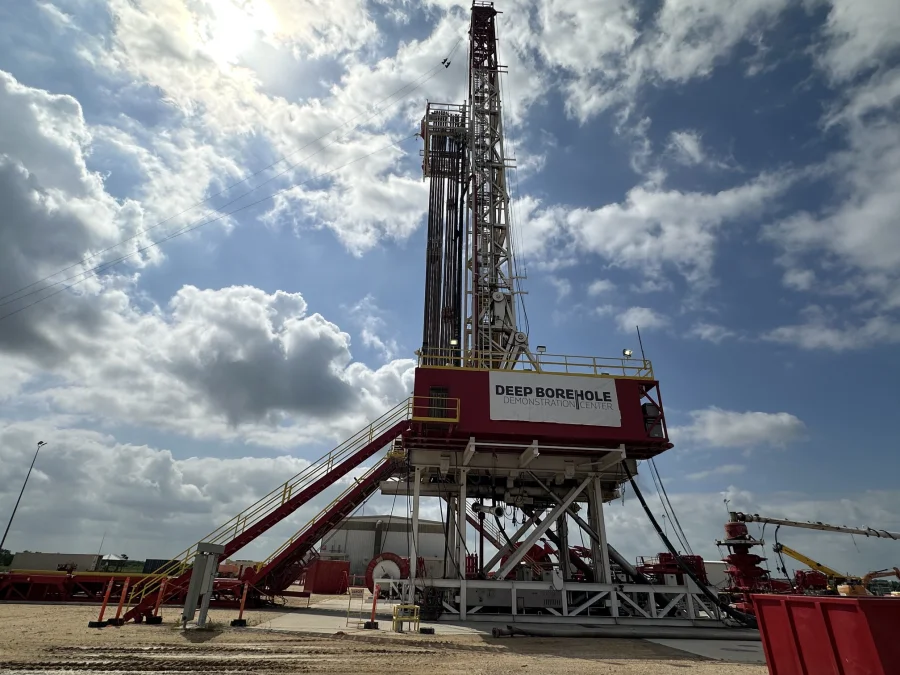
First comes a warning about cows. Then one about snakes and scorpions. By the time the massive drilling rig appears beyond the cattle blocking the gravel road, it is clear this is no ordinary oilfield stop — and no ordinary answer to America's radioactive waste problem.
Cameron, Texas: where a security gate opens to a nuclear experiment
Near Cameron, population 5,300, down a gravel road in central Texas, sits the Deep Borehole Demonstration Center. A security gate carries a sign that reads, "Watch out for the cows" — and the cattle do block the road, delaying the first sight of the rig.
A large, bearded man in red Halliburton coveralls and a helmet delivers the orientation. His warning is blunt: beware of snakes and scorpions. "Not trying to scare you; that's just part of the orientation," he says, according to the report.
The nuclear waste problem America never finished solving
The United States has produced radioactive waste for decades without a permanent place to put it. Much of it remains in temporary storage, with final disposal decisions deferred for generations. The Cameron project is aimed directly at that gap.
From fracking fields to fission waste: an unusual crossover
Halliburton built its reputation on drilling and fracking, not nuclear power. But the vertical drilling skills used to reach oil and gas reservoirs are, in principle, the same skills required to bore deep holes for sealed waste canisters.
That crossover is the foundation of the partnership between nuclear waste startup Deep Isolation, Halliburton, and other collaborators at the Texas site.
Who carries the cost of the waste backlog
The nuclear waste problem is not abstract. Communities living near temporary storage sites carry the uncertainty; electricity customers ultimately pay for management and security; future generations inherit whatever is left behind.
A disposal method that could be deployed closer to waste sources and with less surface footprint would change that calculus — if it proves safe and affordable.
The goal, as the project partners describe it
According to the original report, the stated mission of the demonstration center is direct: to solve the nation's nuclear waste disposal problems.
The site pairs Deep Isolation's waste-containment design with Halliburton's drilling muscle to show that deep borehole disposal can be done at scale — not just on paper.
Deep borehole disposal, explained in plain terms
The broad concept works like this: drill a very deep, narrow hole, lower sealed canisters of radioactive waste to the bottom, and seal the hole behind them. The idea depends on natural geology — the depth of surrounding rock — to isolate waste from the surface and from groundwater above. The Texas demonstration is about proving that the drilling and containment can actually be carried out.
What is confirmed, and what is still unproven
Confirmed from the report: the demonstration center exists near Cameron; Deep Isolation and Halliburton are partners in the project; a full drilling rig is on location; and the mission is to address the nation's nuclear waste disposal challenge.
What remains unclear: whether the technique wins regulatory approval, whether its costs compare with alternatives, and when any commercial-scale project might follow. None of that has been established yet.
Halliburton's advantage: decades of drilling under pressure
The oilfield services leader brings something rare into the nuclear space: years of deep-drilling practice, field-tested equipment, and crews experienced in difficult geology.
In a field where drilling depth and reliability decide success, that engineering base is a genuine moat. It is also why the partnership is being watched closely by the energy industry.
The debate over burying waste deep underground
The case for deep burial is geological isolation — waste placed far below water sources, in stable rock, with no need for active surface management for centuries.
Critics and regulators still worry about the long run: canisters ageing over thousands of years, the difficulty of monitoring a sealed well, and a mistake that cannot be easily reversed. Supporters counter that today's above-ground storage also carries real risk. The demonstration will not settle that debate, but it could inform it.
Oilfield expertise is finding a second life
Halliburton is not alone in repurposing oil and gas know-how. The same drilling capabilities behind fracking are being directed at geothermal energy, hydrogen storage, and carbon capture. Nuclear waste disposal is the newest — and highest-stakes — entry on that list.
What to watch at the Cameron site
For residents, the signs to watch are operational: what comes out of the demonstration drilling, how containment is verified, and what regulators say next.
For the industry, the question is economic — can borehole disposal compete with existing interim storage? For policymakers, it is whether this technology earns a place in a national waste strategy.
What could come next
If the demonstration meets its goals, the logical next step would be regulatory engagement and conversations with potential waste-owner customers. If it falls short, the project still narrows the field of options. This is forward-looking context, not an announcement — no official next steps have been reported.
Our Take
America's nuclear waste problem is often framed purely as a policy failure — and it is. But it is also an engineering problem, which is why this partnership matters.
The idea of using oil-drilling expertise to sink waste deep below the surface is not a gimmick. It is a serious, testable hypothesis that deserves evaluation on evidence. The cows and the scorpion warnings make for a memorable scene, but what happens underground near Cameron is the part worth watching.
Frequently Asked Questions
What is the Deep Borehole Demonstration Center?
It is a test site near Cameron, Texas, where nuclear waste startup Deep Isolation, oilfield services giant Halliburton, and other partners are using a repurposed oil-drilling rig to explore deep borehole disposal of radioactive waste.
Why is Halliburton working on nuclear waste disposal?
Halliburton brings decades of deep-drilling and fracking expertise. The same vertical drilling skills used in oil and gas can, in principle, be used to drill deep boreholes for sealed nuclear waste canisters — which is the core idea behind the partnership