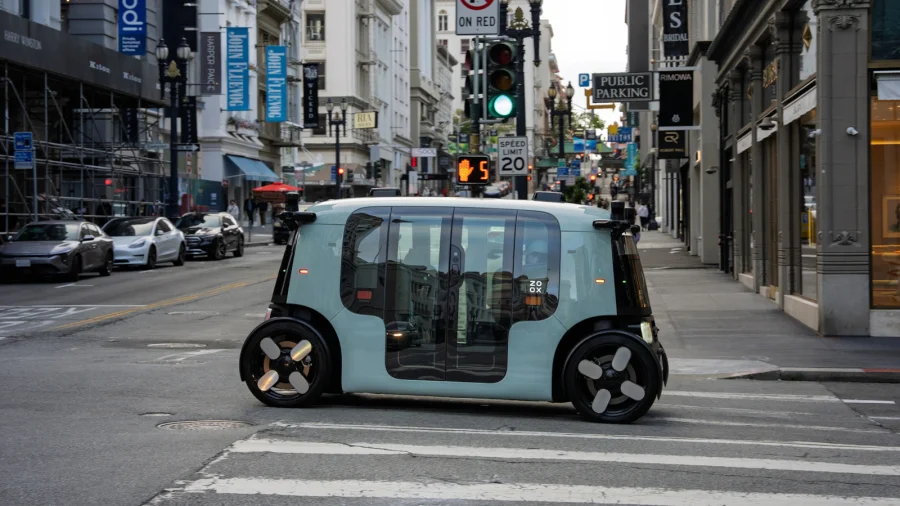
Imagine hailing a cab and watching it pull up with no one behind the wheel — no driver, no steering wheel, just an empty space where both used to be. That scenario just crossed a major regulatory line. Amazon's Zoox has become the first autonomous vehicle without manual controls to receive federal approval to charge passengers for rides, according to the original report.
What NHTSA's approval actually changes
The National Highway Traffic Safety Administration has given Zoox the green light to operate paid rides. It is the first time a fully driverless vehicle with no steering wheel has cleared this specific regulatory hurdle.
The distinction matters. Most self-driving programs on U.S. roads — including several taxi pilots — have used vehicles with steering wheels and pedals as a fallback. Zoox's vehicle was designed without them entirely.
Why a missing steering wheel is a big deal
Federal vehicle safety standards were written around a human driver. Rules covering steering columns, mirrors, and pedals assume a person can take over in an emergency.
A vehicle built to operate with zero manual controls challenges those assumptions at a fundamental level. That NHTSA has now moved past this hurdle signals a shift in how regulators evaluate purpose-built autonomous vehicles, not just adapted ones.
How Zoox got here — what we can verify
The verified facts in this story are narrow but significant. Zoox is Amazon's autonomous vehicle unit. Its robotaxi has no steering wheel by design. NHTSA has granted it permission to charge for rides, per the original report.
Details beyond this — when the approval was granted, which cities are covered, or what safety conditions were attached — have not been disclosed in the reporting available. Those specifics remain open questions rather than confirmed facts.
What paid rides could mean for passengers
For riders, the practical change is subtle but real. A robotaxi with no steering wheel offers more interior space, no expectation of driver interaction, and a fully automated experience from pickup to drop-off.
For cities and transit networks, the implications are larger. If Zoox scales paid service successfully, it could accelerate competition in a robotaxi market where most players still operate vehicles that resemble conventional cars inside.
NHTSA's decision and what it signals
The agency's approval is, at its core, an acceptance that a vehicle without manual controls can be safe enough for commercial passenger use. That is a consequential position for a federal regulator to take.
The original report does not include a statement from NHTSA or Zoox. Readers should treat the approval as confirmed, but any official justification or conditions attached to it remain unreported at this stage.
The thinking behind a no-steering-wheel design
Zoox's architecture treats the driver as obsolete from the start. No wheel, no pedals, no manual fallback. This is a fundamentally different engineering philosophy from systems that gradually add automation to traditional cars.
The trade-off is straightforward: the design maximizes the passenger experience and simplifies the autonomy case, but it demands far greater confidence in the technology before regulators will allow it on public roads.
Confirmed facts vs what remains unclear
Confirmed: NHTSA has authorized Zoox to charge for rides. Zoox is the first no-manual-controls autonomous vehicle to receive this approval. Zoox is owned by Amazon.
Unclear: Where paid service will launch, how much it will cost, who will be eligible, what safety conditions NHTSA imposed, and when riders can actually book a Zoox. None of these details are available in the source material.
Not verified: Any claim about Zoox's safety record, ride volumes, or operational performance. Those facts have not been established in this reporting cycle.
Why Amazon's hold on Zoox matters
Amazon brings something most robotaxi startups lack: deep capital, logistics infrastructure, and a long history of absorbing short-term losses for long-term advantage.
Zoox also offers a proprietary advantage few competitors can match — a vehicle designed from the ground up for full autonomy, rather than a modified production car. This distinction is now backed by regulatory recognition, which strengthens Amazon's position in the autonomous mobility race.
Concerns and open questions
Regulatory approval is not a safety verdict. Critics of no-steering-wheel designs argue that removing manual controls removes the last layer of human intervention in edge cases the software has never encountered.
There are also unanswered operational questions. How will Zoox handle weather, road construction, emergency vehicles, and police stops without a human inside? The approval raises these concerns even as it answers the threshold question of legality.
A broader shift in autonomous vehicle regulation
The approval does not happen in isolation. Across the U.S., states and federal agencies have been wrestling with how to regulate vehicles that do not fit legacy safety frameworks.
NHTSA's decision on Zoox could establish a template. Other companies designing purpose-built autonomous vehicles — shuttles, delivery pods, and robotaxis — will likely point to this approval as evidence that regulators can accommodate fully driverless designs.
What riders, investors, and cities should watch
For riders, the practical advice is simple: do not expect an immediate coast-to-coast launch. Regulatory approval is a prerequisite, not a rollout plan.
For investors and industry watchers, the signals to track are operational ones — where Zoox deploys first, how the service handles real-world conditions, and whether other no-steering-wheel designs follow through the same regulatory pathway.
For city officials, the conversation should begin now. The regulatory framework for paid driverless rides is being written, and local governments will need their own rules for curb access, liability, and passenger safety.
What happens next
The natural next step is an operational announcement from Zoox — launch market, service area, and pricing. Until that happens, the approval remains a landmark without a commercial form.
Looking further ahead, this decision could push competitors to accelerate their own no-manual-controls programs. It also raises the possibility that NHTSA will face a stream of similar applications, forcing the agency to build out a more systematic review process for driverless-by-design vehicles.
Our Take
This approval is best understood as a regulatory turning point, not a commercial launch. The significance lies in what it permits, not what it promises.
A vehicle with no steering wheel carrying paying passengers has been the defining image of autonomous transport for a decade. That image now has federal sanction. Whether Zoox can convert this first into a durable business — and whether the safety record justifies the confidence — is the next story. For now, the milestone belongs to Amazon's Zoox, and the industry will measure itself against it.
Frequently Asked Questions
What did NHTSA approve for Amazon's Zoox?
NHTSA granted Zoox permission to charge passengers for rides in its autonomous vehicle, according to the original report. It is the first approval of its kind for a fully autonomous vehicle with no steering wheel or manual controls.
Why is the Zoox robotaxi's lack of a steering wheel significant?
Most self-driving programs use modified conventional cars with a steering wheel as a manual fallback. Zoox's vehicle was designed without one entirely, meaning it operates solely on its autonomous system with no human takeover option. Federal approval of this design marks a regulatory first.
Where can riders use the Zoox robotaxi?
The original report does not specify launch cities, pricing, or availability dates. The approval covers paid rides, but operational details have not been disclosed in the available source material.
Does this approval mean autonomous vehicles without steering wheels are now legal everywhere in the U.S.?
No. The approval applies specifically to Zoox's application to NHTSA. Autonomous vehicle regulation in the U.S. is a patchwork of federal and state rules, and other companies must still seek their own approvals. Zoox itself may also face state-level requirements depending on where it operates.