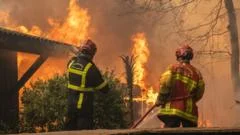
The flames now stretch across two countries, and for the families packing their cars in haste, the nightmare is only beginning. More than a quarter of a million people have been ordered to leave their homes as wildfires surge through southwestern France and parts of Spain — one of the largest mass displacements ever caused by fire in Western Europe.
Blaze Near Bordeaux Defies Containment
French authorities say the fires burning near Bordeaux are still far from being brought under control. Despite deploying hundreds of firefighters and water-bombing aircraft, the flames continue to leap across dry forests, feeding on tinder-like vegetation left brittle by an intense summer heatwave.
“We are in an exceptional situation,” a local prefecture official told reporters. “The fire is moving fast, and we cannot guarantee safety without evacuations.”
Spain Warns of ‘Complex Hours’ Ahead
Across the border, Spain’s Prime Minister Pedro Sánchez addressed the nation, warning of “complex hours” as multiple wildfires burn in regions including Extremadura and Catalonia. The PM urged residents to follow evacuation orders and praised emergency crews working around the clock. “We ask for maximum caution,” Sánchez said. “The worst may not be over.”
Why This Crisis Is Different
Summer wildfires are not new to southern Europe, but the scale of evacuations this year is extraordinary. More than 250,000 people displaced in a matter of days — equivalent to the population of a mid-sized city. The speed of the flames, driven by record temperatures and drought, has left little time for warnings. Many residents have described fleeing with only documents and pets.
Who Is Affected and How They Are Coping
Evacuees have been housed in temporary shelters — schools, sports halls, and civic centres — set up by local authorities. Some families are sleeping in cars. In the French village of Landiras, residents watched from a distance as flames consumed the forest they had known all their lives. “You see your world burn and you can do nothing,” one evacuee said, wiping soot from his face.
Emergency Response and International Help
Both France and Spain have deployed military emergency units. France has requested aircraft from the European Union’s civil protection pool. Spain has activated the Military Emergency Unit (UME). Cross-border cooperation is underway, with shared satellite surveillance and firefighting resources.
Why Containment Is Proving So Difficult
Firefighters cite a triple threat: extreme heat, high winds, and dense, dry vegetation. The fires create their own weather — updrafts that fan the flames and make aerial drops less effective. Ground crews struggle to build firebreaks when the blaze jumps roads and rivers. Officials say until the weather breaks, full containment remains unlikely.
Confirmed Facts vs What Remains Unclear
Confirmed: At least 250,000 evacuations across France and Spain; multiple active fire fronts; official warnings from both governments. Unclear: Exact number of structures destroyed; whether any casualties have occurred (authorities have not reported deaths as of now); timeline for lifting evacuation orders.
Risks and Balanced View
Some local residents have criticised the timing of evacuations, saying warnings came too late for some remote hamlets. Others question whether enough land-clearing and prevention work was done before summer. Officials acknowledge that climate change is making such fires more frequent and intense, but stress that this year’s conditions are exceptional even by recent standards.
Wider Trend: Heatwave-Fuelled Wildfires Across Europe
This year’s blazes are part of a broader pattern. From Portugal to Greece, wildfires have increased in frequency and severity, linked to rising global temperatures. Scientists warn that what was once a “once-in-a-century” event may now become a regular summer occurrence. The evacuation of a quarter-million people may be a preview of a hotter, more dangerous future.
Practical Guidance for Affected Residents
If you are in an evacuation zone: leave immediately, take important documents and medicines, inform neighbours, and follow official routes. Do not attempt to stay and protect property. For those sheltering: register with local authorities, check on elderly neighbours, and stay informed via official apps or radio. Mental health support is available at evacuation centres.
Future Outlook: What Could Happen Next
Meteorologists predict the heatwave will persist for at least another 48 to 72 hours. Further evacuations are possible as winds shift. Once the fires are contained, the focus will shift to damage assessment and recovery — a process that could take months. Governments are already planning compensation and rebuilding measures. The scars — both on the land and in the minds of evacuees — will remain for years.
Our Take
The numbers are staggering — 250,000 people uprooted in a region that rarely sees such mass displacement. But behind the statistic are real families losing homes, livelihoods, and a sense of safety. This crisis is a stark reminder that climate-driven disasters do not respect borders. The response from authorities has been swift, but the challenge is bigger than any single country. Europe must prepare for a new normal where summer no longer means holidays by the beach — but escape from the flames.
Frequently Asked Questions
Why are 250,000 people evacuating in France and Spain?
A series of fast-moving wildfires, fuelled by extreme heat and drought, have forced mass evacuations in southwestern France (near Bordeaux) and several regions of Spain. Authorities issued mandatory evacuation orders to protect lives.
Which areas are most affected by the wildfires?
The worst-hit French area is the Gironde department around Bordeaux, including towns like Landiras and La Teste-de-Buch. In Spain, fires are burning in Extremadura, Catalonia, and parts of Aragon.
What is Spain’s government doing about the fires?
Spain’s PM Pedro Sánchez has warned of “complex hours” and activated the Military Emergency Unit. Multiple water-bombers and ground crews have been deployed, with support from EU partners.
How long will the France and Spain wildfires last?
Firefighting efforts continue day and night. Authorities say full containment is unlikely until the heatwave breaks, which could take another 48–72 hours. Some fires may burn for weeks in remote areas.