
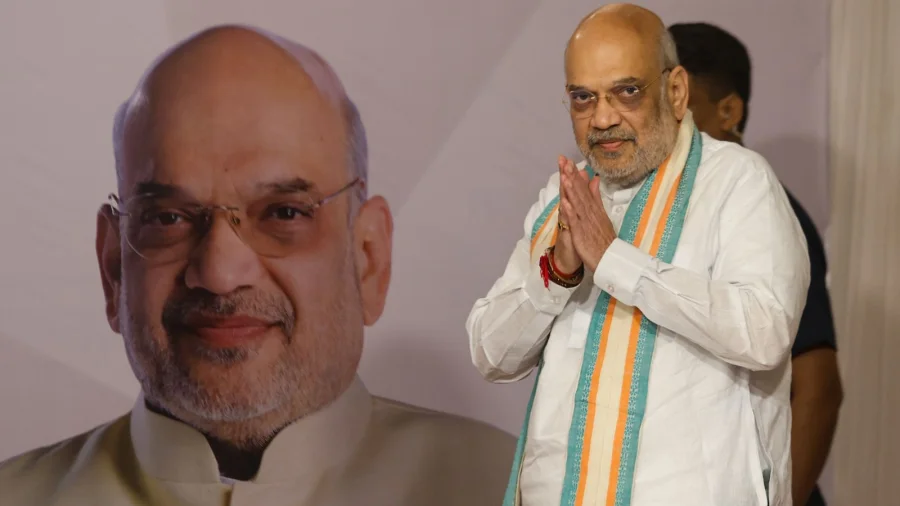
For crores of Indian families, the law that decides how a marriage is registered, how a divorce is granted and who inherits what still depends on the religion a person was born into. Amit Shah has now attached a deadline to ending that patchwork.
According to the statement reported, the Home Minister has said the Uniform Civil Code should be in place across all NDA-ruled states before the 2029 Lok Sabha polls. That one line does two things at once — it revives Article 44 as a live political promise, and it shifts the burden of delivery onto state capitals rather than Parliament alone.
Why 2029 Is a Political Deadline, Not a Legal One
The Lok Sabha elections are due in 2029. Between now and then, a long queue of assembly elections will pass through states where the NDA and the Opposition are in direct contest. That is what gives the timeline its weight.
Article 44 sits in Part IV of the Constitution — the Directive Principles. It tells the State to endeavour to secure a uniform civil code, but it cannot be enforced in a court the way a fundamental right can. There is no constitutional clock forcing action. The clock here is electoral.
That distinction matters. A deadline of this kind is a statement of political intent, not a legal obligation. Nothing binds a future government to it.
What a Uniform Civil Code Would Actually Change Inside a Family
Personal law in India is not one system. Hindus, Muslims, Christians, Parsis and others are governed by different statutes on marriage, divorce, maintenance, adoption and succession. Tribal communities are largely governed by custom.
A uniform code would bring these under common rules — one age of marriage, one set of grounds for divorce, one succession formula. For a woman fighting for an equal share in ancestral property, the difference could be substantial.
For a family that has followed its own customs for generations, the same change could feel like an intrusion. Both reactions are real, and both sit at the centre of the debate.
Uttarakhand Built the Template. Most Other States Are Still at the Study Stage
Uttarakhand became the first state to bring a Uniform Civil Code into force, after its legislature passed the law and rules were notified. Its framework — a code covering marriage, divorce, succession and live-in relationships, with Scheduled Tribes kept outside its ambit — is now the working template others can copy or adapt.
Elsewhere, the picture is uneven. Some BJP-ruled states have announced expert committees or public consultations. Others have spoken about it before and during elections without a draft on the table.
That gap between announcement and gazette notification is where most of this story will actually be decided.
From Article 44 to Today: How the Debate Reached This Point
The idea of a common civil code is as old as the Constitution itself. It was debated in the Constituent Assembly, where members disagreed sharply over whether it should be a right or an aspiration. The compromise produced Article 44 — aspirational, not enforceable.
In 2018, the Law Commission's consultation paper concluded that a uniform code was "neither necessary nor desirable at this stage", arguing instead for reform within existing personal laws. The debate did not end there; the next Law Commission invited fresh views from stakeholders and the public.
What changed after that was the political landscape, not the constitutional text. A string of state-level moves has now replaced the older, stalled conversation about a single national law.
The Legal Route States Can Use — and Why It Is Being Used
Personal laws sit in the Concurrent List, which means both Parliament and state legislatures can legislate on them. That single fact explains the strategy.
A national Bill would need numbers the government may not want to test on the floor. A state Bill needs only a state majority. The result is a route that is slower on paper but far more controllable in practice.
It also creates a complication, discussed later, that supporters rarely emphasise: many different state codes are not the same thing as one uniform code.
Who Is Affected First — and Who Is Being Left Out
The immediate effects would fall on people whose lives are currently governed by religion-specific rules — in registration of marriages, in divorce proceedings, in inheritance disputes that reach civil courts.
Women's groups have long argued that uniform succession and maintenance rules would remove some of the sharpest inequalities between communities. That argument has been made across party lines for decades.
At the same time, tribal communities in several states have sought protection from any uniform code, on the grounds that their customs are distinct from both religious personal law and mainstream civil law. Uttarakhand's exemption for Scheduled Tribes reflects that concern.
Where the Centre Stands, and Where the Silence Is
No national Uniform Civil Code Bill has been enacted. The Centre's public position has been to encourage and welcome state-level movement, while leaving the question of a national law open.
Among NDA allies and in the Opposition, the response has not been uniform. The issue has historically cut across party lines and religious lines at the same time, which is why endorsements tend to be carefully worded.
Officials have not published a state-by-state checklist or a draft schedule tied to the 2029 timeline. Until they do, the pace of implementation remains a matter of inference rather than record.
What Is Confirmed, and What Is Still Unclear
Confirmed: Amit Shah has set the 2029 Lok Sabha polls as the political marker for a UCC across NDA-ruled states. Confirmed:



