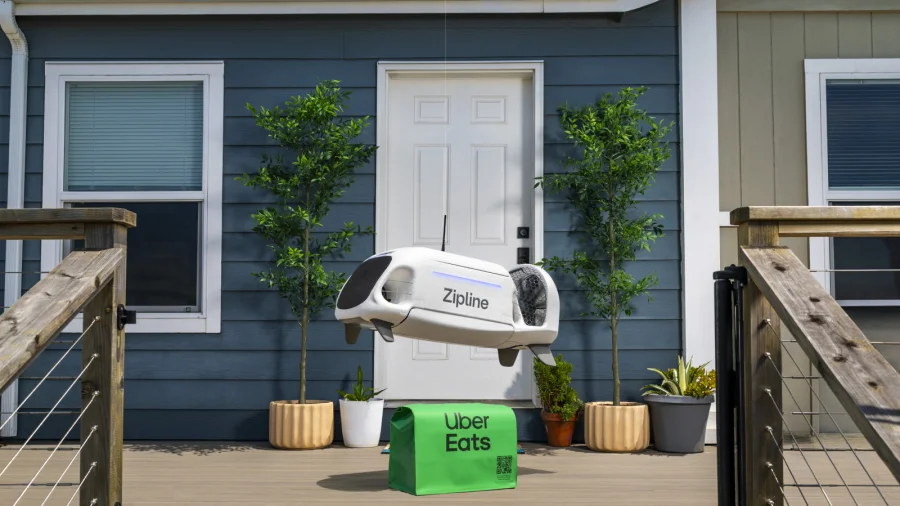
The next time your food order arrives, it might not come from a rider on a motorcycle weaving through traffic — it could descend from the sky into your driveway. Uber has set an ambitious target of 1 million daily drone deliveries through a partnership with Zipline, and the first drone-based Uber Eats orders are expected later this year.
Uber and Zipline set a sky-high delivery target
The partnership plugs Zipline's drone delivery capability directly into Uber Eats' existing order system. Uber's stated ambition: one million drone deliveries every single day.
That would represent a massive leap from today's road-based delivery model, and it signals that Uber is positioning aerial delivery as a core pillar of its long-term strategy rather than a pilot project.
What a million daily drone deliveries would change for customers
If the target is realised, the delivery experience changes at a fundamental level. Drones do not sit in traffic, wait at signals, or get delayed by congested city roads — they take a direct route from restaurant to customer.
The most visible benefit for regular users would be speed. Orders that currently take 30 to 40 minutes in dense urban areas could arrive in minutes, with the drone lowering the package directly at the doorstep.
Why the Zipline partnership matters for Uber
For Uber, this is about more than novelty. A successful drone network could reduce long-term reliance on human delivery partners, lower per-order costs at scale, and strengthen Uber Eats as competitors also explore automated options.
Zipline brings the flying hardware, launch systems and logistics know-how. Uber brings the vast customer base, restaurant network and order volume. Together, they form a delivery chain that starts on ground and finishes in the air.
Where the announcement leaves the biggest open questions
Uber has not specified which cities will see the first Zipline deliveries, how drone delivery will be priced, or what remaining regulatory approvals are required.
These details are not minor footnotes. Large-scale drone delivery depends on aviation authority clearances, defined flight corridors, safe landing mechanisms, and community tolerance of drones operating over residential areas.
The obstacles between announcement and actual flights
Several practical hurdles could slow the rollout. Airspace restrictions, adverse weather, noise concerns from residents, battery range limits and certification delays are all realities that large drone programs face.
None of these are confirmed barriers to the Uber-Zipline plan — but they are the conditions that will decide whether the 1 million daily delivery figure is a near-term goal or a distant ambition.
How should regular Uber Eats users read this news
For now, there is nothing users need to do — the service is not live yet. When the first flights begin, customers in launch areas may see a new drone delivery option appear in the app, likely subject to distance limits, package size restrictions and weather conditions.
Until then, the practical takeaway is simple: the option is coming, but its availability will depend entirely on where and how fast Uber and Zipline can secure approval to fly.
What to watch in the coming months
The strongest signals to track are city announcements, regulatory filings and the pace of pilot launches. If the first Zipline flights stay on schedule later this year, the bigger question becomes how quickly the operation scales toward the million-a-day mark.
If the initial launches face regulatory friction or operational delays, the timeline for that target will likely stretch well beyond what the announcement implies.
Our Take
This is a bold statement of intent, and the partnership itself is a serious vote of confidence in drone delivery. But the distance between "first flights later this year" and "one million deliveries daily" is enormous.
The announcement is best read as the opening chapter of a long rollout, not a prediction of imminent disruption. Whether the target becomes reality will depend on regulation, scale, and whether customers genuinely embrace the idea of meals arriving from the sky.
Frequently Asked Questions
When will Uber Eats drone delivery start?
According to the announcement, the first Zipline drone deliveries for Uber Eats orders will begin later this year. Specific cities and exact launch dates have not been revealed.
What is the Uber-Zipline partnership?
Uber is partnering with Zipline, a drone delivery company, to fulfil Uber Eats orders by air. Uber's stated goal is 1 million daily drone deliveries through the partnership.
Will Uber Eats drone delivery cost more than regular delivery?
Pricing has not been announced. It remains unclear whether drone orders will carry a premium over standard delivery fees until Uber discloses its pricing model.
Is 1 million daily drone deliveries a realistic goal?
The target is highly ambitious, and the announcement does not specify a timeline for reaching it. Hitting that number would require extensive regulatory approvals, large-scale operations, and widespread customer adoption.