By Rohan Iyer | Auto & EV Technology Correspondent
Few cars have been promised for as long, and delivered as little, as Tesla's second-generation Roadster. First shown nearly a decade ago, it has spent years shifting from one deadline to the next. Now there is a date on the calendar — October 10 — and the same question that has followed every previous one: will it hold?
A Date on the Calendar, and the Asterisk Attached to It
The reported plan is straightforward: Tesla will stage a debut for the second-generation Roadster on October 10. That is a reveal event, not a delivery date.
And the announcement arrives with its own caveat built in. The report notes the date holds only "so long as it's not delayed again" — a line that tells you everything about how this car's timeline has been treated so far.
Why a 2017 Promise Still Matters in Tesla's Story
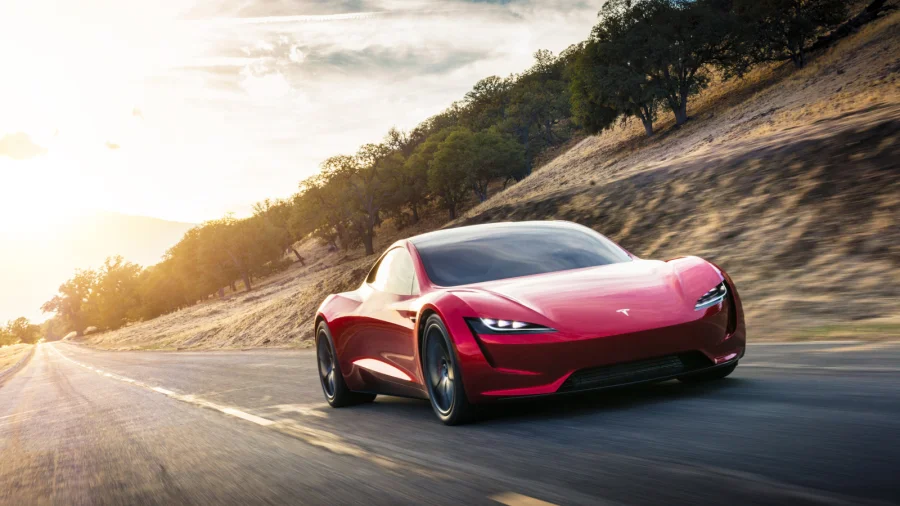
The Roadster was not unveiled at a dedicated launch. It appeared as a surprise at the end of Tesla's Semi event in November 2017, a bonus reveal that caught even close watchers off guard.
That night, Tesla presented the car as a halo product — the machine that would sit above everything else in its range and reset expectations for what an electric vehicle could do. Around nine years later, that promise is still open.
For Tesla, it represents something rarer than a new model. It is unfinished business.
From Surprise Reveal to Repeated Delay: The Timeline
At the 2017 unveiling, Tesla set an ambitious target: the Roadster was slated to reach the market by 2020. That target passed without the car arriving.
What followed was a long sequence of revisions — some stated publicly, others implied through changes in Tesla's priorities as it shifted attention toward mass-market models, manufacturing scale, battery supply and, more recently, autonomy and robotics. The Roadster stayed on the roadmap. It simply kept moving along it.
Because we could not verify any new official statement in the source material reviewed, this report treats the October 10 date as reported scheduling rather than a confirmed corporate commitment. That distinction matters.
Who Is Actually Still Waiting
The Roadster's audience is narrower than Tesla's, but unusually committed. Reservation holders from the original announcement have waited years, some through multiple changes in Tesla's own product strategy.
For them, the stakes are practical and specific: a date, a price, and a delivery window. For the wider EV market, the stakes are symbolic. A car like this is judged less on sales volume and more on what it says about a company's engineering ceiling.
And for investors, the Roadster is a small business line with an outsized signal value — it tests whether Tesla can still execute on a long-dated promise it made to the public.
What Tesla Has Said — and What We Cannot Confirm
Tesla made a set of headline claims at the 2017 reveal, including a sub-two-second 0–60 mph acceleration figure and an exceptionally long claimed range. Those numbers were company claims made at that time, not independently verified results, and they were never formally restated in the current reporting.
Pricing guidance and reservation terms were also announced back then. Treat all of those figures as legacy information until Tesla reconfirms them at the debut. Nearly nine years is a long time in battery chemistry, software architecture and manufacturing — the car that shows up may not match the car that was promised.
Confirmed Facts vs What Remains Unclear
Confirmed: A debut for the second-generation Roadster has been scheduled for October 10, per the report. The vehicle was first shown nearly a decade ago. The launch has been delayed before.
Unclear: Which production year the October 10 event refers to, whether the date is a firm commitment or a target, final specifications, final pricing, reservation terms for existing holders, and production or delivery timelines.
Speculation: Any assertion that the Roadster will enter production, ship to customers, or match its original performance claims is unverified. We are labelling it as such.
Why the Roadster Still Matters to Tesla's Business
Tesla's advantage has never rested on any single model. It rests on a stack that competitors have struggled to copy all at once: a proprietary Supercharger network that solves the charging anxiety problem, vertical integration across battery, software and drivetrain, over-the-air updates that improve cars after purchase, and a brand that carries cultural weight beyond the automotive sector.
A halo car like the Roadster exists to showcase that stack at its most extreme. It is a marketing instrument disguised as a product.
That is also why delays cost more than they would for an ordinary automaker — the car is not just a vehicle, it is a credibility marker.
The Risks Hiding Behind the Headlines
First, the obvious one: the date could slip again, and another miss would carry more weight than the ones before it simply because expectations have been reset so many times.
Second, the competitive landscape has changed completely. When the Roadster was announced, ultra-high-performance EVs were rare. Today the segment has genuine contenders across Europe and Asia, and benchmark claims are harder to hold.
Third, there is an internal competition for attention. Tesla's stated focus has moved toward autonomy, software and robotics. A low-volume supercar competes for engineering resources against those priorities.
Fourth, delivering a hypercar is not the same as delivering it at scale, to a promised specification, at a promised price. The gap between a debut and a driveway is where most ambitious car programmes die.
A Pattern That Runs Through the EV Industry
Tesla is not alone here. Across the electric vehicle sector, announced timelines have routinely outrun manufacturing reality — from battery supply constraints to software delays to shifting demand.
What makes the Roadster distinctive is the length of the gap. Nearly a decade between reveal and debut is extreme even by industry standards, and it has become a case study in how halo promises age when a company's strategy evolves faster than its product plan.
The broader shift is also relevant: the EV market has moved from a phase of pure aspiration to one of price competition, margin pressure and consolidation. A supercar debut lands differently in that environment than it would have in 2019.
What Buyers, Investors and Enthusiasts Should Do Now
Do not treat October 10 as a delivery date. Treat it as the point at which verified information finally replaces years of assumption.
If you are a reservation holder or were considering one, wait for the event and for published terms — pricing, specification and delivery windows — before making financial decisions. Old figures floating online are not current commitments.
If you are an investor, keep the Roadster in proportion. Its direct revenue contribution is likely to be modest next to Tesla's core vehicle business; its importance lies in what it signals about execution capability.
If you simply follow cars, the honest position is that the date is news, and everything beyond it is still open.
What Happens After October 10
If the debut goes ahead, the immediate outcome is clarity: confirmed design, confirmed specification claims, and presumably a firmer view on production. If it slips again, the cost is not the calendar — it is the credibility of the next announcement.
Either way, the interesting story will not be the car on the stage. It will be what Tesla can say afterwards about when that car actually reaches customers.
Our Take
The Roadster has become less a vehicle than a measure of how long a company can keep a promise alive. Scheduled debuts are easy to announce and historically difficult for Tesla to hold to, and this one explicitly arrives with that possibility attached.
What makes October 10 worth watching is not the acceleration figure or the range claim. It is whether a near-decade-old commitment finally converts into something concrete — a specification sheet, a price, a date for delivery.
Until then, the fairest thing anyone can say is this: Tesla has scheduled a debut. Everything else is still a promise.
Frequently Asked Questions
When is Tesla's second-generation Roadster expected to debut?
A debut is scheduled for October 10, according to the report. The original account cautions that the date holds only if it is not delayed again, so it should be treated as a planned reveal rather than a guaranteed event.
How long has the Roadster been delayed?
The car was first shown in November 2017 at Tesla's Semi event. Tesla initially targeted a 2020 market arrival, which did not happen. That puts the gap between first reveal and the planned debut at close to nine years.
How much will the new Tesla Roadster cost?
Tesla announced pricing guidance at the original 2017 reveal, but no updated pricing has been confirmed in the current reporting. Readers should treat all older figures as legacy information until Tesla publishes terms at the debut.
Will the Roadster actually go into production this time?
That is unconfirmed. A debut date does not establish a production date, delivery timeline or final specification. Until Tesla confirms those details, any claim that the car is definitely arriving for customers remains speculation.