The military balance on the Korean Peninsula is shifting — not because of a battlefield assessment, but because of a diplomatic calculation. President Trump has said the United States will scale back its military drills in South Korea, linking the decision to Seoul's refusal to take part in the Iran conflict and to what he described as his "very good relationship" with North Korean leader Kim Jong Un.
Trump links drill cutback to Seoul's Iran decision
The core announcement is straightforward: the US will downsize its military exercises in South Korea. According to the original report, Trump tied this decision directly to South Korea staying out of the Iran war — a conflict that drew American military action but not Seoul's participation.
Trump also pointed to his personal rapport with Kim Jong Un as a factor in the downsizing decision. That combination — an alliance partner's wartime stance and a personal relationship with an adversary — forms the stated rationale.
Why a smaller exercise schedule matters
US-South Korea joint drills are not routine bureaucracy. They are the visible muscle of the alliance's deterrence posture against North Korea's nuclear and missile programs. Scaling them back changes the signal sent to Pyongyang, to Seoul's own public, and to regional powers watching the peninsula's stability.
The exercises have historically been a point of friction with the North, which has called them invasion rehearsals. A reduced schedule could ease that tension — but it also raises questions about readiness and the credibility of the US security commitment.
How US-Korea drills became a diplomatic flashpoint
For decades, the US and South Korea have conducted large-scale joint exercises, including operations like those that rotate troops, aircraft, and naval assets across the region. North Korea has consistently condemned them, and they have often spiked tensions just as diplomatic efforts were underway.
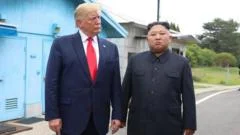
Trump's engagement with Kim began with the landmark 2018 Singapore summit, followed by meetings in Hanoi and at the Panmunjom border village in 2019. Those encounters changed the political atmosphere around the drills, creating room for pauses and downsizing that earlier administrations had not pursued. The new announcement extends that pattern into a fresh rationale.
Who feels the impact of reduced drills
For US service members stationed on the peninsula and their South Korean counterparts, a scaled-back exercise schedule means fewer large-scale training cycles, shifting rotation patterns, and a different operational rhythm. For families attached to those units, the change can affect deployment schedules and time apart.
For South Korean civilians, the drills have long been a backdrop of daily life — visible jets, naval movements, and periodic disruption near training zones. For the wider region, the downsizing touches a more delicate question: how seriously the US commitment to defend South Korea is being recalibrated.
The White House rationale, in Trump's words
The only direct statement reported in the original story is Trump's reference to his "very good relationship" with North Korea's leader. That phrase anchors the decision in personal diplomacy rather than purely military logic.
The Iran linkage adds a separate thread: South Korea, a key US ally with troops deployed in various global missions, did not join the American action in the Iran conflict. Trump's framing suggests that decision shaped his thinking on how much Seoul is willing to invest in US-led military operations.
What the decision signals about US policy
Analysts reading this move will see two competing interpretations. One: Trump is consolidating a legacy of reducing tensions with North Korea through personal engagement and visible de-escalation. Two: Washington is conditioning alliance benefits on allies' willingness to support its military priorities elsewhere.
The downsizing may also signal that Washington is comfortable with a lower-profile military footprint on the peninsula — a position that diverges sharply from traditional US security doctrine in Northeast Asia. It is a deliberate bet, the report suggests, that personal relationships can substitute for conventional deterrence signaling.
Confirmed facts vs open questions
What is verified, based on the original story: Trump said the US would scale back South Korea military drills. He cited Seoul's Iran war stance. He cited his "very good relationship" with North Korea's leader.
What remains unclear: which specific exercises will be reduced, when the changes take effect, whether South Korea's government was consulted, and how the US military command on the peninsula will adjust. North Korea's reaction is also unverified at this stage. All of this should be treated as unfolding rather than settled.
Risks of downsizing the alliance's military footprint
The credibility of extended deterrence rests on visible capability. Security analysts who favor strong exercises argue that reduced drills can erode interoperability between US and South Korean forces — the ability to fight together quickly in a crisis. That risk is not hypothetical; it compounds with every canceled rotation.
There is also a diplomatic risk. South Korea's political establishment and public have historically valued the training as proof of American commitment. A downsizing announced with little public detail could unsettle an ally that has grown accustomed to Washington's defense guarantees.
Personal diplomacy meets military posture
This decision fits a wider pattern in Trump's foreign policy: personal relationships driving major military and strategic choices. From summits with Kim Jong Un to shifts in troop posture, the style has been transactional and personality-driven.
The pattern has supporters who credit it with opening channels that previous administrations could not, and critics who warn that alliance policy should be built on institutional commitments, not individual rapport. Both views deserve weight as the consequences of this decision unfold.
What to watch in the coming weeks
For readers tracking this story, the next signals will come from official channels: US Forces Korea announcements, South Korea's defense ministry statements, and any response from Pyongyang. Whether the downsizing is a one-time adjustment or a sustained trend will become clearer with the next scheduled exercise cycle.
If North Korea welcomes the move, it could revive diplomatic momentum. If it dismisses it as insufficient, the strategic impact could be muted. Either outcome depends on details that have not yet been made public.
Where the US-North Korea relationship could go next
The decision creates room for a possible reopening of dialogue, but nothing in the initial report confirms that a new summit or working-level talks are planned. The exercise reduction may be an end in itself — a gesture of de-escalation — rather than a step toward a broader deal.
Without verified information about North Korea's position, speculation must be cautious. What is reasonably expectable is that Pyongyang will react to the move in some form, given its long history of responding to US military posture changes.
Our Take
This story matters because it marks another instance of military strategy being driven by a single diplomatic relationship. The US-South Korea alliance has survived for over seven decades on predictability; announcing a shift tied to an ally's stance in a distant conflict introduces a conditional element that allies will notice.
The "very good relationship" with Kim Jong Un is real, by Trump's own account — but relationships between states are not the same as relationships between leaders. The durability of this decision, and the security of the peninsula, will depend on whether the downsizing is a calculated posture or a precedent that weakens deterrence without producing diplomatic returns.
Frequently Asked Questions
Why is Trump scaling back South Korea military drills?
According to the original report, Trump said the US will scale back military drills in South Korea because Seoul stayed out of the Iran war. He also cited his "very good relationship" with North Korea's leader, Kim Jong Un, as a reason for downsizing the exercises.
What did Trump say about Kim Jong Un in this decision?
Trump referenced his "very good relationship" with North Korea's leader as a factor in deciding to reduce the size of the military exercises. This reflects the personal diplomacy that has characterized US-North Korea engagement during his presidency.
Did South Korea really stay out of the Iran war?
The headline and original story state that South Korea stayed out of the Iran conflict, and that this was the rationale Trump cited for the drill reduction. Specific details about South Korea's military role in that conflict are not included in the report.
Could the South Korea military drills be resumed later?
Nothing in the original report rules out a future resumption. The downsizing is described as a decision to scale back the exercises, but changing security conditions, alliance consultations, or shifts in North Korea's behavior could influence whether the schedule is restored.