
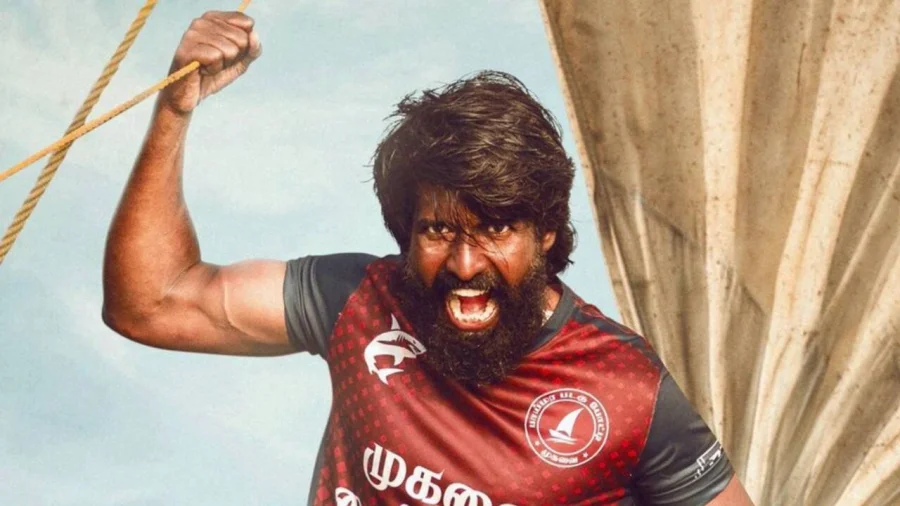
For close to two decades, Soori was the man who made Tamil cinema laugh. He was the friend, the sidekick, the comic relief who walked into a scene, cracked a line and walked out with it. Then he shot a film that put him in the sea. And by his own account, that changed everything about how he looks at his job.
In a candid reflection on his career, Soori has spoken about what it actually means to cross over from comedy to leading man — not as a promotion, but as a rebuild. His latest film, Mandaadi, pushed him through sequences on the water that he admits tested him in ways his earlier work never did.
The Sea Shoot That Soori Calls His Hardest Yet
Water is unforgiving on a film set. Light changes, currents move, and a crew can lose an entire day to conditions no one controls. Soori has described the sea sequences in Mandaadi as a stretch of work that demanded more of him physically and mentally than anything he had done before.
What makes that admission interesting is who it comes from. Soori spent years doing physically demanding comedies — falls, chases, exaggerated action played for laughs. He is not an actor easily rattled by a long day on location. That he singles out this shoot says something about the bar Mandaadi set.
Why a Sidekick's Promotion Is a Bigger Deal Than It Sounds
Tamil cinema does not hand out second acts easily. A comic actor is usually boxed in for life — audiences associate the face with a joke, and filmmakers write to that association. Breaking out requires more than a good performance. It requires the audience to forget, briefly, why they liked you in the first place.
That is the tightrope Soori has been walking. Every serious role risks being read as a stunt. Every comic role risks confirming the old image. For an actor in his position, there is no neutral choice.
Two Directors, Two Turning Points
Soori is direct about who helped him make the turn. He credits director Mathimaran with the insight and direction that carried him through Mandaadi — the kind of guidance that shapes not just a performance but an actor's understanding of what a scene is for.
The other name in the story is Vetri Maaran. Soori has acknowledged that Viduthalai was the moment the industry and the audience began to look at him differently. It was not a supporting turn that got noticed; it was a recalibration.
What Viduthalai Did to the Audience's Memory of Soori
An actor's image lives in the audience's memory, and that memory is stubborn. For years, seeing Soori on screen triggered a reflex: something funny is about to happen. Viduthalai interrupted that reflex.
That is the real achievement. It is one thing to give a strong performance; it is another to break a conditioned response in millions of viewers at once. Once that response is broken, even partially, a career opens up. Directors begin to see possibilities, and casting conversations change.
What Is Confirmed — and What We Still Don't Know
Confirmed: Soori has publicly discussed the transition, the difficulty of the sea sequences in Mandaadi, Mathimaran's role in his growth, and Viduthalai's impact on how he is perceived. Those are his own words and his own framing.
Unclear: no verified details about Mandaadi's release plan, production timeline or box-office expectations are available in the material on record. Any claim about how the film will perform, or how the industry will respond, remains speculation at this stage.
The Risk in Being Taken Seriously
There is a genuine downside to a successful reinvention. Actors who break out of comedy often find that the industry overcorrects — they are offered only grim, heavy roles, and the range that made them valuable disappears.
There is also commercial risk. Comedy pays reliably in Tamil cinema. Serious films depend on word of mouth, critical reception and timing. If a leading-man project underperforms, the pressure to return to what worked becomes immediate and hard to resist.
Why the Shift Matters Beyond One Career
Soori's move is part of a broader pattern in Indian cinema. Comedians are increasingly being handed the centre of the frame — a shift driven partly by streaming platforms hungry for character-led stories, and partly by audiences who have grown tired of the same heroic template.
The old hierarchy assumed comedy was a lower rung. That assumption is weakening. Soori is not just benefiting from the change; he is evidence for it.
If You're Following Soori's Next Move, Watch for This
For viewers, the useful question is not whether Soori can act in a serious role — that has been answered. The question is what kind of lead he becomes. Will he build a body of work that straddles both, the way a handful of actors before him have managed? Or will the industry force a choice?
Watch the roles he accepts next, and watch whether directors with serious material start writing specifically for him. That is the clearest signal that the transition has held.
What Comes After Mandaadi
Much depends on reception. A strong response would cement Soori's place among actors who successfully crossed over, and would likely encourage producers to back similar gambits with other comedy performers.
A muted response, by contrast, would be read by the industry as a warning. Neither outcome can be predicted honestly right now — and anyone claiming otherwise is guessing.
Our Take
What stands out in Soori's account is not the hardship. Actors endure hardship constantly and rarely talk about it with this much candour. What stands out is the admission that cinema itself looks different to him now — that he is watching scenes as a lead rather than waiting for his cue.
That is a quieter, more significant shift than any single performance. It suggests an actor who has stopped treating comedy as a destination and started treating it as one skill among several. In an industry that still sorts performers into categories early and permanently, that is the harder thing to pull off.
Frequently Asked Questions
What is Soori's new film Mandaadi about?
Details of the film's plot and release are limited in the material currently available. What is known is that Soori underwent an intense shoot involving sea sequences, which he has described as physically and mentally demanding.
Which film changed the way audiences saw Soori?
Soori has pointed to Vetri Maaran's Viduthalai as the turning point — the project after which audiences and the industry began to see him as something other than a comedy actor.
Who directed Mandaadi?
Mathimaran directed Mandaadi. Soori has credited his direction and insight as central to his growth as a performer during the making of the film.
Is Soori leaving comedy behind?
There is no indication of that. His comments frame the move as an expansion of range rather than an abandonment of comedy, and the industry typically expects actors to work across both.
Why does this transition matter to Tamil cinema?
It tests a long-standing assumption that comic actors cannot carry a film. If Soori succeeds, it opens the door for other comedians to be considered for lead roles with serious material.



