
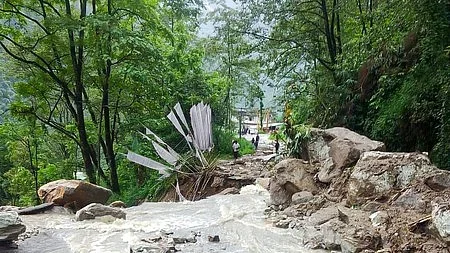
In Rimbi, the decision came before the collapse. On Tuesday, officials said 128 residents had been moved out of 28 houses judged too vulnerable to stay in — not because those homes had already come down, but because the risk of them doing so had grown with every spell of rain.
Across Gyalshing district, the ground has been shifting since 12 September. Landslides have been reported at Singlitam and Rimbi, damaging homes and public infrastructure in an area where families live close to slopes that have already proven unstable.
Rain That Won't Let Up, and Slopes That Keep Moving
The Sikkim State Disaster Management Authority (SSDMA) said heavy rainfall had intensified landslide activity across the district, with Singlitam and Rimbi emerging as the two most affected locations.
The damage so far is two-fold: private homes on cracked, sinking ground, and public infrastructure that connects villages to each other and to the district headquarters. That second loss matters more than it looks on paper — in hill districts, a damaged stretch of road or an affected water line can cut off an entire settlement for days.
Why the Ground in Gyalshing Gives Way So Easily
Gyalshing, in western Sikkim, sits in what geologists broadly describe as young, steep and heavily fractured Himalayan terrain — a landscape still rising, still eroding, and saturated for months during the monsoon. Its river valleys and cut hill roads funnel water quickly downslope, and the soil that holds together for most of the year can loosen after consecutive wet spells.
That is the geography behind the headline. When rainfall stops being occasional and becomes constant, the safety margin on an already steep slope shrinks — and that margin is what officials in Rimbi were measuring when they ordered people out.
How the Evacuation Was Carried Out
The sequence, based on official statements, runs like this: landslides were reported at Singlitam and Rimbi from 12 September, affecting homes and public assets. As rain continued, the district administration assessed houses at risk.
In Rimbi, 28 houses were identified as vulnerable, and the 128 people living in them were shifted. In Singlitam, seven families directly affected by a landslide were moved to a relief centre in Singlitam Ward.
More than 33 people — among them children and elderly residents — are now staying at that shelter, where food and essential supplies are being provided.
Inside the Singlitam Ward Relief Centre
For the families at the shelter, the evacuation has solved one problem by creating another. Their immediate exposure to a sliding hillside has been reduced, but they are now living away from their belongings, their livestock and their routines, with no clear date for return.
The presence of children and elderly people at the centre is significant. They are the two groups most vulnerable during a disaster — slower to move, more dependent on medicines and routine care, and hit hardest by displacement that lasts longer than a night or two.
Round-the-Clock Watch: What Authorities Are Doing
District officials and other government departments are maintaining continuous surveillance, according to the SSDMA, alongside relief, safety and restoration operations.
That combination — watching, supplying, repairing — reflects a standard but demanding approach in Himalayan disaster management: keep monitoring the unstable slopes rather than treating the evacuation as a one-time event.
Reading the Numbers: 28 Houses, 128 People, One Precautionary Call
The arithmetic points to roughly four to five people per house in Rimbi, which is typical of rural households in the region. It also explains why an operation that sounds small — 28 houses — involved moving well over a hundred people.
What stands out is the word officials used: precautionary. The evacuation was not a response to a body count or a collapsed ward. It was a pre-emptive decision to empty homes judged unsafe before the hillside made the decision for them.
What Is Confirmed — and What Is Still Unclear
Confirmed: landslides at Singlitam and Rimbi since 12 September; damage to homes and public infrastructure; evacuation of 128 residents from 28 vulnerable houses in Rimbi; seven Singlitam families shifted to a relief centre; more than 33 people at the shelter with food and supplies; round-the-clock surveillance by district officials.
Unclear: the full extent of infrastructure damage, the number of homes rendered permanently uninhabitable, the total number of affected families across the district, and when residents will be permitted to return. Rainfall forecasts and any further evacuation plans have not been detailed in the statements available so far.
Anything beyond these points — casualty figures, road closures, weather alerts, compensation announcements — should be treated as unverified until confirmed by district authorities or the SSDMA.
The Risks That Come With an Evacuation
Precautionary evacuations save lives, but they are not cost-free. Families leave behind belongings, livestock and standing crops. Shelters can come under pressure if more people arrive. And in a region where monsoon rains can persist, the threat to the slope does not end just because the houses are empty.
There is also the harder, longer question of restoration. Rebuilding a damaged hill road is not the same as repairing it — and repeated monsoon damage raises difficult conversations about whether some settlements remain safe to live in at all.
The opposing view is equally worth stating plainly: moving too early can be criticised as disruptive and costly, and moving too late can be irreversible. Officials here chose the earlier option.
A Pattern Across the Himalayas, Not Just Sikkim
Gyalshing is the latest district in a Himalayan belt that has seen recurring rain-triggered landslides in recent years. Sikkim, along with parts of Uttarakhand, Himachal Pradesh and Arunachal Pradesh, faces the same fundamentals: steep slopes, intense monsoon bursts and infrastructure built across fragile mountain terrain.
What changes from district to district is not the risk itself, but the readiness — how quickly houses are surveyed, how fast families are moved, and how well shelters function once people arrive.
If You Live on a Slope in Sikkim: What to Do Now
Follow the district administration's instructions on evacuation and do not return to a vacated house until officials declare it safe. If you are still in a vulnerable area, watch for new cracks in walls or ground, tilting trees or utility poles, sudden muddy water emerging from a slope, or a road surface that has begun to sag.
Keep essentials — identity papers, medicines, drinking water and a charged phone — packed and ready. Report any new ground movement to local authorities immediately rather than waiting for the next official survey, and rely on official channels rather than unverified messages circulating on social media.
What the Next Few Days Could Look Like
What happens next depends largely on the rain. If it eases, teams can complete damage assessments and determine which homes are fit for return. If it continues, more houses may be added to the vulnerable list and more families moved.
Officials have not announced a return timeline. Until they do, the working assumption on the ground is that the slopes are being monitored, the shelters remain occupied, and the precaution that emptied 28 houses in Rimbi stays in place.
Our Take
The most important detail in this story is not the number evacuated — it is the decision to evacuate at all. Hill districts often learn about slope failure the hardest way, when a house is already gone. Moving 128 people out of 28 homes before that happens reflects a shift toward acting on risk assessments rather than disaster counts.
The test now is what follows: whether assessments are quick and transparent, whether shelter conditions hold up, and whether families are told honestly when — or whether — they can go home. Early action deserves credit, but it only builds long-term trust if the follow-through is equally serious.
Frequently Asked Questions
Why were 128 people evacuated in Rimbi, Sikkim?
Officials said the evacuation was precautionary. Twenty-eight houses in Rimbi were assessed as vulnerable because of intensified landslide activity caused by heavy rainfall, so all 128 residents living in them were shifted to safety. The step was taken before the houses suffered further damage.
Which areas in Gyalshing district are affected by the landslides?
According to the Sikkim State Disaster Management Authority, landslides have been reported at Singlitam and Rimbi since 12 September, affecting homes and public infrastructure in both locations.
How many people are staying in the relief centre at Singlitam?
Seven families directly affected by the landslide at Singlitam were moved to a relief centre in Singlitam Ward. More than 33 people, including children and elderly residents, are staying there and are being provided food and essential supplies.
Are the landslides in Gyalshing still active, and when can people return home?
District officials and government departments are maintaining round-the-clock surveillance, which indicates the risk has not been declared over. No official timeline has been announced for residents to return, and families should wait for clearance from the district administration before going back to evacuated homes.

