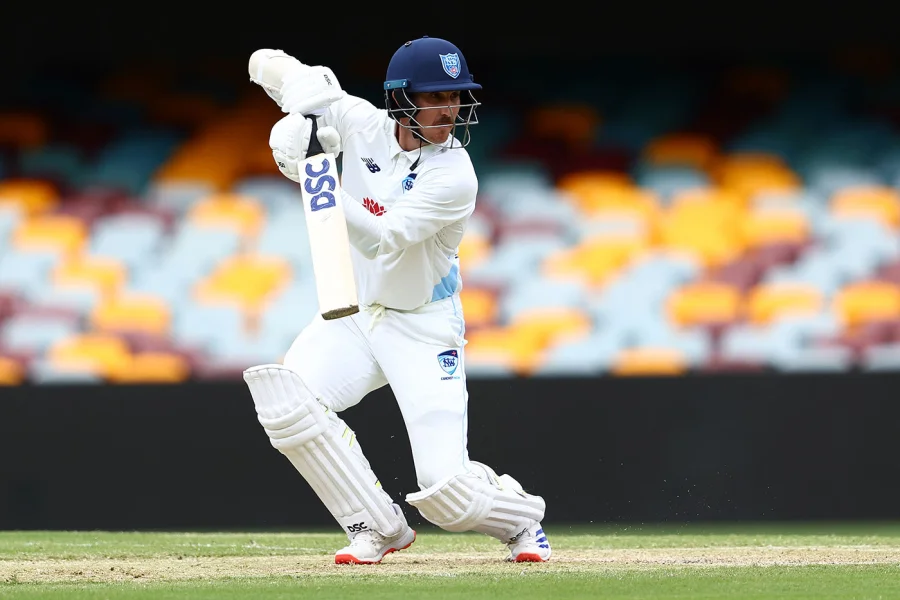
New South Wales does not have one new captain. It has two. Nic Maddinson and Shaw will lead the Blues this season, with Jack Edwards stepping back from the role — an announcement that lands at almost exactly the moment Brad Haddin begins his first summer in charge.
On paper, it reads as a line in a pre-season bulletin. In practice, it resets how one of world cricket's biggest domestic programmes will be run: who sets the tone, who fronts the media, and whose voice a 20-year-old debutant hears first when the pressure arrives.
Jack Edwards Steps Back — and NSW Turns to Two New Leaders
Edwards's decision to step away from the captaincy is the thread that ties the whole announcement together. He came through the NSW pathway, earned his place the hard way and took on the leadership job during a period of transition at the state, including a change of head coach.
Stepping back from the captaincy is not necessarily the same as stepping out of the side — but NSW has not detailed what Edwards's role looks like from here, and that silence is worth noting rather than filling in.
Two Captains, One Dressing Room: What the Split Signals
The material available does not spell out how the captaincy will be divided between Maddinson and Shaw — by format, by competition, by conditions, or some other arrangement. That detail matters, because the answer changes what the role actually looks like.
What the pairing does suggest is a deliberate blend. Maddinson is a left-handed top-order batter who has represented Australia at Test level and has spent well over a decade on the domestic circuit, moving between states and formats. That kind of career teaches a player how to absorb pressure quietly, which is most of what domestic captaincy is.
Why This Handover Matters Beyond the Scoreboard
NSW is Australia's largest cricket state and its most demanding leadership job. Selection calls, batting orders, bowling changes and results are dissected in Sydney and nationally in a way that simply does not happen in every state.
For younger players, the captain is often the first senior voice they hear on a bad day. A captaincy change is therefore a development decision as much as a tactical one — something easy to forget when it is announced in a single sentence.
How the Blues Reached This Point
Edwards led NSW through a period of change at the state, including the coaching transition that eventually brought Haddin in. Now, with Haddin's first season approaching, the captaincy has been reshaped alongside it.
What has not been made public is the full reasoning: whether Edwards initiated the change, whether it was a mutual call, or how the two new captains intend to share the load. Until that is confirmed, any explanation circulating is an assumption, not a fact.
The Human Side: What Changes for Players and Support Staff
A captain sets the temperature of a squad. For a young fast bowler learning to bowl the 80th over, or a rookie opener facing the new ball in November, the difference between one familiar voice and two new ones is not abstract.
Support staff feel it too. Batting plans, field settings and communication with selectors all run through the captain. A change at the top usually means a period of recalibration before anything settles.
Brad Haddin's First Summer Begins With One Question Answered
Haddin arrives as a former Australia wicketkeeper-batter who has worked inside the national coaching structure. For any new head coach, captaincy is the first major structural decision — and getting it aligned early gives him a settled platform before the first ball of the season.
Resolving it now, rather than mid-season, avoids the awkwardness of a leadership question hanging over the opening rounds.
Confirmed Facts vs What Remains Unclear
Confirmed: Maddinson and Shaw have been named New South Wales captains. Jack Edwards has stepped back from the role. The change comes before Brad Haddin's first season in charge.
Unclear: how captaincy duties will be divided between the two; which formats each will lead in; whether Edwards remains in the selection frame; and the reasons behind the change. Nothing in the material reviewed contains direct quotes from the players, the coach or Cricket NSW, so commentary on those points should be treated as speculation.
Risks and the Balanced View
A shared or reshaped captaincy is not automatically an upgrade. Two voices can become one too many if the boundaries blur, and a split structure can slow decision-making in the field if it has not been clearly defined.
There is a reasonable counter-argument for continuity, too. Edwards knew the group, the venues and the personalities. Changing that interrupts institutional knowledge at the very moment a new coach is trying to build it.
Without the full details, both the optimism and the criticism are premature.
The Wider Pattern in Australian Domestic Cricket
NSW's move sits inside a broader conversation about captaincy in Australian domestic cricket. Schedules now overlap more than they once did, with Sheffield Shield, One-Day Cup and Big Bash commitments pulling on the same players.
States have increasingly asked whether one captain should carry all of it. That is context, not confirmation — NSW has not said workload or format is the reason here, and it should not be reported as though it has.
What This Means for Fans and Followers of the Blues
Expect the captaincy question to shape pre-season coverage more than any warm-up result. Watch for how the pair handle bowling changes on flat pitches and how they front up after a loss — those moments reveal more than any press release.
Also worth tracking is Edwards himself. Batting without the captaincy has, for many players, produced a noticeable uptick in output. It has also, for others, removed a source of confidence. Which way it goes is genuinely unknown right now.
What Comes Next
Clarity on the split of duties should arrive before the season starts, and the first competitive fixture under Haddin will be the real test of whether a two-captain model works or simply looks tidy on paper.
The early weeks will be about communication, not silverware. If NSW gets that right, this will be remembered as a smart structural call. If it doesn't, it will be remembered as a gamble.
Our Take
Handing the captaincy to Nic Maddinson and Shaw while Jack Edwards steps back is the kind of decision that looks administrative on paper and feels seismic inside a dressing room. It is also a clear statement about direction: NSW is pairing a seasoned domestic campaigner with a newer leadership voice, and doing it under a new head coach rather than a settled one.
The risk is that it reads as indecision — two captains because no single choice was made. The opportunity is that it gives Haddin flexibility across formats and takes weight off Edwards, who has carried a lot of it. Which interpretation proves correct will be settled by results, and results in Australian domestic cricket take a long time to argue with.
Frequently Asked Questions
Who are the new New South Wales captains?
Nic Maddinson and Shaw have been named as New South Wales captains. Maddinson is a left-handed top-order batter with significant first-class experience and has played Test cricket for Australia.
Why did Jack Edwards step back as NSW captain?
The reasons have not been publicly detailed. Edwards has stepped back from the role, and NSW has not specified whether the decision was his own, mutual, or part of a wider restructure under new head coach Brad Haddin.
What does Brad Haddin's appointment mean for New South Wales?
Haddin, a former Australia wicketkeeper-batter, is entering his first season in charge of the state. Naming new captains before that season begins gives him a settled leadership structure rather than an unresolved question hanging over the opening rounds.
Will New South Wales have two captains in every format?
That has not been confirmed. The available information names both Maddinson and Shaw as captains but does not specify how duties will be divided across the Sheffield Shield, One-Day Cup and other competitions.