By [Reporter Name] | Technology & Robotics Desk
The most revealing thing about Agility Robotics' newest humanoid is not what it lifts or how fast it walks. It is what it does when a person walks towards it: it gets out of the way. If that is not enough, it sits down.
The company has debuted Digit 5, which it describes as its first humanoid robot engineered to work safely near humans without putting flesh-and-blood colleagues at risk. The robot's response to a nearby person is deliberate — move aside, remain still, or lower itself into a seated position rather than let the gap close.
A Robot That Steps Aside Instead of Standing Its Ground
Agility's description of Digit 5 centres on behaviour rather than hardware alone. When the robot detects a person at a distance, it can autonomously take precautions such as repositioning to avoid them, or standing still so the person can pass without coming closer.
The closer a person gets, the more conservative the response becomes. In close proximity, Digit 5 can choose to squat and assume a seated posture — an unusual but telling design decision, because it removes the robot's height advantage and reduces the space it occupies.
Why a Squat Is More Than a Party Trick
For anyone who has walked a factory floor, the significance is practical. Industrial robots have traditionally been kept behind fencing, light curtains or pressure-sensitive mats precisely because they cannot be trusted to notice a human in their path.
If a humanoid can safely share open floor space, the economics of automation change. Barriers cost money, consume square footage and force workflows to be split into robot zones and human zones. Removing them makes mixed teams possible.
From Caged Cells to Shared Floors
The standard answer to industrial robot safety for decades has been separation: put the machine in a cell, lock the gate, and keep people out while it works. That approach is robust, but it is also rigid, and it limits where automation can be deployed.
Agility's pitch is that a legged, mobile robot needs a different answer, because it is meant to move through spaces that people already use. A machine that walks to the work cannot be fenced in permanently.
Who This Is Actually For
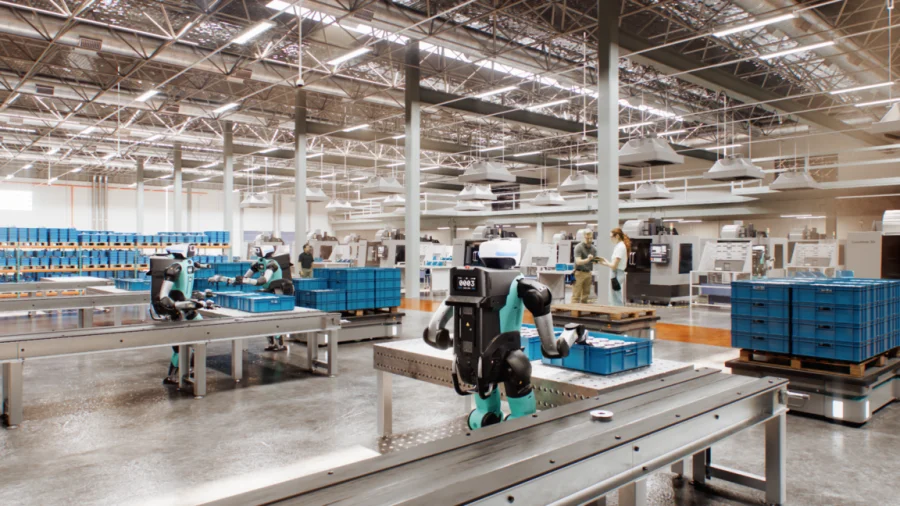
Warehouse and automotive factory floors are the two environments named in the announcement. Both are settings where people and machines already work in the same building, often separated only by procedure and markings rather than steel.
For workers, the practical question is not whether the robot is clever but whether it is predictable. A machine that stops, waits or sits down is easier to read than one that simply continues on its path and expects people to move.
What the Company Says About the Safety System
Agility has framed the capability in technical terms. According to the company's announcement, the robot was designed with a "complex safe motion system" that can take a variety of different mitigations depending on exactly what the situation demands.
That phrasing matters: it suggests a graded response rather than a single emergency stop. A robot that chooses between slowing, diverting, halting and crouching is attempting to stay productive while remaining safe — the harder engineering problem.
Reading the Claim: What "Safe Motion" Really Means
Safe motion is not a marketing phrase without substance. In industrial robotics it generally refers to monitored speed, force and separation limits, with the machine proving it can react before contact occurs.
What is not yet in the public record is how Digit 5's system was tested, under what conditions, and against which benchmarks. Those details decide whether the capability is a genuine shift or an incremental improvement.
Confirmed Facts vs What Remains Unproven
Confirmed: Agility has announced Digit 5, described the stop, avoid and squat behaviours, and attributed them to a safe motion system. The two target environments named are warehouses and automotive factories.
Unproven or undisclosed: independent safety assessment, third-party testing, certification to any specific standard, failure rates, commercial pricing, customer names and deployment dates. Anyone treating those as settled is ahead of the evidence.
The Moat: Why Agility Is Betting on Safety, Not Speed
Humanoid robotics is a crowded field, and most competitors are judged on dexterity, payload or how quickly they learn new tasks. Agility appears to be competing on a different axis — trust.
That is difficult to copy quickly. Safety behaviour has to be validated across thousands of unpredictable human movements, and the company that accumulates that validation first sets the reference point others are measured against. It is also the argument that opens doors to customers who would never accept an unproven machine near their staff.
Risks, Liability and the Jobs Question
None of this removes the underlying risks. A robot that misreads a situation — a worker crouching behind a pallet, a sudden movement, a reflective surface — is still a machine with mass and momentum. Liability frameworks for humanoids sharing space with people remain unsettled in most markets.
There is a workforce dimension too. Barrier-free robots are easier to deploy, which means adoption could accelerate. Whether that translates into people working alongside machines or being replaced by them is a question the industry has not answered honestly.
The Wider Pattern: Automation Is Leaving the Cage
Agility's announcement fits a broader shift. Across industrial robotics, the direction of travel has been towards machines that operate in unstructured, human-populated environments rather than sealed-off ones.
Mobile robots in warehouses already navigate around people. The new step is applying that coexistence logic to humanoids, which are taller, heavier and far more consequential if something goes wrong.
What Workers, Plant Managers and Investors Should Watch
Workers should watch for training and floor protocol changes — a robot that behaves differently near people requires people to understand its signals. Plant managers should look for site-level risk assessments rather than headline claims.
Investors should separate a demonstration from a deployment. The clearest signals will be named customers, published safety validation and insurance or regulatory acceptance of barrier-free humanoid operation.
What Could Happen Next
The likely path is gradual: pilots in controlled areas, expanding as safety data accumulates. Regulators and standards bodies may eventually codify what "safe enough" means for a walking humanoid near a person.
If that happens, the constraint on humanoid adoption stops being technical capability and becomes cost, reliability and trust. Digit 5's squat is a small gesture pointed squarely at the third one.
Our Take
Agility has chosen the least glamorous selling point in robotics and possibly the smartest one. Speed and strength are easy to demonstrate in a video; safe behaviour around unpredictable humans is what actually gets a machine onto a working factory floor.
The caution is that safety claims are the hardest kind to verify from the outside. Until independent testing and named deployments surface, Digit 5 deserves attention for the direction it signals — not for a promise that has already been proven.
Frequently Asked Questions
What is Agility Robotics' Digit 5?
Digit 5 is a humanoid robot from Agility Robotics that the company says is its first designed to work safely near humans without physical separation barriers. Its safety behaviour includes moving away, standing still or squatting when a person comes close.
How does Digit 5 avoid harming human coworkers?
According to Agility, the robot uses a complex safe motion system that applies different mitigations depending on the situation. When it detects a person at a distance it may reposition or stop; in close proximity it can lower itself into a seated position to reduce contact risk.
Does this mean robots and humans can work together without safety cages?
That is the intended outcome, and it is what could unlock wider use in warehouses and automotive factories. However, barrier-free operation depends on validation, site-level risk assessment and customer acceptance, which have not been publicly documented for Digit 5.
Is Digit 5 available to buy or already deployed?
The announcement does not include pricing, commercial availability or confirmed deployment dates in the material available. Treat any specific rollout timeline as unconfirmed until the company states it publicly.