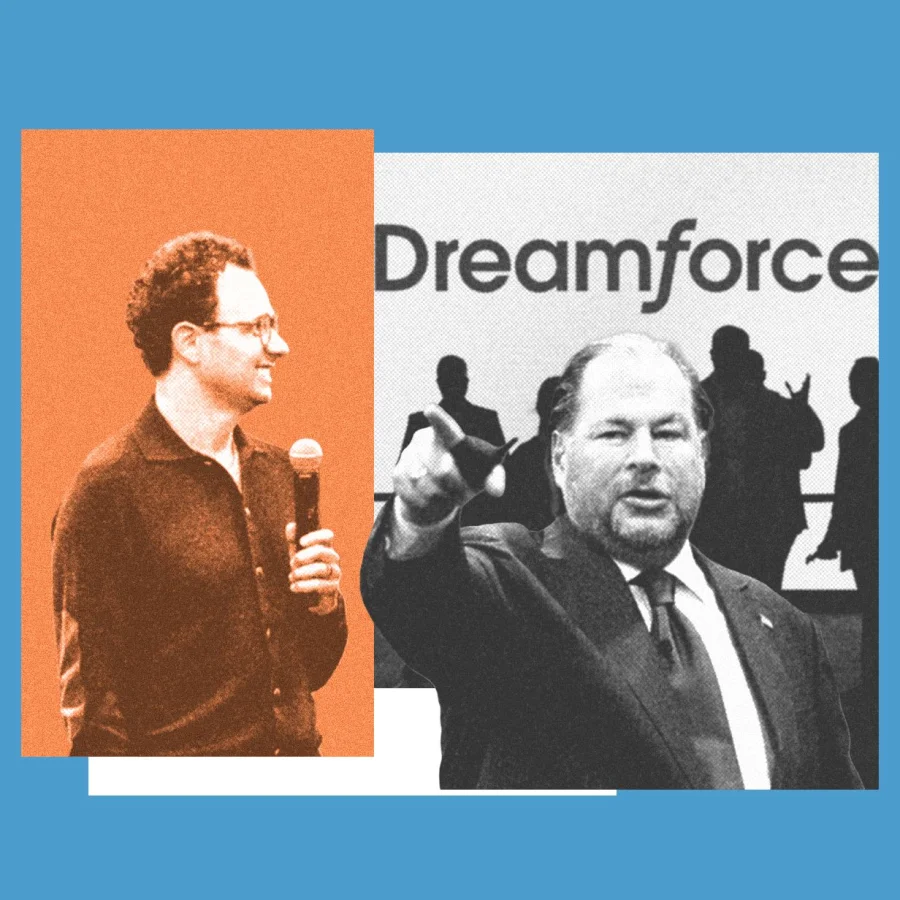
Salesforce spends a year building toward Dreamforce. It is the company's biggest stage, the week it defines what it wants to sell next, and a rare chance to speak directly to tens of thousands of customers at once. Then three people with very different stakes in artificial intelligence started arguing about speed — and the agenda shifted.
The AI slowdown debate arrived at a customer conference uninvited. The heads of OpenAI, Anthropic and Nvidia used the platform to publicly disagree about whether AI development should be slowed down, turning a software event into a referendum on the industry's direction.
A Product Showcase That Became a Philosophy Seminar
Dreamforce is, at its core, a commercial event. Sessions are built around adoption, integration and return on investment. Buyers come to hear how AI will sit inside the tools they already use.
A debate about whether the technology should advance more slowly is a different kind of conversation entirely. It raises questions customers rarely ask on a show floor — about risk, about oversight, and about whether the tools they are being sold will exist in the same form in five years.
Why "Should AI Slow Down?" Is Not Really a Technical Question
On the surface, the argument sounds like a disagreement about engineering. It isn't. It is a disagreement about who absorbs the cost of caution.
Slowing down means longer safety testing, larger evaluation budgets and delayed revenue. Speeding up means capturing market share before a competitor does. Those trade-offs land differently depending on where a company sits in the stack — and the three companies on stage sit in very different places.
Three Companies, Three Incentives
Nvidia sells the hardware that makes large-scale AI training possible. Its business scales with the volume of compute the industry consumes, which makes calls for restraint commercially awkward.
OpenAI has built its position on being at the frontier. Its funding story, its talent pipeline and its enterprise pitch all rest on the assumption that capability keeps moving forward.
Anthropic has positioned itself differently in public — around safety research and structured commitments about how models are developed and released. That positioning is a genuine strategic choice, and it is also part of how the company differentiates itself.
None of these are moral positions. They are structural ones, and that is precisely why the debate on stage could not be resolved in a single session.
What This Means for Ordinary Users and Workers
For most people, the practical stakes are narrower than the rhetoric suggests. The near-term questions are about jobs, data, cost and reliability — not about abstract timelines.
If AI tools keep arriving at their current pace, workplaces will keep absorbing them without much public debate. If the pace slows, adoption slows with it, and the promised productivity gains arrive later than the sales decks suggested.
Either way, the people most affected are rarely in the room when the decision is made.
Salesforce's Moat: Distribution, Data and the Agent Layer
It is worth remembering why this debate landed on Salesforce's stage at all. Salesforce's advantage is not that it builds frontier models. It is that it already sits inside the daily workflow of a very large number of companies.
That gives it three things: a distribution channel most AI startups would envy, a vast store of customer data to ground AI features in, and a switching cost baked into enterprise contracts. Its bet is that the money in AI will be made in the application layer — agents that do work inside existing systems — rather than in the models themselves.
That is a defensible position. It is also one that depends on the underlying models continuing to improve at a predictable rate.
The Case Against the Hype Loop
The sceptical reading of the Dreamforce moment is less flattering. A public debate about slowing down is also good marketing: it signals seriousness, generates headlines and positions each company as thoughtful rather than merely fast.
Critics of the industry argue that safety language and acceleration incentives have coexisted comfortably for years, and that both can be true of the same company at the same time. The debate is real, but it is also a performance — and conferences reward performance.
What Is Confirmed and What Remains Unclear
Confirmed: the AI slowdown debate took place at Dreamforce and involved the leadership of OpenAI, Anthropic and Nvidia. Confirmed: the three companies hold materially different commercial positions on the pace of AI development.
Unclear: the precise wording of what each executive said, whether any concrete commitment was made, and how much of Salesforce's own agenda was displaced as a result. Those details should be checked against original reporting and any official transcript before being treated as fact.
This Is Bigger Than One Conference
The Dreamforce exchange fits a pattern that has been building for two years. AI governance has moved from academic papers into boardrooms, legislatures and now customer conferences.
Regulators in the United States and Europe are drafting and enforcing rules that will shape how models are trained and released. Companies are publishing safety frameworks partly to pre-empt regulation and partly to shape it. A keynote stage is now a policy venue whether the organisers intended it or not.
What Readers, Investors and Workers Should Do Now
Treat conference-stage debates as signals, not commitments. A disagreement stated publicly tells you where commercial incentives lie; it does not tell you what a company will actually do.
For investors, the useful question is not who sounded more responsible but which business model survives a slower release cadence. For workers, the useful question is which tasks inside your role are being automated, regardless of the timeline debate. For businesses buying AI tools, ask vendors for concrete deployment terms — data handling, model versioning, exit clauses — rather than reassurances about safety.
What Happens Next
The likely path is continued divergence rather than consensus. Individual labs will publish their own frameworks, regulators will apply pressure unevenly across jurisdictions, and enterprises will make procurement decisions based on cost and risk appetite rather than philosophy.
Salesforce, meanwhile, will keep doing what it did before the debate started: selling AI embedded in the software its customers already pay for. Whether the debate helped or hurt that pitch is the open question.
Our Take
The most interesting thing about this story is not that three executives disagreed. It is that a slowdown debate became the dominant narrative at an event designed to sell software.
That tells you something about the moment the industry is in. AI is now commercially mature enough to have a customer conference — and controversial enough that the conference cannot stay on message. Salesforce invited the industry onto its stage, and the industry brought its argument with it.
The company's long-term position looks sound: distribution and embedded data are hard to replicate. But the episode is a reminder that in AI, no one fully controls the narrative — not even the host.
Frequently Asked Questions
What happened at Dreamforce?
The leaders of OpenAI, Anthropic and Nvidia publicly debated the pace of AI development at Salesforce's annual Dreamforce conference, turning a customer and product event into a wider discussion about whether AI should slow down.
What is the AI slowdown debate?
It is an argument about whether frontier AI should be developed and released more slowly to allow for safety testing, evaluation and regulation — weighed against the commercial cost of delaying deployment.
Did the three companies agree on anything?
No public consensus or joint position has been reported. Their disagreement reflects structurally different business models rather than a simple disagreement about risk.
Why does this matter if I don't work in tech?
Because the pace of AI development determines how quickly AI tools reach workplaces, how much regulation follows, and how much choice ordinary users and workers have in the transition.