
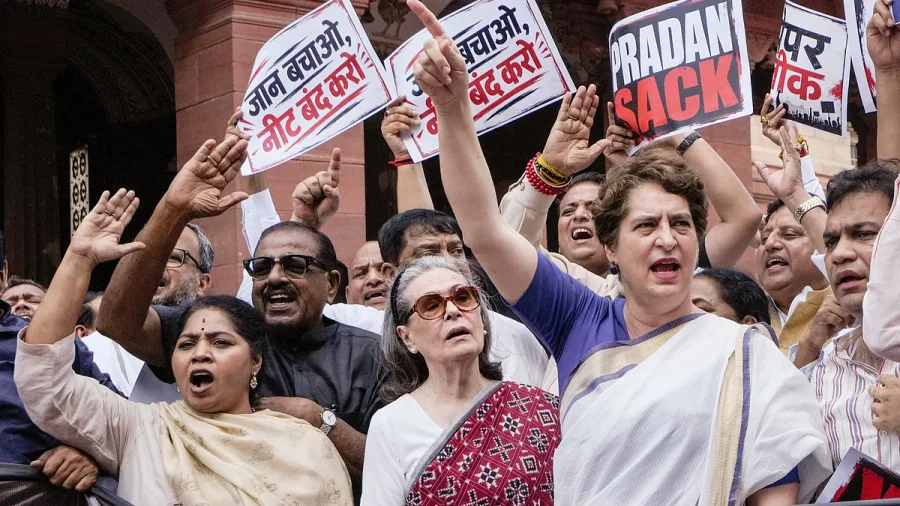
The political temperature over the NEET paper leak controversy rose sharply on Thursday as Congress MP and general secretary Priyanka Gandhi Vadra turned the tables on the media, demanding that journalists first question Prime Minister Narendra Modi and the Centre before seeking her answers.
Congress Leader's Blunt Message to Reporters
Speaking to reporters in the Parliament House complex, Priyanka Gandhi did not mince words. "From now on, I will only answer those questions that are necessary. All of you ask only those questions that the government wants you to," she said, accusing the media of selective coverage that favoured the ruling BJP.
Three Demands Before She Speaks
The Congress leader laid down specific conditions for engaging with the press. She demanded that journalists first ask the government whether Education Minister Dharmendra Pradhan would resign over the NEET paper leak. She also questioned why Prime Minister Modi had not come to Parliament while students were protesting outside. Additionally, she asked why Union Home Minister Amit Shah had allegedly ordered police action against demonstrators.
Why This Escalation Matters
Priyanka Gandhi's sharp retort signals a deepening political crisis over the NEET controversy. The Congress and other opposition parties have been demanding a Joint Parliamentary Committee (JPC) probe into the paper leak, which has affected thousands of medical aspirants across the country. By directly challenging the media's role, the Congress is attempting to shift the narrative from the leak itself to the government's accountability and transparency.
Student Protests and Political Fallout
The NEET paper leak has triggered widespread protests from students and parents, who allege that the government has failed to protect the integrity of the examination process. The opposition has seized on the issue, accusing the Modi government of shielding ministers and avoiding parliamentary accountability. Priyanka Gandhi's remarks are seen as an attempt to keep the pressure on the government and force a debate in Parliament.
Government's Response and Silence
As of now, the government has not officially responded to Priyanka Gandhi's specific demands. Education Minister Dharmendra Pradhan has denied any wrongdoing and has not offered to resign. Prime Minister Modi has not addressed the NEET issue in Parliament, a point the Congress leader highlighted. The government has maintained that the matter is under investigation and that strict action will be taken against those responsible.
What the Media's Role Reveals
Priyanka Gandhi's accusation that the media is asking only government-friendly questions touches on a broader debate about press freedom and editorial independence in India. Critics argue that some news outlets have been reluctant to aggressively question the government on sensitive issues, while supporters of the government dismiss such claims as political posturing.
Confirmed Facts vs What Remains Unclear
What is confirmed: Priyanka Gandhi made the statement to reporters in Parliament on Thursday. She demanded answers on Pradhan's resignation, PM Modi's absence from Parliament, and Amit Shah's alleged role in police action. What remains unclear: Whether the media will take up her challenge and whether the government will respond directly to her questions. The exact details of Amit Shah's alleged involvement have not been independently verified.
Risks and Balanced View
While Priyanka Gandhi's stance has energized the opposition, critics argue that refusing to answer media questions could be seen as avoiding accountability herself. Some political analysts suggest that the Congress leader's strategy may backfire if the public perceives it as deflection rather than a genuine demand for transparency. The media, for its part, faces the challenge of maintaining impartiality while covering a politically charged issue.
Wider Pattern of Political-Media Tensions
This incident is part of a recurring pattern in Indian politics where opposition leaders accuse the media of being a government mouthpiece. Similar accusations have been made by other opposition figures, including Rahul Gandhi and Arvind Kejriwal, reflecting a growing distrust between political parties and mainstream news organizations.
What Students and Citizens Should Know
For students affected by the NEET paper leak, the political drama may offer little immediate relief. The Supreme Court is currently hearing petitions related to the controversy, and a final decision on re-examination or compensation is awaited. Citizens should follow official updates from the Education Ministry and the Supreme Court for accurate information, rather than relying solely on political statements.
What Happens Next
The Congress has indicated it will continue to raise the NEET issue in Parliament and on the streets. Priyanka Gandhi's challenge to the media could lead to a more aggressive line of questioning from some journalists, or it could deepen the standoff between the opposition and the press. The government's response in the coming days will determine whether the controversy escalates further or subsides.
Our Take
Priyanka Gandhi's demand that the media question the government first is a calculated political move, but it also highlights a genuine public concern: the perception that powerful governments can influence news coverage. While the Congress leader's refusal to answer questions may frustrate some, her underlying point about accountability is valid. The NEET paper leak is not just a political issue—it affects the futures of hundreds of thousands of young Indians. A transparent investigation and parliamentary debate are essential, regardless of who asks the questions.
Frequently Asked Questions
Why did Priyanka Gandhi refuse to answer media questions?
Priyanka Gandhi said she would only answer questions after journalists first ask the government about the NEET paper leak, including whether Education Minister Dharmendra Pradhan will resign and why PM Modi has not addressed Parliament on the issue.
What is the NEET paper leak controversy?
The NEET paper leak refers to the alleged breach of the National Eligibility cum Entrance Test (NEET) question paper, which has led to protests from students and demands for a JPC probe. The government says it is investigating the matter.
Has the government responded to Priyanka Gandhi's demands?
As of now, the government has not officially responded to her specific demands. Education Minister Dharmendra Pradhan has denied wrongdoing, and PM Modi has not addressed the issue in Parliament.
What does this mean for students affected by the NEET leak?
The political developments may not directly impact the investigation or the Supreme Court's decision on re-examination. Students should follow official updates from the Education Ministry and the court for clarity on their next steps.

