
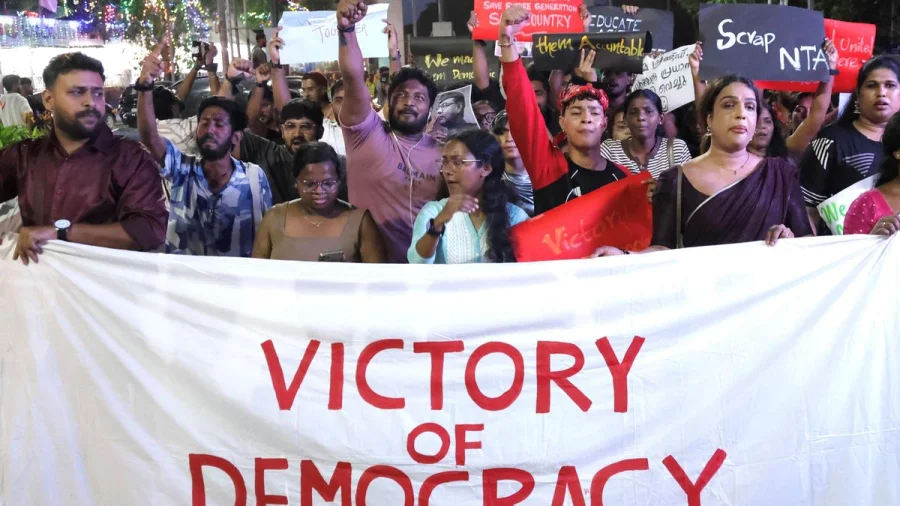
The chants of “NEET leak nahi chalega” echoed through central Delhi as streams of students and members of political forums converged for victory marches, celebrating the fall of a Union Minister widely blamed for the NEET question paper leak. For many, this was not just about one resignation—it was proof that collective student agitation can shake the highest corridors of power.
Victory marches and solidarity meets take over city streets
From India Gate to Jantar Mantar, groups gathered in spontaneous rallies, waving banners and distributing sweets. Reports say the largest turnout was near the minister’s residence, where protesters had camped for weeks under the banner of “Exam Suraksha Manch.” The festive mood was laced with a harder demand: full accountability for the leak that compromised lakhs of medical aspirants.
Why the NEET paper leak became a political flashpoint
The NEET-UG exam, taken by over 2 million students annually, saw a major question paper leak in July that forced the cancellation of scores in several states. Allegations of lax oversight and political interference mounted, with student groups accusing the minister of ignoring repeated warnings. The resignation, announced late yesterday, is seen as a direct concession to street pressure.
From campus protests to a national victory
What began as small campus sit-ins at Delhi University and JNU snowballed into a citywide movement after social media amplified calls for “NEET justice.” Political forums—including student wings of opposition parties and apolitical civil society groups—joined forces, turning the leak into a test of government accountability. The minister’s exit is the first scalp for a movement that has vowed to keep pressing for reform.
Who is affected and what real change looks like
For the thousands of medical aspirants whose futures hung in limbo after the leak, the resignation offers symbolic relief but no immediate solution. Re-examination dates remain uncertain, and many students face a year of lost time. Yet the victory marches signal a broader shift: young Indians are increasingly willing to take to the streets for systemic issues beyond just exam results.
What the minister’s resignation means—officially and politically
The minister’s brief statement cited “moral responsibility” but did not admit direct involvement. Opposition leaders called it a “forced exit” and demanded a high-level probe. The ruling party has distanced itself, saying the minister acted on his own. Meanwhile, the Ministry of Education has announced a review of exam security protocols, though no timeline has been set.
How social media fueled the protest momentum
Hashtags like #NEETLeakHai and #MinisterResign trended for weeks, organising offline gatherings and turning local anger into a national conversation. Student influencers and campus pages broadcast real-time updates from protest sites, creating a digital solidarity network that sustained the movement even during lulls in media coverage.
Confirmed facts vs what remains unclear
Confirmed: The Union Minister resigned; victory marches occurred in Delhi; the NEET question paper leak is under investigation. Unclear: The exact role of the minister in the leak; whether the resignation was voluntary or pressured; details of any future re-examination schedule. All speculation about the minister’s next move or political fallout remains just that—speculation.
Risks and the road ahead for student activism
While the resignation is a win, experts warn that single-issue protests rarely lead to structural reform. The movement faces the risk of dissipating now that the immediate target is gone. Student leaders acknowledge this and are pivoting to demand a permanent exam security framework, but sustaining momentum without a clear villain is a tough challenge.
Wider trend: Why young Indians are taking politics into their own hands
This is part of a broader pattern of student-led accountability movements in India—from the anti-CAA protests to the recent hunger strikes over fee hikes. The NEET leak victory shows that when institutional checks fail, street power can become a corrective force. It also highlights the growing politicisation of education, a space traditionally left to bureaucrats.
What students and parents should do next
For affected NEET aspirants, the priority remains tracking official announcements about re-exams and counselling timelines. Parents are advised to follow only verified government sources and avoid paying for “leaked question banks” that often surface during such crises. Student unions are distributing helpline numbers for mental health support, as the uncertainty has taken a toll on many young candidates.
What could happen next in the NEET leak saga
The CBI is likely to expedite its investigation, and a parliamentary committee may summon officials. Political analysts predict the ruling party will try to shift focus to economic issues, while the opposition will keep the heat on. Students have announced a “monitoring cell” to watch the probe’s progress and a second wave of protests if no tangible action is taken within three months.
Our Take
This is a rare moment in Indian politics where student-led street pressure has directly toppled a Union Minister. But celebration alone won’t fix a broken exam system. The real victory will be measured by whether the next NEET is leak-proof, transparent, and fair. Until then, the marches are a powerful statement—not an end, but a beginning.
Frequently Asked Questions
Why did the Union Minister resign?
The minister stepped down after weeks of student protests demanding accountability for the NEET question paper leak, which disrupted the medical entrance exam for lakhs of students.
What is the NEET question paper leak?
In July, the NEET-UG question paper was leaked in parts of India before the exam, forcing authorities to cancel scores and announce a re-examination for affected candidates. The leak is under investigation by the CBI.
How did students celebrate the resignation?
Students and political forums held victory marches, solidarity meets, and public gatherings across Delhi, particularly near India Gate and the minister’s residence, calling for further accountability and exam reforms.
What happens next for affected NEET aspirants?
The Ministry of Education is expected to announce a new exam date for the affected centres. Students should monitor official NTA and government websites. The protest movement plans to continue until a leak-proof system is guaranteed.



