
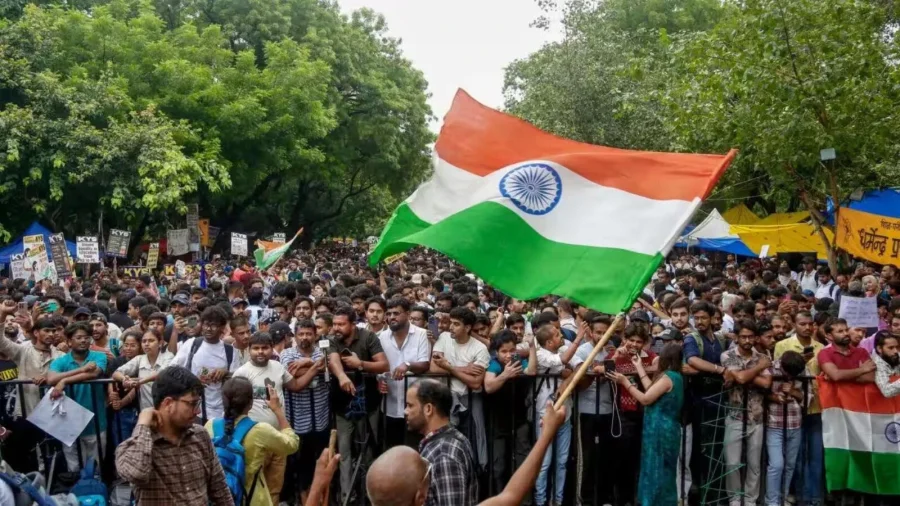
Every year, lakhs of Indian teenagers walk into examination halls carrying years of coaching, broken sleep, and a family's entire hope. The question before them is simple to read and brutal to answer: will the seat be mine? The recent NEET crisis — a leaked paper, a minister's resignation, a nation's anger — has pulled the curtain back on this older, quieter anxiety that Indian students have lived with for decades.
A Leaked Paper, a Resignation, and a Nation's Anxiety
The immediate story is one of institutional failure. The NEET exam was thrown into crisis after a question paper was leaked, shaking public faith in one of India's most consequential tests. The political fallout followed quickly, ending with the resignation of the education minister, according to the original report.
But for students and parents across India, the leak was not the real shock. The shock was the reminder of how much was riding on the exam in the first place.
Why the Race to Become a Doctor or Engineer Feels So Brutal
In India, a medical or engineering seat is not just an admission. It is treated as a life sentence — for success or for failure. Families invest years of income in coaching, often moving teenagers away from home to dedicated exam towns. The emotional stakes are so high that the fear of failure shapes entire childhoods.
This is what makes the system uniquely harsh: the difficulty is not just the syllabus — it is the scale of competition, with millions of students pressing against a small pool of elite seats.
From 3 Idiots to Kota's Coaching Rooms: A Pressure Built Over Decades
This pressure is not new. Popular culture caught it early — the film 3 Idiots turned the engineering exam dream into a national conversation about whether the system was producing engineers or anxieties. Years later, the coaching rooms of Kota have become the physical symbol of this struggle: thousands of students in one city, chasing the same handful of outcomes.
What has changed is the intensity. The dream has been democratised, but the number of prized seats has not kept pace in the same way — leaving more and more students fighting for the same narrow gate.
The Strange Paradox: Fierce Competition, Yet Empty Seats
Here is the contradiction that confuses outsiders and frustrates insiders. Even as millions fight for top seats, thousands of other seats in colleges across India remain empty every year. This is not a simple shortage of opportunities — it is a shortage of good opportunities, and a mismatch between what students are trained for and what the system actually offers.
The result is a distorted market: enormous pressure at the top, quiet waste at the margins, and a middle ground where quality, affordability, and employability all become question marks.
Who Pays the Real Price of This Exam War
The heaviest cost falls on students themselves. Years of hostels, test-series fees, and parental sacrifice are compressed into a few hours of examination. For every student who cracks the seat, many more carry the weight of "what next?" — often with no plan and little institutional support.
Parents pay too, financially and emotionally. In many Indian households, the doctor or engineer dream is not the child's ambition alone; it is a family project, measured in loans, postponements, and silent compromises.
What the Official Response Has Signalled
The resignation of the education minister in the wake of the NEET crisis was a political response to a trust breakdown. But officials have also signalled a broader reckoning: exam security, transparency, and the conduct of high-stakes tests are now under sharper public scrutiny than ever before.
Whether that scrutiny translates into real reform — better seat capacity, saner syllabi, stronger security — remains to be seen. What is clear is that the old answer of "just study harder" no longer satisfies a generation that sees the system as unfair.
Beyond the Leak: What This Crisis Is Really Telling India
The NEET leak is a symptom. The deeper message is that India has built a society where a teenager's worth is measured in percentile ranks and branch codes. The crisis is not simply about one paper being leaked — it is about a system that creates so much desperation that a leak can light a national fire.
Analysts and education observers would argue that the real difficulty of becoming a doctor or engineer in India is not academic. It is structural: a pyramid of demand, a plateau of supply, and a culture that refuses to widen the definition of success.
What Is Confirmed, What Is Still Unclear
What is confirmed: the NEET crisis began with a leaked paper, the political fallout led to the education minister's resignation, and the underlying pattern of millions chasing limited seats while thousands go empty is an established part of India's education landscape.
What remains unclear: the full scale of the leak's impact, the long-term policy response, and whether this moment will actually force the structural reform that students have been demanding for years. At the time of writing, no high-confidence external sources were available to verify additional details beyond the original report.
The Push and the Damage: A Balanced Look at the Exam Race
It would be unfair to describe the system as purely broken. The competition has produced extraordinary achievers — doctors serving remote districts, engineers building global products. The discipline of the exam race has genuine merit, and for many first-generation aspirants, it remains the most reliable ladder available.
But the same system has a darker ledger: student suicides in coaching hubs, years of wasted potential, and a generation raised on the idea that a single exam defines a lifetime. Supporters of the current system point to merit and rigour. Critics see a high-stakes lottery dressed up as education.
The Wider Pattern: A System That Pushes and Punishes
India is not alone in this. Across Asia, from South Korea to China, exam cultures create similar pressures. But India's version is distinctive because of its scale and its paradox: a country with a young population, hungry for opportunity, watches thousands of seats rot unfilled while millions sweat for the same few.
The pattern points to a deeper economic story — a formal job market that rewards credentials more than skills, and a society that has not yet built enough alternative pathways to respect and security.
What Students and Parents Can Do Now
For students facing the next cycle of exams, the practical advice is unglamorous but essential: build a backup plan. A single-exam identity is a fragile foundation. Exploring allied health sciences, diploma routes, emerging technology fields, and skill-based careers can reduce the emotional terror of "one shot only."
For parents, the most valuable support is often not more pressure but more perspective. Asking "what will you do with your life" matters less than asking "what kind of work would make you feel alive." The system will not change overnight — but individual families can widen their own definition of success before the system does.
What Could Change Next
The political temperature around NEET suggests that exam reform is now unavoidable in some form. Possible directions include tighter paper-security protocols, re-exam mechanisms, and a serious conversation about expanding quality seats in medicine and engineering. The harder reform — rebuilding a culture that stops treating a rank as a destiny — will take far longer.
If the crisis produces only new rules and no new seats, little will change for the millions waiting at the gate. If it forces a genuine rethink of how India educates, tests, and values its young, the leaked paper may finally be remembered as the moment the country asked the right question.
Our Take
This story matters beyond the political drama because it is about the most basic promise a society makes to its children: that effort will be rewarded fairly. When a leaked paper can bring down a minister, it is not because paper is sacred — it is because millions of families have invested everything in the belief that the exam is the only door. The genuinely difficult task for India is not making the exam harder to crack. It is building enough doors — and enough dignity in every outcome — so that no single test holds the power to break a generation.
Frequently Asked Questions
Why is it so hard to become a doctor or engineer in India?
The difficulty comes from extreme demand against limited supply. Millions of students appear for entrance exams like NEET and JEE each year, but only a small fraction secure seats in top or even decent institutions. This creates intense competition where even small differences in marks decide a student's future.
Why did the NEET exam become a national crisis?
The crisis began with a leaked question paper, which shattered trust in the fairness of the exam. Because NEET is the single gateway to medical education in India, any compromise of the test is seen as a direct attack on millions of students' futures. The political fallout led to the education minister's resignation, as reported.
Are engineering seats really going empty in India?
Yes — thousands of engineering seats, especially in smaller and less reputed colleges, remain unfilled every year. This happens even while top colleges see fierce competition. The gap exists because students and families prefer quality and employability over simply holding a degree.
What does Kota's coaching culture have to do with this crisis?
Kota symbolises the extreme version of India's exam pressure — thousands of students living away from home, studying for years for a single shot at medical or engineering seats. It shows how the system converts adolescent years into test preparation, and it has become the human face of both aspiration and distress in India's education race.



