
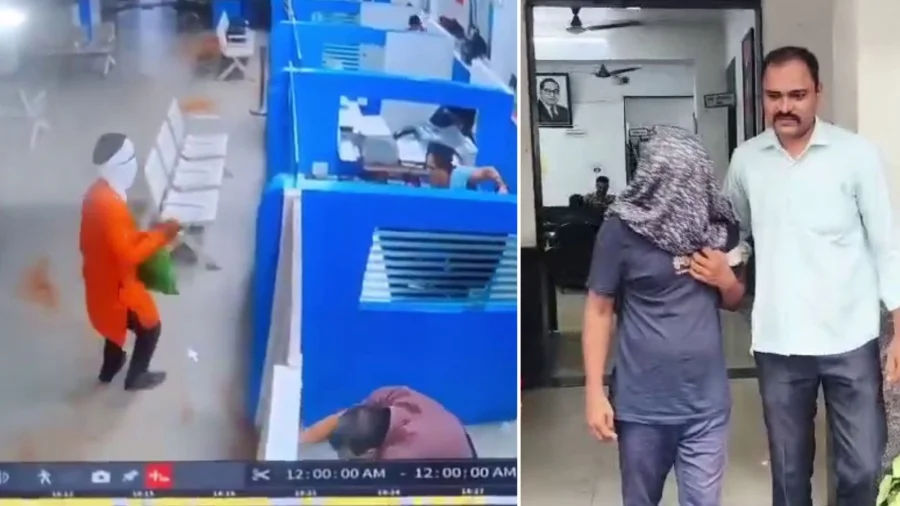
By Crime Desk | Nagpur & Vidarbha Bureau
A man is reported to have thrown chilli powder at bank staff in Nagpur and walked away with Rs 4.53 lakh in cash. He has since been arrested. What makes the case travel beyond Nagpur is the method: no weapon that anyone would recognise as one, no noise, no struggle that lasts more than a few seconds.
What Happened at the Bank Counter
As per the available account, the man approached bank staff, threw chilli powder at them, and used the resulting confusion to take cash amounting to Rs 4.53 lakh before fleeing. He was subsequently arrested.
Beyond that sequence, the record is thin. The bank and branch, the exact date and time, the accused's age and identity, and whether he acted alone have not been confirmed from primary sources.
A Kitchen Ingredient That Works Like a Weapon
Chilli powder is cheap, legal, available in every market, and raises no suspicion in a bag or a pocket. Thrown into the eyes at close range, it causes immediate burning and temporary loss of vision — enough to disable a person for the few seconds an attacker needs.
That is the uncomfortable logic of this case. A bank counter is built to handle cash, but its staff are seated, stationary and at arm's length from anyone who walks in.
The People Behind the Counter
The immediate victims here are employees doing an ordinary shift — handling deposits, withdrawals, paperwork. A cash counter is a workplace, not a frontline post, and staff are rarely trained or equipped to respond to a physical attack at their own desk.
Whether the staff required medical attention after the chilli powder was thrown has not been confirmed. Eye exposure to capsaicin, the compound that gives chilli its heat, is painful and can need washing and, in some cases, medical care — but the specifics of this incident are not known.
Arrest Made, Questions Still Open
The arrest is the one clear legal development so far. What it does not settle is the money trail: how the cash was moved, and whether any part of the Rs 4.53 lakh has been recovered.
In cases of this kind, the investigation typically covers CCTV footage from the branch and approach roads, the route taken after the escape, and any prior record of the accused. None of those details have been confirmed in this case.
What the Law Usually Deals With Here
Acts of this nature generally fall under provisions dealing with robbery and voluntarily causing hurt under the Bharatiya Nyaya Sanhita, which replaced the Indian Penal Code. Whether those provisions have been applied, and in what form, has not been confirmed.
Practically, the outcome of such cases often depends on recovery of the cash, identification evidence, and whether the accused is linked to other offences. The presumption of innocence applies until a court decides otherwise.
Confirmed Facts, and What Is Still Speculative
Confirmed: chilli powder was thrown at bank staff in Nagpur; Rs 4.53 lakh in cash was taken; a man has been arrested in the matter.
Not confirmed: the accused's identity, the bank and branch, the timing, the number of people involved, the sections invoked, the recovery of the money, and whether anyone was injured seriously enough to need hospital care. Any claim on these points should be treated as unverified until officials state it on record.
Why Bank Branches Stay Vulnerable
Cash is concentrated in a small, public, walk-in space — the opposite of a secured vault in terms of accessibility. In smaller branches, a single guard, a low counter and a queue of customers can make the job of responding to a sudden attack harder.
The larger pattern in Indian retail crime is the shift towards low-tech, non-lethal methods that create a few seconds of chaos. Such methods are harder to screen for than a weapon at the door, which is exactly why they persist.
What Banks and Staff Can Practically Do
For bank employees, the standard advice in a sudden assault is to prioritise distance and sight over confrontation — step back, protect the eyes, raise the alarm, and let the CCTV and the cash-tracing trail do the investigative work.
For customers present at the time, the safest response is to stay out of the way, avoid filming at close range, and cooperate with staff and police afterwards. For branch managers, the useful questions are unglamorous: is the footage clear, is it retained long enough, and are staff given any basic drill for a physical attack?
Future Outlook
The immediate focus is likely to be the recovery of the cash and the strengthening of the evidence chain — footage, witness accounts, and any prior record. A charge sheet and trial would follow if the case proceeds along the usual course.
What remains genuinely open is whether this was an opportunistic act or part of a wider set of similar offences. Without official confirmation, that cannot be asserted either way.
Our Take
The striking part of this story is not the amount taken — Rs 4.53 lakh is modest by the scale of bank frauds that dominate headlines. It is the asymmetry. One man with a handful of powder defeated a system designed around locks, cameras and cash limits, simply by attacking the people sitting closest to the money.
That is worth remembering the next time branch security is discussed only in terms of vaults and alarms. The weakest link in a bank counter has always been the human being behind it — and this case is a reminder that protecting the money and protecting the staff are the same problem.
Frequently Asked Questions
What happened at the Nagpur bank?
A man threw chilli powder at bank staff and fled with Rs 4.53 lakh in cash. He has been arrested in connection with the incident.
How much money was taken?
Rs 4.53 lakh, according to the account of the incident available so far. Whether any of it has been recovered is not confirmed.
Were the bank staff injured?
Chilli powder was thrown directly at staff, which causes eye pain and temporary vision problems. The extent of any injuries, and whether medical treatment was needed, has not been confirmed.
Who is the accused?
Only that he is a man who has been arrested in the case. His name, age and background have not been confirmed from official sources at this stage.



