
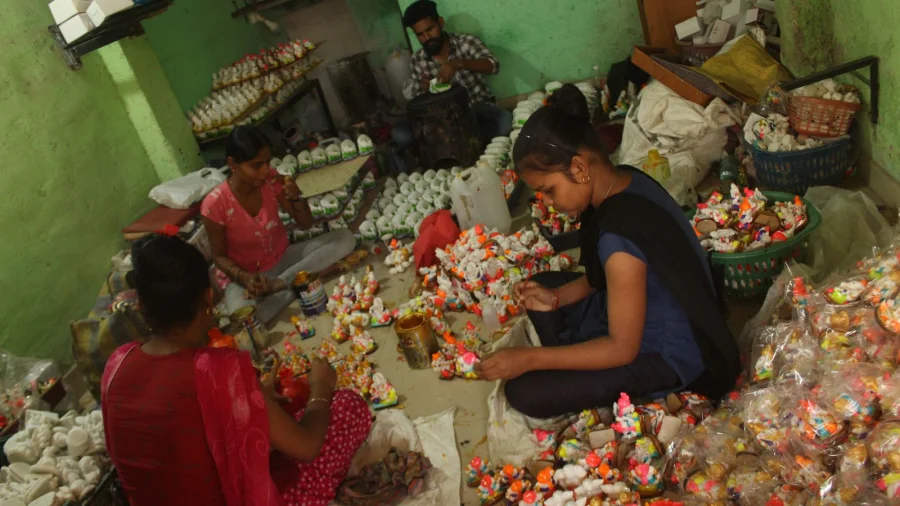
Through lockdowns and after them, Work from Home was celebrated as the great workplace compromise. But an emerging account out of Mumbai tells a harsher story: for the city's women, remote work has quietly become a double shift — and in stressed households, the report claims, the cost is now being paid by children drawn into labour.
The core claim about Mumbai's working mothers
The story, captured in the headline "Work from home takes its toll on Mumbai's women, draws children into labour," makes a pointed accusation: the flexibility offered to urban professionals did not reach women as relief. It reached them as added weight.
According to the account, women in Mumbai households absorbed more work — office deadlines on one side, cooking, cleaning, and childcare on the other — while their families, and in some cases employers, treated the arrangement as normal. The heaviest allegation is that the strain pushed some children out of classrooms and into work.
The Mumbai squeeze no corporate policy accounted for
Mumbai's housing reality makes WFH a different beast than it is in larger homes elsewhere. Crorepati chawl and mid-sized flat alike became offices, schools, and kitchens simultaneously. For women, the boundaries between professional and domestic space collapsed entirely.
What made the situation worse is that remote work was never a shared family adjustment. The account suggests the extra labour of making WFH functionable — meals on time, children quiet during calls, home presentable for video meetings — fell on women.
That is consistent with a wider pattern documented during the pandemic years: flexible work does not remove domestic duty, it simply layers employment on top of it. In households without support, the first casualty is the mother's health; the next, the children's safety and schooling.
How children slip into the labour net
The mechanism described in the report is not dramatic abduction or factory exploitation. It is quieter: an elder daughter skipping online classes to cook while her mother attends a meeting; a son sent to a relative's shop because no adult can supervise him; a family so squeezed by income loss that a child's wage, however small, becomes necessary.
These are the grey-area pathways through which children edge toward labour. Whether this account treats such work as paid employment, heavy household responsibility, or school dropout is unclear from the headline alone — which is precisely why verification matters.
What is confirmed — and what still needs proof
Let us be honest about the limits of this story. At the time of writing, no underlying survey, dataset, or named investigation behind the claim was available for independent review.
What is confirmed:
• The headline and its assertion exist as a published account.
• WFH's uneven burden on women is a documented, widely reported phenomenon in urban India.
• Child labour is illegal in India, yet economic distress is a known driver of child work.
What remains unclear:
• Whether the account is based on a formal study, NGO fieldwork, or anecdotal reporting.
• The number of children allegedly affected.
• Whether the claim refers to paid child labour or unpaid household drudgery.
Until the source material is released, the precise scale should not be treated as established fact.
The official silence and the legal floor that already exists
No response has yet come from the Mumbai Police, the Maharashtra Labour Department, or the Brihanmumbai Municipal Corporation. That silence is not evidence against the claim — it simply means the story has not yet moved from allegation to official acknowledgment.
The legal context, however, is settled. India's Child and Adolescent Labour (Prohibition and Regulation) Act, 1986, as amended in 2016, prohibits the employment of children below 14 in any occupation, and of adolescents between 14 and 18 in hazardous work. If the report identifies specific cases, the law already provides the ground for intervention.
A pattern that reaches far beyond Mumbai
This account is not an island. Across Indian cities, the shift to remote work produced a gendered crisis that researchers and women's rights groups have flagged repeatedly: when the home becomes the office, women lose the only private space they had — and children absorb the spillover.
The Mumbai case, if corroborated, would be among the sharpest illustrations of that failure: the modern workplace's most celebrated perk, converted by poverty and patriarchy into a household crisis.
What affected women and families should do now
Families experiencing this pressure should not wait for the debate to conclude. Practical steps matter first.
Parents who cannot supervise children during work hours should explore creche and day-care options, many of which now accept school-age children for online-class support. Women facing an unsustainable load — at home or from employers — can reach out to the Maharashtra State Commission for Women or local women's helplines.
Anyone who sees a child out of school and into work can report it to Childline at 1098, a 24x7 national helpline that connects to local protection authorities.
What happens next
The burden now sits with the report's publishers and with authorities. If underlying data exists, it must be released for scrutiny. If the claim is built on field cases, those cases should be handed to the labour department and the Child Welfare Committee for action.
Separately, employers and policymakers face a question they have avoided since 2020: if WFH continues, who pays for the childcare, the space, and the unpaid domestic labour that makes it possible? If that question remains unanswered, the Mumbai account will not be the last of its kind.
Our Take
This story deserves attention for what it says — and caution for what it does not yet prove. The headline captures a plausible, painful reality; the absence of verifiable data makes it, for now, an allegation rather than an established finding.
Neither response is adequate. dismissing it because the data is unpublished ignores how often India's most uncomfortable truths surface first in reporting, not statistics. Accepting it wholesale without evidence undermines the very credibility needed to force official action.
The responsible path is pressure: on the report's authors to show their work, and on authorities to investigate rather than wait.
Frequently Asked Questions
Is there proof that Work from Home is increasing child labour in Mumbai?
Not yet. The claim exists as a published account, but the underlying report or data has not been released for independent verification. No official statistics on WFH-linked child labour in Mumbai have been published.
How does Work from Home burden women more than men?
In most urban Indian households, domestic work and childcare are still treated as women's responsibility. WFH adds paid employment on top of that existing load, leaving women with longer combined work hours and less rest, while men's domestic contribution typically does not rise equally.
What is the legal age for work in India?
Under the Child and Adolescent Labour (Prohibition and Regulation) Act, 1986 (amended 2016), children below 14 cannot work in any occupation, and adolescents aged 14 to 18 cannot work in hazardous occupations. Violations are cognisable offences.
Where can child labour be reported in Mumbai?
Childline's 24x7 helpline 1098 is the fastest route — it connects callers to local child protection authorities. Cases can also be reported to the Maharashtra Labour Department's child labour cell or the local Child Welfare Committee, which handles rescue and rehabilitation.



