
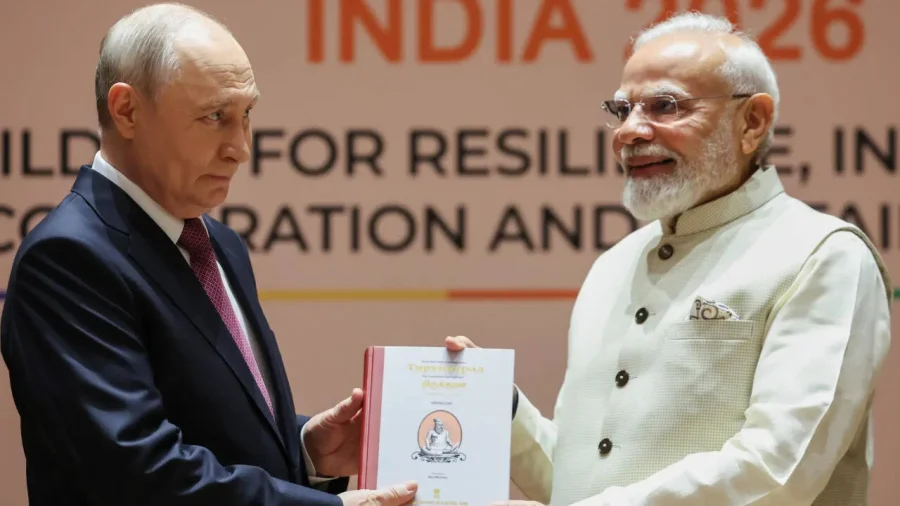
Prime Minister Narendra Modi has once again placed India's position directly in front of President Vladimir Putin: this war has to end at a negotiating table, not on a battlefield. The message is not new. The moment, however, is.
With diplomatic efforts to end the Ukraine conflict gathering pace, a peace message from a leader who can still get a hearing in both Moscow and Western capitals carries more weight than a routine statement of principle.
A Message Repeated for a Reason, Not a Ritual
India has said the same thing for three years, and it has said it in almost the same words: dialogue and diplomacy, not escalation. That consistency is deliberate.
By repeating it before his engagement with Putin, Modi keeps India anchored to a negotiated outcome — and keeps New Delhi from being slotted into either camp as the war enters a phase where settlements, not just sanctions, are being discussed.
What Delhi Is Actually Asking Moscow to Hear
India's message has three practical strands. First, that battlefield gains cannot become the basis of a lasting peace. Second, that communication channels must stay open, including the ones India itself uses. Third, that the economic shock of this war — energy, food, fertiliser — falls hardest on countries that never chose it.
That last point matters in New Delhi because it is the language of the Global South, where India increasingly speaks on behalf of a large bloc rather than for itself alone.
From Samarkand to Now: How India's Line Took Shape
The clearest turning point came in September 2022, when Modi told Putin at the SCO summit in Samarkand that "today's era is not of war" — a line reported worldwide and quoted ever since.
What followed was not a shift in alignment but an expansion of contact. Modi visited Moscow in 2024 and Kyiv later the same year, a sequence few leaders could have attempted. India continued buying discounted Russian crude despite Western pressure, and continued abstaining on UN resolutions it felt did not advance talks.
Read together, the pattern is clear: India wants to be the country that is still speaking to everyone when the talking finally matters.
Why the Timing Matters More Than the Words
Peace messaging lands differently depending on the weather around it. When both sides are digging in, it is background noise. When proposals are circulating and capitals are calculating costs, the same words become an opening.
That is the shift the headline points to. The push to end the war has moved from slogans to structure — less about who is right, more about who will sign what.
The Households Paying for a War They Didn't Choose
For Indian families, this is not distant geopolitics. Fuel bills, fertiliser costs, edible oil prices and freight rates have all been shaped by a conflict 4,000 km away. Every round of escalation has shown up somewhere in a monthly budget.
There is a human ledger too: Indian students and workers who had to leave Ukraine, families split by evacuation, and a diaspora that tracks every diplomatic signal with more anxiety than most newsrooms do.
Delhi's Balancing Act, Explained Without Spin
India's official position, stated repeatedly by the Ministry of External Affairs, is that it stands for dialogue and is ready to contribute to any credible peace effort. That is a stance, not a strategy document — deliberately broad enough to survive contact with reality.
Critics, particularly in Western capitals, have argued that India's refusal to condemn the invasion and its continued energy trade blunt the moral force of its peace appeals. New Delhi's answer is that it is precisely because it kept those channels open that it can still be heard in Moscow.
Both readings are defensible. The results will settle the argument better than the commentary will.
Why India Is Heard in Both Moscow and Washington
India's real asset here is not military weight or economic leverage. It is access. Very few countries can pick up the phone in both capitals and expect someone to answer.
That access rests on four pillars: decades of defence and diplomatic ties with Russia, a deepening strategic partnership with the United States, leadership of the Global South, and a domestic economy large enough to make its neutrality consequential rather than decorative.
None of this makes India a mediator with a mandate. It makes India a messenger with credibility — and in a stalled conflict, credible messengers sometimes matter more than formal mediators.
Confirmed, Reported, and Still Unclear
Confirmed: India's stated position on ending the Ukraine war through dialogue, and its record of abstaining on related UN votes.
Reported: That Modi has reiterated this peace message ahead of Putin, and that efforts toward ending the war have gained momentum — the framing at the centre of this story.
Unclear: The exact timing and format of the contact, the precise wording used, whether any new proposal or timeline was discussed, and whether the Russian side has responded in substance. Reports available so far do not establish these, and any claim to the contrary should be treated as speculation.
The Risks in Reading Too Much Into a Peace Message
The obvious risk is over-interpretation. A peace message is a position, not a breakthrough, and India does not control either war aims in Moscow or sanctions policy in the West.
There is a second risk: that repeated appeals begin to sound like ritual, and lose their capacity to shape events. India's diplomacy has to convert consistency into movement at some point, or the consistency itself becomes the story.
Third, and least discussed: if talks do begin, India could be asked to underwrite outcomes it has no power to enforce — military disengagement, monitoring, reconstruction. That is a shelf of commitments New Delhi has so far avoided, sensibly.
A War That Has Already Redrawn the Global Order
Whatever happens next, this conflict has already changed how the world works. Sanctions have become a first-resort tool. Energy trade has been rerouted along political lines. Defence supply chains are being rebuilt with a war-footing urgency Europe had abandoned decades ago.
It has also accelerated a quieter shift — middle powers deciding that non-alignment is not indecision but a strategy. India's peace messaging is one expression of that trend. So is the queue of countries now offering themselves as bridges.
If You're Following This Story, Watch These Signals
Ignore the noise and track four things. One, the official readout — what the Ministry of External Affairs says publicly after the engagement, and what it conspicuously leaves out. Two, whether a negotiating format with a venue, participants and a mandate emerges.
Three, whether sanctions relief or frozen-asset questions enter formal discussion — that is the clearest sign talks are real. Four, whether India's UN voting pattern changes at all. A shift there would say more than any communiqué.
What Could Move Next — and What Probably Won't
A reasonable expectation is more diplomacy, more shuttle contact and more public appeals, with modest technical progress on humanitarian issues. Confidence-building measures, prisoner exchanges and grain or energy arrangements are the kind of smaller agreements that often precede anything larger.
A comprehensive settlement in the near term would require concessions neither side has signalled a willingness to make. Careful observers should hold both ideas at once: momentum is real, and so are the walls it keeps hitting.
Our Take
India's peace message to Putin is not a diplomatic flourish, and it is not a solution. It is a position staked out early and held through pressure from every direction — which is rarer in world politics than it sounds.
The value of that position will be tested, not in how often it is repeated, but in whether it survives contact with a settlement that no party will find comfortable. For now, New Delhi has done the thing it can do: it has kept itself in the room. The harder question is what India is prepared to do once the room starts making decisions.
Frequently Asked Questions
What did Modi say to Putin about peace?
Modi has reiterated India's long-standing position that the Ukraine war should end through dialogue and diplomacy rather than military escalation. The exact wording of the latest exchange is not established in available reports, so any precise quotation circulating online should be verified against an official readout.
Why does India's peace message matter in this war?
Because India is one of very few countries with working diplomatic channels to both Moscow and Western capitals. That access gives its appeals a hearing that statements from more clearly aligned nations do not receive.
Has India condemned Russia's invasion of Ukraine?
No. India has not condemned the invasion and has abstained on multiple UN resolutions related to the conflict, while consistently calling for dialogue and an end to hostilities. Critics say this weakens India's moral position; New Delhi argues it preserves the credibility needed to be heard in Moscow.
Does this mean India is acting as a mediator?
Not formally. India has positioned itself as a country willing to contribute to peace efforts, but it has not taken on a mediation mandate and has avoided commitments it cannot enforce. Think credible messenger rather than appointed arbiter.
Editor's note on sourcing: This report is based on the story in focus and on India's publicly stated position and documented diplomatic record. Details of the latest exchange — timing, format and wording — remain unconfirmed in available reporting, and are labelled as such above. No statement has been attributed to any official unless it is a matter of public record.



