
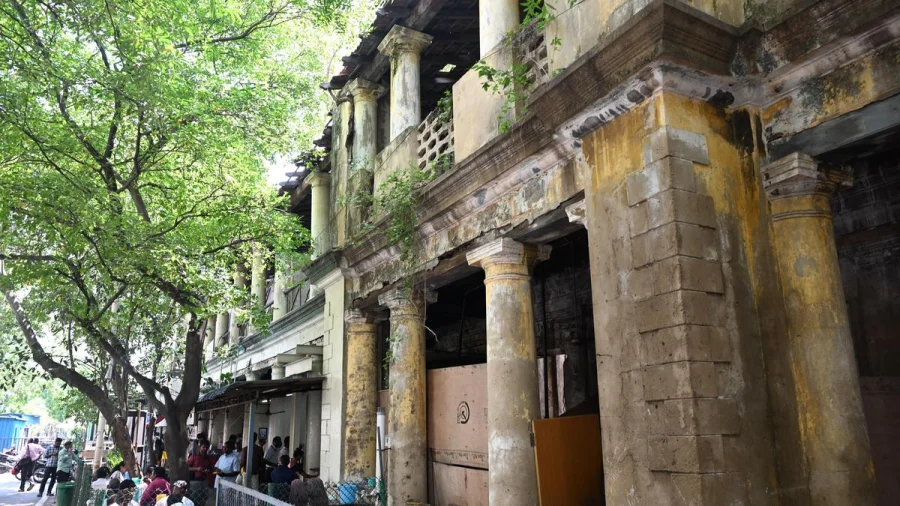
The King's Barracks at Fort St. George has survived sieges, artillery and three centuries of salt-heavy coastal air. What it may not survive is a clearance that never arrived. The building, described in reporting as being on the verge of collapse, was meant to make way for a new structure. That structure was never built.
A Plan for Fort St. George That Never Left the File
The DMK government mooted a heritage-appropriate structure in place of the King's Barracks inside the Fort St. George complex in Chennai. According to the original report, the proposal was for a multi-storeyed building.
It could not be implemented. The defence authorities, who retain a hold over the barracks, did not grant approval — and without that clearance, the plan had nowhere to go.
Why One Unbuilt Building Matters to an Entire City
Fort St. George is not a ruin at the edge of Chennai. It is the point from which the city grew — the 17th-century English fort around which Madras took shape — and it still works for a living, housing the Tamil Nadu Secretariat.
That dual identity is the problem. Every structure inside its walls sits at the intersection of three competing claims: heritage, security, and the ordinary administrative needs of a functioning state government. When those claims collide, the building usually loses. This one has.
The Barracks, the Garrison and a Boundary Nobody Redrew
King's Barracks takes its name from the soldiers it once housed and ranks among the oldest surviving structures within the fort complex. Ownership inside Fort St. George has been layered for decades: the state government operates from the Secretariat side, while defence authorities retain control over specific buildings, including this one.
That split is where the proposal stopped. Whatever stage the state's plan had reached, reconstruction on defence-controlled ground could not proceed without the defence establishment's consent — and, according to the report, that consent was never given.
What a Collapse Would Take With It
For Chennai residents, the barracks is not an abstraction. It is part of a streetscape that predates the city's own municipal memory, and part of the reason Fort St. George still reads as a fort rather than a government campus with old walls.
If the structure fails, what is lost is not only stone and lime mortar. It is one more piece of documented, physical evidence of how colonial Madras was built, garrisoned and lived in — evidence that cannot be reconstructed from photographs alone.
A File With No Public Paper Trail
No statement from the defence authorities explaining the decision — or the reasons behind it — is available in the public record reviewed for this report. Nor is a documented timeline of when the proposal was made and when it effectively lapsed.
That absence matters. In heritage disputes, the difference between "rejected" and "never processed" is the difference between a decision that can be appealed and a file that simply went quiet. On the available record, it is not possible to say which this was.
What the Stalled Proposal Reveals About Heritage Decisions
The King's Barracks case is a clean illustration of how heritage protection actually works in India — rarely through a single dramatic decision, more often through overlapping jurisdiction. A state government can announce intent. A central agency or the armed forces can hold the key. Neither has to say no out loud; the project simply stops.
That structure produces a peculiar outcome. The building is neither restored nor replaced. It is left to time, which is the slowest and least accountable decision of all.
Confirmed Facts vs What Remains Unclear
Confirmed on the available record: The Tamil Nadu government mooted a new structure in place of the King's Barracks. The proposal was for a multi-storeyed building. It was not implemented because defence approval was not received. Defence authorities retain control of the building. The barracks is described as being on the verge of collapse.
Unclear: The exact date the proposal was made and abandoned, its estimated cost, the architectural design and how "heritage" was defined in it, whether a structural safety assessment exists, whether any restoration alternative was formally considered, and the specific grounds on which the defence establishment withheld approval. Any claim beyond the above would be speculation, and should be treated as such.
The Risks on Both Sides of the Argument
The case for replacement: A structure on the verge of collapse is a safety and liability question. If the original fabric cannot be saved, a new building that respects the fort's scale and materials may be the only way to keep the site in use rather than fenced off and forgotten.
The case for restraint: Demolishing an original colonial-era barracks and putting a multi-storeyed block in its place inside a 17th-century fort is not conservation — it is substitution. Heritage bodies have consistently argued that once original fabric is gone, the site's historic value drops sharply, and what replaces it rarely matches the streetscape.
The defence position: Security and operational control over military-held premises are legitimate concerns, and no authority is obligated to open a controlled site to redevelopment for reasons of tourism or civic pride. That argument is defensible even where it leaves a historic building unprotected.
India's Old Forts Are Running Out of Time
The King's Barracks is not an isolated case. Across the country, colonial-era military and administrative buildings sit on land divided between the armed forces, state governments, port trusts and central agencies. Each has a stake; none has sole authority.
The result is a familiar pattern: buildings that are too significant to demolish quietly, too contested to restore quickly, and too expensive to maintain by default. They deteriorate until a collapse forces a decision that should have been taken years earlier.
What Readers, Residents and Heritage Watchers Can Do
If you live in Chennai or follow the city's heritage, the practical steps are unglamorous but effective. Ask for the file — a Right to Information request to the state archaeology or municipal department, and to the district administration, can establish whether any proposal or structural assessment exists and why it lapsed.
Heritage groups can press for a public structural audit of the barracks, regardless of who controls the land, because a safety finding creates its own momentum. Visitors can support the fort's public-facing spaces so the site stays in civic conversation rather than fading into a protected-but-ignored category.
What Could Happen Next
Three routes are possible, and none is confirmed. The state and defence authorities could reach an understanding that allows restoration in situ — the outcome heritage experts generally prefer. A revised proposal could be submitted that keeps the original facade and footprint intact. Or the impasse could continue, and the decision could be made by the building itself.
No official timeline for any of these has been made public.
Our Take
This is a small story that explains a large problem. The King's Barracks did not fail because anyone decided it should be lost. It failed because the decision belonged to more than one authority, and no one was obliged to decide.
Heritage conservation in India is often described as a funding problem. It is at least as often a jurisdiction problem. Until there is a clear, named authority accountable for a building like this — with a deadline attached — collapsing structures will keep waiting on clearances that never come, and the loss will be recorded, eventually, as nobody's fault.
Frequently Asked Questions
What is the King's Barracks at Fort St. George?
It is one of the oldest surviving buildings inside the Fort St. George complex in Chennai, historically used to house soldiers of the garrison. It sits within the fort area that also houses the Tamil Nadu Secretariat, and it is described in reporting as being on the verge of collapse.
Why was the proposed structure at Fort St. George not built?
Because the defence authorities, who retain a hold over the King's Barracks, did not grant approval. Without their clearance, the state government's proposal for a multi-storeyed structure in its place could not proceed.
Who controls the buildings inside Fort St. George?
Control is divided. The state government functions from the Secretariat portion of the fort complex, while defence authorities retain control over specific buildings, including the King's Barracks. That split is central to why the proposal stalled.
Is Fort St. George open to visitors?
Parts of the fort complex, including its public museum spaces, are accessible to visitors. Access to defence-controlled buildings such as the King's Barracks is not open to the public, and no restoration or replacement work is currently under way on that structure on the available record.



