Summary
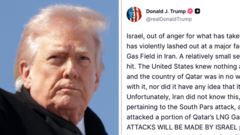
Recent military strikes on Iranian gas fields have raised serious questions about the level of cooperation between the United States and Israel. Following these attacks, Donald Trump shared a series of messages on Truth Social that suggested a strong but complicated bond between the two allies. While the strikes represent a major escalation in the region, the public response from the U.S. indicates that both nations may have different ideas about how far the conflict should go. This situation matters because it affects global energy prices and the risk of a much larger war.
Main Impact
The attacks on Iran’s energy infrastructure have shifted the focus of the conflict from military targets to economic ones. By hitting gas fields, the goal appears to be cutting off the financial resources that Iran uses to fund its regional activities. This move has immediate effects on the global economy, causing a jump in energy costs and creating uncertainty in international markets. It also puts the U.S. in a difficult position, as it must balance its support for Israel with its own desire to avoid a long and costly war in the Middle East.
Key Details
What Happened
In a series of coordinated strikes, several major gas production sites within Iran were targeted and damaged. These facilities are responsible for a large portion of the country’s domestic energy and its export revenue. Shortly after the news broke, Donald Trump posted on his social media platform, praising the precision of the operations. However, his words also carried a warning that the United States would prioritize its own interests and security. This has led many experts to wonder if Israel acted alone or if the U.S. gave a green light for these specific targets.
Important Numbers and Facts
The strikes reportedly hit three main gas fields, causing production to drop by an estimated 20% in the short term. Following the news, global oil and gas prices saw a 5% increase within a single day of trading. While no U.S. troops were directly involved in the strikes, the military hardware used by Israel is largely supplied by American companies. Reports suggest that the U.S. was informed of the mission only shortly before it began, which suggests that the two countries are not always in perfect sync regarding timing and strategy.
Background and Context
For many years, Israel and Iran have been involved in what experts call a "shadow war." This means they often attacked each other through cyber warfare, small sea skirmishes, or through other groups. However, the recent direct hits on energy fields show that the conflict is no longer in the shadows. Israel views Iran’s nuclear program and its support for regional groups as a direct threat to its existence. The U.S. has historically been Israel's strongest ally, providing billions of dollars in military aid. Under the current political climate, the U.S. is trying to show strength while also making sure it does not get pulled into another "forever war" that costs trillions of dollars.
Public or Industry Reaction
The reaction to the gas field attacks has been divided. In Israel, many political leaders praised the move as a necessary step to protect their borders and weaken their enemy. In the United States, the reaction was more mixed. Supporters of the "America First" policy expressed concern that getting too involved in an energy war could hurt American consumers at the gas pump. Meanwhile, Iran has vowed to respond, calling the attacks a violation of international law. Energy industry experts are worried that if the conflict continues to target fuel sources, it could lead to a global energy crisis that would hurt many developing nations.
What This Means Going Forward
The next few weeks will be critical for the relationship between the U.S. and Israel. If Israel continues to target economic sites, the U.S. may have to decide whether to offer full military backing or to pull back to prevent a global recession. There is also the risk that Iran will retaliate by targeting shipping lanes or other energy facilities in the region. This could lead to a cycle of revenge that is hard to stop. The U.S. will likely try to use its influence to keep the conflict from growing, but Trump’s social media posts suggest that the U.S. will not stay quiet if it feels its own interests are at stake.
Final Take
The U.S. and Israel are clearly working toward similar goals, but they are not always in lockstep. While they both want to limit Iran’s power, the U.S. is much more concerned about the global economic fallout of an energy war. Trump’s recent comments show that while the alliance is firm, the U.S. will always look at the cost to American citizens before committing to a full-scale conflict. The world is watching to see if these two allies can stay on the same page or if their different priorities will eventually lead to a public disagreement.
Frequently Asked Questions
Why were the gas fields targeted?
The gas fields were targeted to weaken Iran's economy. By damaging these sites, the attackers hope to reduce the money Iran has available to spend on its military and regional influence.
What did Trump say on Truth Social?
Trump praised the effectiveness of the strikes but also emphasized that the U.S. must be smart about its involvement. He suggested that the U.S. should not be forced into a war that does not directly serve its own national security.
Will this cause gas prices to go up?
Yes, any conflict that involves major energy-producing regions usually leads to higher prices. If the attacks continue or if Iran retaliates against other oil and gas sites, prices at the pump could rise significantly for consumers around the world.