
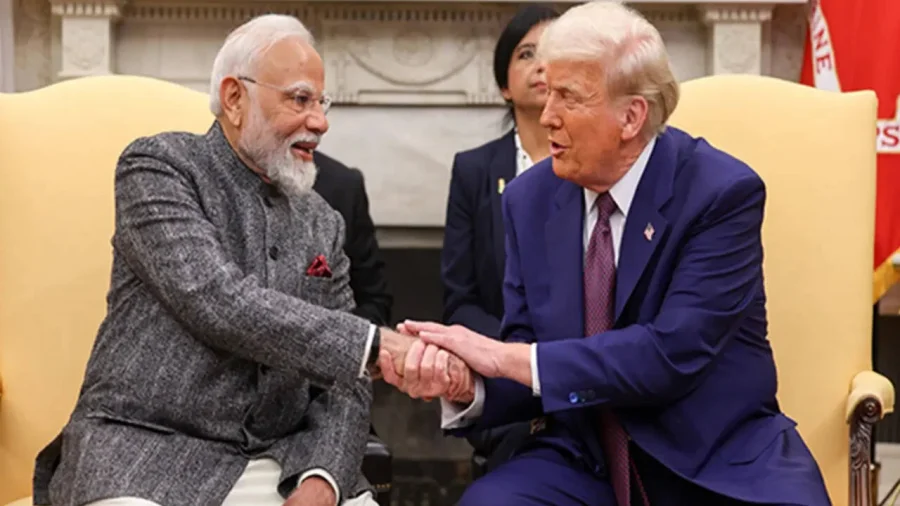
India's name is still on America's list of major drug transit and producing countries. That is the headline Delhi would rather not read. The line that follows it — public praise from President Donald Trump for Prime Minister Narendra Modi's crackdown on illicit opium poppy farming — is the one Indian officials will read more closely.
Two signals arrived together, and they point in opposite directions. One is a formal designation. The other is a diplomatic compliment. How India handles the gap between them will shape the next phase of a relationship that now runs through trade, security and narcotics enforcement at once.
Trump's Message: Praise for Modi, Plus a Listing India Would Rather Not Have
According to the development as reported, Trump welcomed Modi's efforts to curb illicit opium poppy cultivation — a public acknowledgement of enforcement work on the ground in India.
At the same time, Washington named India among 23 countries designated as major drug transit or producing nations. That designation places India in a category that includes some of the world's most significant drug-trafficking corridors, a grouping no government welcomes.
There is no indication in the account that the two moves contradict each other. They are separate instruments — one diplomatic, one formal.
Why a US Designation Matters More Than the Praise
Compliments fade. Listings are recorded, repeated annually and cited by agencies, banks and foreign governments for years.
For Indian exporters, financial institutions and pharma companies, a drug-related designation abroad can translate into closer scrutiny in compliance checks, even when no sanctions are attached. That is the quiet cost of a label, and it is why Delhi tracks these designations closely.
How America's Annual Drug List Actually Works
The United States identifies major drug transit and major illicit drug producing countries on a recurring basis, and the list is not designed to be a scorecard of any single government's policing.
Countries appear on it for a mix of reasons — geography, trafficking routes, production capacity and the scale of the problem rather than the sincerity of the response. That distinction is precisely the one the account of this development makes: the designation does not reflect a failure by India to tackle the drug trade.
In other words, the list is a map of risk, not a verdict of guilt.
The Farmers, the Licences and the Line Between Legal and Illicit Opium
India's opium story is unusual, and that is what makes this designation complicated for ordinary readers to parse.
India is one of a small number of countries authorised to cultivate opium poppy legally for medicinal purposes, under a government-supervised licensing system that supplies alkaloids used in pain management and codeine-based medicines. Practically, that means poppy fields in parts of Rajasthan, Madhya Pradesh and Uttar Pradesh are not automatically illegal.
The problem — and the focus of Modi's crackdown as described — is what happens outside that system: unlicensed cultivation, diversion of licensed crop, and smuggling networks that feed regional and global markets.
What Washington Said — And What It Left Unsaid
The account confirms the praise, the 23-country designation, the clarification that it is not a judgement on India's enforcement, and the intent to keep working with India under the Drug Policy Framework.
It does not provide the exact wording of the statements, the full list of the other countries named, or any new commitment, funding or deadline. Those gaps matter, and readers should treat them as gaps rather than fill them in with assumption.
Reading Between the Lines of Trump's China Nudge
In the same breath, Trump urged China to strengthen action against precursor chemical flows — the industrial ingredients used to manufacture synthetic drugs.
The inclusion is deliberate. It shifts part of the conversation toward supply chains that sit outside India's borders, and it frames cooperation as a shared problem rather than a bilateral one. For India, that framing is favourable: it suggests the focus is on trafficking flows, not on Indian enforcement failure.
Confirmed Facts vs What Remains Unclear
Confirmed in the account: Trump's praise for Modi's anti-opium efforts; India's inclusion among 23 designated countries; the clarification that this does not reflect a failure by India; continued cooperation under the Drug Policy Framework; the call for Chinese action on precursor chemicals.
Unclear or unverified: the exact wording of any statement, the complete list of designated countries, whether India raised objections, and whether any operational commitments followed. This report is based on the headline summary and original brief available; it is an early account of a developing story and should be read that way.
Risks India Should Weigh, Even With the Compliment
The obvious risk is reputational. A designation that is repeated annually can quietly harden into a perception problem, particularly among international banks and shipping lines that run their own risk models.
There is a domestic risk too. Enforcement crackdowns on poppy cultivation touch licensed farmers whose livelihoods depend on a legal crop, and heavy-handed action can push cultivation further underground rather than eliminate it.
And there is the risk of over-reading the praise. A favourable mention is not a guarantee of removal from any list — that requires sustained, measurable cooperation over time.
The Wider Pattern: Drug Diplomacy in a Trade-First Era
Narcotics enforcement has moved from a specialist file into the mainstream of great-power bargaining. Tariffs, technology controls and drug cooperation are now discussed by the same officials in the same rooms.
India's position reflects that shift. It keeps both channels open — welcoming recognition of its enforcement record while continuing to work under the Drug Policy Framework — without conceding that the designation is fair.
What This Means for Farmers, Pharma and Policymakers
For licensed cultivators, the practical message is that compliance matters more, not less. Licence records, yield reporting and crop disposal are the paperwork that separates a legal field from a suspect one.
For India's pharmaceutical and alkaloid sector, the focus is on traceability — demonstrating that legally grown opium flows into regulated medicinal channels and nowhere else.
For policymakers, the task is to convert a compliment into a case file: data on seizures, prosecutions, licensing audits and cross-border cooperation that can be presented the next time the designation is reviewed.
What Could Happen Next
Further engagement under the Drug Policy Framework is the most likely immediate course, with coordination on trafficking routes and precursor chemicals.
Removal from the designation list is a longer game. It would depend on how Washington assesses India's cooperation in the next review cycle — something the account does not address, and which cannot be predicted from the information available.
Our Take
This is not a story about India being singled out. It is a story about how formal labels and informal praise can coexist, and why Delhi needs to manage both.
The praise is useful — it acknowledges genuine enforcement effort against illicit poppy cultivation, an area where India's licensing model makes its challenges distinct from those of most producing nations. The designation is the harder fact, because it is written down and repeated.
The sensible Indian response is neither indignation nor complacency. It is documentation: prove the enforcement, protect the licensed farmer, and steadily narrow the space for illicit cultivation that keeps the country on the list.
Frequently Asked Questions
Is India on the US list of major drug transit or producing countries?
Yes. According to the development reported, India is among 23 countries designated by Washington as major drug transit or producing nations.
Does this designation mean India has failed to tackle drug trafficking?
No. The account states the designation does not reflect a failure by India to tackle the drug trade, and the US has said it wants continued cooperation under the Drug Policy Framework.
What is illicit opium cultivation in India?
India permits licensed opium poppy cultivation for medicinal use. Illicit cultivation refers to unlicensed poppy farming, or diversion of legally grown crop into illegal channels — the activity Prime Minister Modi's crackdown targets.
What did Trump say about China in this context?
He urged China to strengthen action against precursor chemical flows, the industrial ingredients used to manufacture synthetic drugs. No further detail was available in the material reviewed.



