
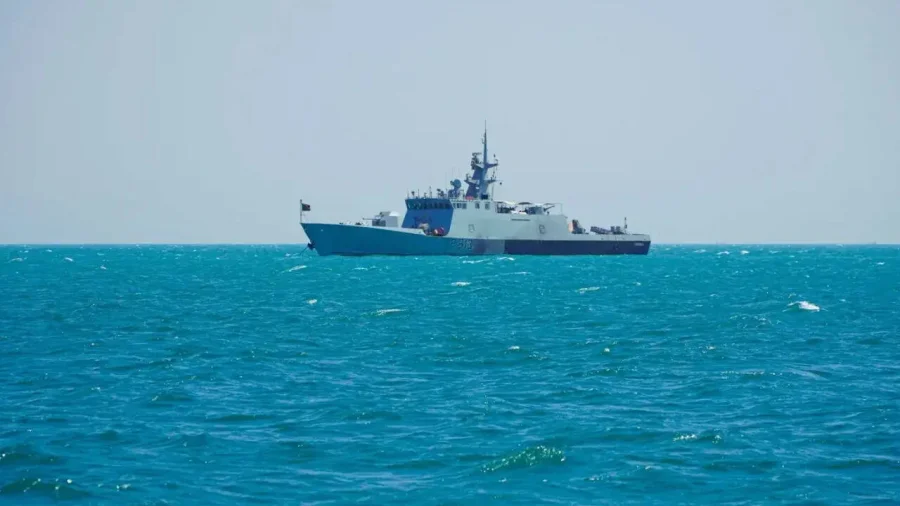
Two naval ships from two nuclear-armed neighbours collided in international waters. It was serious enough that India's Ministry of External Affairs went on record — not with a detailed account, but with a single, deliberately chosen word to describe the conduct involved: "unprofessional."
That word is now the story's centre of gravity. Everything else about the incident — where exactly it happened, which vessels were involved, what damage was sustained — remains officially unstated in the material available at the time of writing.
A Collision Confirmed, a Cause Not Yet Explained
What is confirmed is narrow but significant. Indian and Pakistani naval ships collided in international waters. India's foreign ministry publicly characterised the conduct as unprofessional.
What is not confirmed is equally important to state plainly: there is no verified information on the class or name of the vessels, the precise coordinates, whether either ship was damaged, or whether anyone was hurt. Any claim of intent — accidental or otherwise — would be speculation at this stage.
Why One Word From the MEA Carries So Much Weight
In India-Pakistan diplomacy, phrasing is policy. Calling conduct "unprofessional" stops short of alleging aggression, violation of law, or hostile intent — but it does assign responsibility in principle.
It is a formulation that keeps the incident below the threshold of a formal escalation, while ensuring the record shows New Delhi registered a complaint. For citizens on both sides of the border, that distinction is what determines whether a maritime accident stays an accident.
How the Incident Entered the Public Record
The development surfaced publicly through the headline itself and the MEA's characterisation of the conduct. No primary document, official press release text, or independently verified operational briefing was available to this report.
That gap is not a minor caveat. In military incidents involving India and Pakistan, the first 24 to 72 hours routinely produce contradictory versions — and the versions that survive are usually the ones supported by evidence, not volume.
Who Is Actually Affected — and How
The immediate circle is the crews aboard both vessels and their families, whose welfare cannot currently be confirmed either way. Beyond them sit fishing communities and merchant shipping that operate in busy international waters.
Then there is the larger, slower cost: every such incident hardens public sentiment on both sides, narrows the room for quiet de-escalation, and gives hardliners in each country a fresh talking point.
What Officials Have Said — and What They Have Not
The MEA's "unprofessional" characterisation is the principal public position attributed to India. There is no verified public response from Pakistani authorities in the material available to this report.
Absent that, readers should treat any claim about what Pakistan's navy, government, or military said as unverified until it appears in a named official channel.
Reading the Signal Beneath the Statement
Diplomatic language in this relationship tends to be graded. "Unprofessional" sits in a middle band — sharper than "routine," softer than "provocative" or "deliberate."
That calibration suggests India is keeping the door open for a factual, procedural resolution while making clear it will not let the incident pass unnoticed. Whether that holds depends entirely on what the two navies establish privately.
Confirmed Facts vs What Remains Unclear
Confirmed: Indian and Pakistani naval ships collided in international waters; India's MEA described the conduct as unprofessional.
Reported but not independently verified: Everything operational — vessel identity, location accuracy, damage, injuries, sequence of events.
Public speculation to treat with caution: Claims of deliberate manoeuvring, pre-planned provocation, or a broader pattern of naval confrontation. None of this is established in the available material.
Risks and the Balanced View
The clearest risk is narrative inflation — an incident of uncertain cause being absorbed into a larger story of permanent hostility. That serves no one's security interests.
There is also a genuine counter-argument worth stating: navies operate in close proximity in contested and crowded waters, and collisions between warships of rival states are not automatically hostile acts. And a fair reading cuts the other way too — a collision between two disciplined, professionally crewed warships is unusual enough to deserve a serious explanation.
Both observations can be true. Neither substitutes for facts that have not yet been released.
The Wider Maritime Pattern This Sits Inside
Waters where Indian and Pakistani assets both operate are governed by long-standing international navigation rules, including the collision-avoidance regulations that apply to all vessels at sea. Naval ships are not exempt from those obligations in international waters.
That framework matters because it offers a neutral, technical route out of a politically charged situation: establish what the navigation rules required, and measure the incident against them rather than against rhetoric.
What Readers Should Do With This Story
Slow down. In the first phase of any India-Pakistan military incident, unverified claims travel far faster than confirmed ones. Treat ship names, casualty figures, and map coordinates circulating without an official source as unverified, full stop.
If you hold assets, travel plans, or family links in the region, watch official advisories rather than social media timelines. And when a claim arrives with no attribution, note that absence — it is the most reliable signal you have.
What Could Happen Next
The plausible paths are a quiet, procedural handling through established military-to-military or diplomatic channels, or a more public exchange if either side decides the incident merits escalation.
Which path is taken will likely depend on findings not yet public. That is the honest state of this story: a confirmed collision, a confirmed diplomatic characterisation, and a great deal still unwritten.
Our Take
The instinct to fill a thin story with drama is strong, and it is the wrong instinct here. What New Delhi has done is measured and specific: it has placed on record that it considered the conduct unprofessional, without accusing anyone of attacking or violating anything.
That restraint is the most informative detail we have. It tells you the incident is being handled, not escalated. Whether that holds is the question worth waiting for an answer to — and waiting, in stories like this, is not passivity. It is accuracy.
Frequently Asked Questions
What exactly happened between the Indian and Pakistani naval ships?
An Indian and a Pakistani naval ship collided in international waters, according to the reported development. India's Ministry of External Affairs described the conduct involved as "unprofessional." Specific operational details have not been officially confirmed.
What does it mean when the MEA calls conduct "unprofessional"?
It is a measured diplomatic formulation. It registers official disapproval and assigns a degree of responsibility, but stops short of alleging deliberate hostility, a legal violation, or an act of aggression — leaving room for a procedural resolution.
Were any personnel injured or ships damaged?
There is no verified public information on injuries or damage at this stage. Any such figures circulating without a named official source should be treated as unverified.
Where did the collision take place?
The available material states only that the collision occurred in international waters. No verified coordinates or specific maritime zone have been confirmed publicly.
Does a collision like this automatically mean an escalation between India and Pakistan?
No. Collisions between vessels of rival states can be accidental, and international navigation rules provide a technical framework for assessing fault. Escalation depends on findings and on whether either side chooses to make the incident political.



