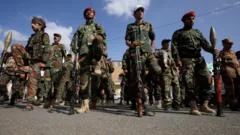
A sliver of barren rock in the middle of the Bab-el-Mandeb strait has become the centre of one of the world's most fragile trade corridors. The Houthis say they have made a major advance in Yemen — and reports state they have taken Perim, the island that sits directly inside the channel ships use to move between the Red Sea and the Gulf of Aden.
If the claim holds, it would place an Iran-backed armed group closer to the physical geography of global shipping than at any point in this conflict. That "if" is doing a great deal of work right now.
What the Houthis Say They Have Taken — and Why Perim Is Different
Perim — also known as Mayun — divides the strait into two channels. Large commercial vessels use the deeper western passage; the eastern channel is too shallow for most of them. An island in that position is not just territory. It is a vantage point over the traffic itself.
The Houthis have not been shy about claiming gains. What makes this claim consequential is the location, not the size of the island.
The Chokepoint Your Weekly Shopping Depends On
Bab-el-Mandeb is roughly 26 kilometres wide at its narrowest. It is the southern gate of the Red Sea, and the Red Sea is the fast lane between Asia and Europe. Container ships, LNG carriers, tankers and bulk vessels carrying grain and fertiliser all pass through it when the route is open.
When that lane is disrupted, the alternative is the Cape of Good Hope — thousands of extra nautical miles, roughly a week or more of added sailing time, and higher fuel, insurance and freight bills that eventually surface in prices.
How the Red Sea Became a Front Line
The Houthis took control of Yemen's capital, Sanaa, in 2014, prompting a Saudi-led coalition intervention in 2015. The war settled into a grinding stalemate, with the group holding much of the country's north and west.
From late 2023, the Houthis began attacking vessels in the Red Sea and Gulf of Aden, saying they were targeting ships linked to Israel over the war in Gaza. The United States and Britain struck Houthi targets in response from early 2024, and a European naval mission was deployed to escort shipping. Much of the world's fleet diverted around Africa instead.
The People Who Feel It First
Yemenis have borne the war's heaviest cost — displacement, destroyed infrastructure, disrupted imports of food and fuel. A tighter Houthi grip on the coast is unlikely to change that arithmetic for them.
Further afield, exporters, port workers, shipping crews and consumers absorb the knock-on effects. Indian cargo moving to Europe, for instance, has faced longer transit times and higher costs since the diversions began. Nobody in that chain gets a vote on what happens at Perim.
A Claim Without Independent Confirmation
This is the part that deserves emphasis: the seizure of Perim has not been independently verified in the material available for this report. No confirmed statement from Yemen's internationally recognised government, the coalition, or maritime security bodies was available either confirming or denying it.
Conflict claims are routinely contested, and both sides have reasons to shape the narrative. Until independent verification emerges — satellite imagery, vessel-tracking anomalies, or a credible on-the-ground account — this should be read as a claim, not an established fact.
What Control of Perim Would Actually Change
Holding an island does not automatically mean closing a strait. The Bab-el-Mandeb is a busy, internationally used waterway, and the Houthis have already demonstrated that they can threaten shipping from the mainland with drones and missiles.
The difference an island makes is proximity and persistence: a fixed presence in the channel, radar and observation over passing traffic, and a harder position to dislodge than a launch site on the coast. That is the strategic logic — and it is precisely the logic that makes verification matter.
Confirmed Facts vs What Remains Unclear
Reasonably established: the Houthis control large parts of northern and western Yemen; Bab-el-Mandeb is a critical global chokepoint; Red Sea shipping has been disrupted since late 2023; naval escorts and sanctions have not restored normal traffic levels.
Unclear: whether Perim has genuinely changed hands, how durable any Houthi presence there would be, what hardware or personnel are involved, and how regional navies and coalition forces intend to respond. Any firm answer to these questions right now is speculation.
Risks and the Other Side of the Story
The obvious risk is escalation: a militarised island in a narrow strait increases the chance of miscalculation between Houthi forces and foreign navies operating nearby. Insurance underwriters tend to price that risk quickly, and higher war-risk premiums are passed to cargo owners.
There is also a counter-argument worth taking seriously. The Houthis have held Yemeni coastline for years without physically blocking the strait, and the group has its own incentives — revenue from shipping, political legitimacy, avoiding a wider war — that cut against a total shutdown. Territory is not the same as capability, and a claim is not the same as control.
A Pattern, Not an Isolated Incident
This fits a broader shift: non-state armed groups are increasingly able to impose costs on global commerce from shorelines they control. The Red Sea has become the clearest laboratory for it, but the same logic applies to the Strait of Hormuz, the Gulf of Guinea and parts of Southeast Asia.
The strategic lesson for importers and governments is uncomfortable — resilience now means planning for chokepoints, not just reacting to them.
What Shippers, Travellers and Investors Should Watch
Watch verification first. Then watch freight rates and war-risk insurance premiums on Red Sea transits, any new naval advisory for the strait, and whether major carriers extend or ease their Cape of Good Hope diversions.
For businesses with Europe–Asia supply chains, this is a moment to re-check buffer stock and contract clauses rather than react to a single headline. For everyone else, the practical signal is simpler: if premiums and diversions move, prices follow months later.
What Could Happen Next
Three paths look plausible. The claim is verified and the Houthis consolidate — raising the threat level in the strait and prompting a firmer naval response. It is partially true, with a light or temporary presence that changes little in practice. Or it is contested and reversed, and the story fades as quickly as it surfaced.
None of these can be confirmed today. The honest position is that the situation is developing and the reporting base is thin.
Our Take
The significance of this story lies less in the island than in the assumption it tests: that the world's most important waterways are effectively policed by states and alliances. Yemen's west coast has shown that assumption to be fragile for two years now.
What is missing is verification. A claim of territorial gain in an active war zone deserves scrutiny before it becomes a headline fact — and reporting that skips that step does nobody any favours, least of all the crews still sailing through the strait.
Frequently Asked Questions
Where is Perim island?
Perim, also called Mayun, lies in the Bab-el-Mandeb strait off Yemen's south-west coast, between the Red Sea and the Gulf of Aden. It splits the strait into a deeper western channel used by large ships and a shallower eastern one.
Who are the Houthis?
The Houthis, formally Ansar Allah, are a Yemeni armed movement that seized Sanaa in 2014 and now controls much of northern and western Yemen. They are widely described as Iran-backed and have attacked shipping in the Red Sea since late 2023.
Why does the Bab-el-Mandeb strait matter so much?
It is the southern entrance to the Red Sea and the shortest sea route between Asia and Europe. Disruption forces ships around the Cape of Good Hope, adding thousands of nautical miles and raising fuel, insurance and freight costs.
Has the Houthi seizure of Perim been confirmed?
No. The seizure is reported, not independently verified in the material available. No confirmation or denial from Yemen's recognised government, the Saudi-led coalition or maritime authorities was accessible at the time of writing.
How could this affect India?
India's trade with Europe moves through this corridor. Since the Red Sea disruptions began, Indian exporters have faced longer transit times and higher freight costs. A further tightening in the strait would likely add to those costs rather than create an immediate shortage.