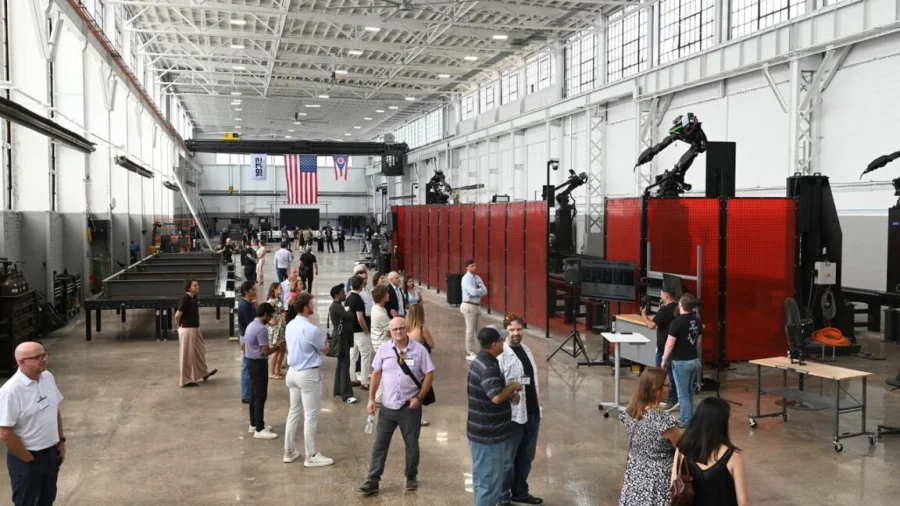
Three engineers who once helped build machines that escape Earth's gravity now want to teach robots to assemble the steel skeletons of tomorrow's infrastructure. Their new company, 1872, opened its doors in Cincinnati on July 22 with a mission that sounds unglamorous by comparison — but could quietly change how America builds data centers, modular housing and next-generation nuclear plants.
Why rocket engineers are suddenly interested in steel skids
1872 is not building rockets. Its first product is a steel skid — a rectangular steel frame that acts as a movable foundation for modular buildings. It sounds simple, but the founders see an outdated industry that still depends heavily on manual welding, cutting and inspection.
The startup wants to use AI-driven software and robots to automate most of that fabrication. The company's stated goal: a prototype factory by 2027 that can run with minimal human involvement.
The Cincinnati launch: July 22 and the Factory One start
1872 officially launched with an inauguration event at Factory One in Cincinnati, Ohio, on July 22. The choice of Cincinnati is notable — the region has deep roots in industrial manufacturing, with access to steel supply chains and a skilled workforce.
Factory One is the company's first facility, but the ambition extends beyond this single site. If the automation model works, it could be replicated in other factories across the country.
Who is paying attention: AI data centers and small nuclear reactors
Two emerging industries are driving early interest. The first is AI data centers. These facilities require large, quickly assembled modular structures — and steel skids are the foundation those structures sit on.
The second is small modular nuclear reactors (SMRs). These compact power plants are being designed as modular units and need robust steel frames. Both industries are growing rapidly, giving 1872 a potential early-mover advantage.
The founders' own words — as far as they go
The team describes their approach directly: "We're building towards autonomy, but we're not necessarily building..." — the sentence is cut off in the original material. The quoted fragment matters, though, because the company is pointedly avoiding the more fashionable phrase "fully autonomous factory."
That small distinction suggests 1872 is being cautious about overpromising, which is typical of founders who have spent years in aerospace where system failures are not an option.
What the source material does not tell us
The available details carry limits. The three engineers' names are not disclosed. There is no information about funding, revenue, or confirmed customers. No timeline has been given for when the first working skid will be ready, only the 2027 prototype target.
Editor's note: We are not treating any unmentioned detail as a fact. All claims below are clearly based on the provided brief.
What former SpaceX experience brings to this factory
SpaceX is known for building rockets in-house with vertically integrated manufacturing. Engineers there are trained to think about reliability, speed, and automation in extreme conditions — exactly the mindset needed to force an old industry like steel fabrication to evolve.
That background also makes them comfortable with long development cycles, which is valuable. A 2027 deadline is roughly three years from now — ambitious but not unrealistic for a prototype.
Why steel fabrication is harder to automate than it looks
Steel cutting and welding involve heat distortion, variable material thickness, and tight safety margins. General-purpose industrial robots have existed for decades, but they often require time-consuming human reprogramming for each new part geometry.
1872's challenge is to make AI-driven software that can read blueprints, plan the welding path, and adjust in real time as the metal shifts. If successful, this could reduce costs and turnaround times significantly in construction-heavy sectors.
The people on the factory floor: concern and opportunity
Any push toward automation creates anxiety about jobs. Steel fabricators and welders are right to ask what this means for employment. The counterargument, for those in the industry, is that skilled welders are already in short supply across the United States.
Automation in this case could fill gaps rather than eliminate entire roles — shifting workers from manual repetitive work to robot supervision, programming, and quality control. But that outcome will depend entirely on how 1872 and similar companies choose to deploy the technology.
Confirmed facts vs. what remains genuinely unclear
Confirmed: Three former SpaceX engineers started the company. It launched July 22. Factory One is in Cincinnati. The initial product is steel skids. The target is a prototype factory by 2027 for AI data centers and small nuclear reactors.
Unclear: Founder names, customer list, funding amount, current size of the team, and whether the prototype will serve both industries from day one.
The bigger pattern: aerospace expertise is leaking into everyday manufacturing
The 1872 story is not isolated. A noticeable number of former rocket engineers are applying aerospace-grade automation to mundane industries — logistics, construction, agriculture. The underlying logic is simple: if you can build a rocket that lands on its own, you can probably rebuild a steel factory.
That skill transfer is accelerating because AI software dropped the cost of machine vision and adaptive control. The steel sector, long resistant to change, is now a ripe target.
What investors and industry watchers should look for next
Watch for three evidence points over the next 12 months: first, whether 1872 produces a functioning steel skid that matches traditional quality and safety standards. Second, whether it attracts a named customer in the data center or nuclear sector. Third, whether it reveals more about its AI software stack to differentiate from existing industrial automation suppliers.
If these milestones appear on schedule, the 2027 prototype date becomes credible. If not, the timeline will almost certainly slip — which is normal in steel, but important to monitor.
Future outlook: one prototype, many possible factories
The company's initial factory in Cincinnati may be its only site at first. But a successful fully automated steel fabrication line would be a template — a product to sell, or a model to franchise across different industrial regions. That is the larger economic prize behind the story: not the skids themselves, but the system that makes them.
For now, the 2027 prototype is the single most important date on 1872's public calendar.
Our take
This is a small story with large implications. The move by three former SpaceX engineers into steel manufacturing reflects a broader reinvention of the industrial economy — where software, automation, and infrastructure converge.
There is no guarantee 1872 will succeed. Steel is demanding, capital-intensive, and every part that fails takes serious consequences. But the company's chosen focus on AI data centers and small modular reactors positions it in two industries that urgently need faster, cheaper, more reliable fabrication. That makes this a story worth following.
Frequently Asked Questions
What is 1872?
1872 is a startup founded by three former SpaceX engineers. It is building an AI-driven robotic factory in Cincinnati, Ohio, to automate the manufacture of steel parts — starting with steel skids used as foundations for modular structures.
What is a steel skid?
A steel skid is a rectangular steel frame that serves as a movable support base for modular buildings. It allows entire structures to be lifted, transported, and placed on prepared sites without needing a custom foundation.
Why are AI data centers and small nuclear reactors mentioned?
Both require modular construction. AI data centers need to be deployed quickly and expanded in stages. Small modular nuclear reactors (SMRs) are being designed as factory-produced modular units. Both need strong steel substructures like skids.
When is the robotic factory expected to be ready?
1872 aims to establish a prototype factory that automates most of its steel fabrication process by 2027. The startup has not yet given a timeline for when its first entirely automated production line will start shipping skids.