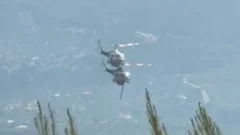
Two people are dead. Two more survived — among them a British pilot — after two firefighting helicopters collided in Greece. The only verified details so far are stark: one Danish and one Greek national were killed, while the British pilot and another Greek crew member came out alive.
A collision in the middle of firefighting duty
The incident involved two helicopters working on firefighting operations in Greece, according to the original report. Both aircraft were airborne when they collided, though the exact circumstances have not been established.
Mid-air collisions are among the gravest risks in aerial firefighting, where aircraft often operate at low altitude and close quarters. That risk is well documented — what exactly happened in this case is not yet known.
The human toll of the crash
Officials identified the two dead as one Danish national and one Greek national. The British pilot who survived, along with another Greek crew member, was part of the same operation — a reminder that every firefighting sortie carries lives beyond the cockpit.
The conditions of the survivors have not been confirmed, and no further identifications have been released.
Why this matters beyond the headlines
Greece depends heavily on aerial firefighting fleets to protect communities, forests and infrastructure, particularly during the summer wildfire season. Every accident involving those aircraft raises the same quiet question: how safe is the firefighting itself?
For the families of the two crew who died, the answer will come too late. For aviation and emergency services, it becomes a matter of procedure, training and accountability.
The gaps still to be filled
Several essential details remain unconfirmed: the precise location of the collision, the time of day, the helicopter models involved, and what caused two firefighting aircraft to intersect. None of this has been independently verified.
At this stage, the verified record is limited to the original account: two dead, one Danish and one Greek; two survivors, one a British pilot.
What typically happens after such incidents
In accidents of this kind, authorities usually open an investigation focused on flight data, cockpit communications, weather conditions and crew coordination. Whether Greek civil aviation officials or the operators' home authorities lead the inquiry has not been confirmed.
Until such a probe produces findings, speculation about causation is exactly that — speculation.
Our Take
This story has been reduced to numbers — two dead, two survivors — but it is really about lives interrupted in an instant. A crew that took off together did not land together.
For now, the most important journalistic obligation is restraint: report what is known, mark what is not, and avoid filling the silence with guesswork.
Frequently Asked Questions
How many people died in the helicopter collision in Greece?
Two crew members were killed when firefighting helicopters collided in Greece — one Danish national and one Greek national, according to the initial report.
Who survived the firefighting helicopter crash in Greece?
A British pilot and another Greek crew member survived the collision. No details about their physical condition have been released.
What caused the two firefighting helicopters to collide?
The cause has not been established. No official investigation findings have been published, and no independent details about the collision are available at this stage.
Were the helicopters fighting wildfires?
Yes — both helicopters were operating in a firefighting role in Greece at the time of the collision, as described in the original story.