
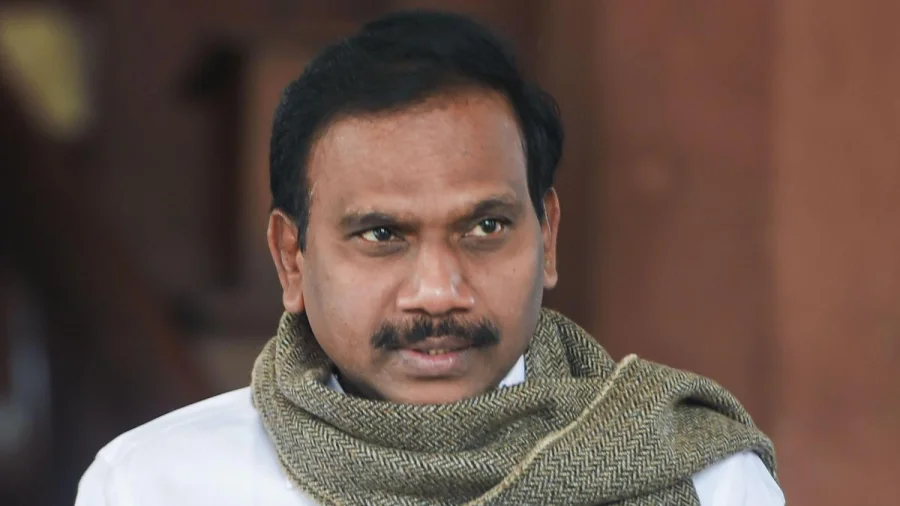
An apology has landed in the middle of one of Tamil Nadu's noisiest political arguments — and it has not quietened the room. DMK MP Raja has expressed regret over remarks aimed at State Minister C.T.R. Nirmal Kumar, a retraction that follows the minister's charge that the DMK had descended into obscene language. The apology closes one line of attack. It does not close the argument.
The Retraction, and the Charge That Forced It
At the centre of the episode is a simple sequence. Remarks were made against Nirmal Kumar. The minister responded by accusing the DMK of resorting to obscene language. Raja then expressed regret.
That order matters. The apology was not spontaneous — it followed a public accusation that shifted the conversation from what one MP said to what a party's standards are.
Why "Language" Is the Real Charge Here
The objection was not to a policy position or a political attack in the ordinary sense. It was about register — the claim that a mainstream party had crossed into language that should not exist in public debate.
In Tamil Nadu's crowded political arena, that is a heavier accusation than it first appears. It invites voters to judge not just a statement but a party's culture.
How the Row Escalated, Step by Step
The publicly reported sequence is short: remarks against the minister, the minister's counter-allegation of obscenity, and then the MP's expression of regret.
What has not been established with certainty is the exact wording used, the setting in which it was said, and whether the exchange happened in the Assembly, at a public event, or online. Those details shape how serious the fallout is — and they remain unconfirmed.
Who Actually Feels This — Beyond the Two Leaders
Rows like this are rarely felt by the two people named in them. They are felt by cadre who repeat the lines, by first-time voters forming impressions of how parties behave, and by women voters in particular, who are often the intended audience of "decency" arguments in Indian politics.
For the TVK, a relatively young force still building its public image, an obscenity charge is a framing opportunity. For the DMK, an old and heavily institutionalised party, it is a discipline question.
Where Each Side Stands
Nirmal Kumar's position, as reported, is that the DMK resorted to obscene language. Raja's position, now, is regret over his own remarks.
Notably, regret is not the same as a party-wide apology, and it is not the same as conceding the broader charge. Raja has walked back his words; he has not, on the available account, accepted that his party has a language problem.
The Political Weight Behind Each Side
The DMK's strength is depth — decades of organisational reach, a firm grip on cadre networks, and a long record in government. That machinery can absorb a controversy and move on.
The TVK's strength is different: it is newer, it speaks to a younger and more online electorate, and it can convert a single viral moment into a much larger narrative. In that asymmetry lies the real contest — an old party's resilience against a new party's agility.
Confirmed, and Not Yet Confirmed
Confirmed: Raja has expressed regret over remarks against Nirmal Kumar. Nirmal Kumar had accused the DMK of obscene language.
Unclear: the exact words at issue, when and where they were said, whether TVK has formally accepted the regret, and whether either party will take internal action. Any claim beyond this point is speculation and should be treated as such.
The Risk of Over-Reading One Apology
There is a temptation to treat every retraction as a turning point. Usually it is not. Apologies in Indian politics are often tactical — designed to close a news cycle rather than settle a dispute.
There is also a risk in the other direction: dismissing the row as noise. Language in politics has real downstream effects on how supporters behave toward opponents, and on how safe public debate feels.
A Pattern That Keeps Repeating
This is not an isolated episode. Across states and parties, "decency" has become a reliable political weapon — deployed by governments against opponents and by opponents against governments, often within the same news cycle.
The result is a debate that is less about the words used and more about who gets to define acceptable speech. That is a bigger fight than any single remark.
What Readers Should Watch For
Ignore clipped videos circulating without context. Wait for the full exchange, if it is released, before forming a view on who said what.
Watch for three signals: a formal statement from Nirmal Kumar or the TVK, any comment from DMK leadership beyond the individual MP, and whether the issue is raised again in the Assembly. Those will indicate whether this is over or only beginning.
Where This Could Go Next
Two paths are plausible. The apology is accepted, the row fades, and both parties return to substantive politics. Or the regret is treated as insufficient, the charge of obscene language is repeated, and the dispute hardens into a standing accusation each side deploys against the other.
Which path unfolds will depend less on the apology itself and more on whether either side sees political gain in prolonging it.
Our Take
The story here is not the apology. It is the willingness of parties to make language itself the battleground — a contest that generates headlines quickly and policy almost never. Raja's retraction is worth noting precisely because it suggests someone calculated that the cost of the words outweighed their benefit. That calculation, made under public pressure, tells us more about Tamil Nadu's political temperature than the remarks ever did.
Frequently Asked Questions
Who is DMK MP Raja?
Raja is a Member of Parliament from the DMK who has now expressed regret over remarks directed at Tamil Nadu Minister C.T.R. Nirmal Kumar. His constituency and the exact forum of the remarks are not confirmed in the available account.
What did Nirmal Kumar accuse the DMK of?
According to the reported exchange, the minister accused the DMK of resorting to obscene language. The remark was a criticism of political conduct rather than of a specific policy.
Has Raja apologised, and has it been accepted?
Raja has expressed regret over his remarks. There is no verified confirmation that Nirmal Kumar or the TVK has formally accepted that regret.
Is the DMK–TVK row over?
Unclear. A retraction can end a controversy or simply pause it. The next indicators will be an official response from the minister or his party, and whether the issue resurfaces in the Assembly.



