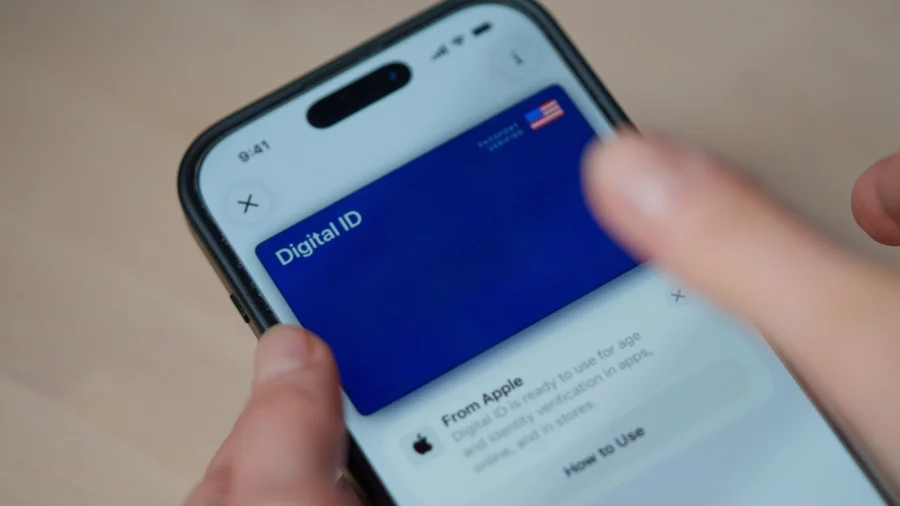
Hand a plastic licence to a traffic officer and you reveal a fixed set of things: your name, your photograph, your date of birth, your address. Hand over an unlocked phone with the same licence on screen, and the officer is no longer holding a card. They are holding your messages, your photographs, your location history and your banking apps — whether anyone looks at them or not.
That gap is the whole story behind digital driver's licences. The card is identical. The container is not.
A Licence Fits in a Wallet. Your Phone Doesn't Fit in a Traffic Stop
Mobile driving licences are now offered or under trial in a number of places, and platforms such as Apple Wallet and Google Wallet have been built to hold them. The pitch is straightforward: no rummaging for a card, fewer lost documents, instant reissue if something goes wrong, and a digital credential that is harder to forge than laminated paper.
None of that is untrue. But it quietly relocates a government-issued document into a privately built consumer device — and that shift is where the safety and privacy questions begin.
The Real Trade: Two Minutes Saved, or a Wider Disclosure?
A digital licence is convenient in the way most digital things are: it removes friction you had stopped noticing. What it adds is a new dependency and a new disclosure surface.
When verification happens on a screen, the person checking you may need to hold your phone, or you may need to hand it over. Where that scene takes place — a traffic stop, a hotel lobby, a bar queue — matters enormously, because the setting shapes how much pressure you feel to comply.
How a Government Document Ended Up Inside a Consumer Wallet
The move from plastic to pixel followed a familiar pattern. Transport agencies began piloting app-based credentials; phone manufacturers built secure storage for them; airports and a handful of venues tested acceptance to see whether the technology held up in queues and under bad lighting.
Adoption has been deliberately slow and uneven. Some places accept a mobile licence for driving checks but not for age-restricted purchases. Others accept it nowhere. That patchwork is itself a privacy issue: rules that are unclear are rules that get tested on ordinary people first.
For Indian readers, one distinction is worth holding on to. A licence held in a government-issued document wallet is a different arrangement from the same licence sitting inside a third-party consumer wallet built by a private company. In the first case the issuer and the holder are the same state. In the second, a private platform sits between you and the authority that issued your ID.
Who Feels the Difference: Daily Commuters, Students, Night-Shift Workers
The people most likely to be asked for ID are also the least likely to want an argument. Students buying alcohol, delivery riders stopped after dark, drivers flagged at a random check, hotel guests checking in late — these are moments where "my licence is on my phone" can turn into "please unlock your phone."
And the strongest reason to think carefully has nothing to do with the licence at all. Modern phones are not ID holders that happen to make calls. They are the most complete record of a person's life that has ever existed in a single object.
What Platforms and Authorities Have Said — and What They Haven't
Platform documentation generally describes wallet credentials as encrypted, tied to the device, and unlocked with a passcode or biometric check before they can be presented. Those are meaningful safeguards, and where they work as described, they are better than a card that can be photographed and copied.
But several questions are not answered by that framing. Can a digital licence be screenshotted, and what happens if it is? What metadata does the wallet generate when a credential is presented, and who can see it? If the credential is backed up, does it travel to a cloud account that sits outside your control?
These are questions, not accusations. They are also exactly the questions a reader should be able to answer before storing an identity document on a device they carry everywhere.
Confirmed Facts vs. Open Questions About Mobile IDs
What can be stated without qualification: mobile licences exist, they are issued by authorities rather than invented by phone makers, and acceptance varies by jurisdiction. What cannot be stated honestly right now is how each platform handles every edge case, because published detail differs between regions and versions.
Transparency note: no verified reporting, official statement or primary source was available for this topic when this piece was written. It is offered as reader guidance, not as a reported news story, and nothing here should be read as an attributed claim by a company or a government body.
Anything beyond that — claims about specific legal protections, specific platform behaviour, specific numbers — should be treated as unconfirmed until you can trace it to an official source.
Why Apple and Google Hold the Gate — and Why That Matters
Wallets are not neutral furniture. They are ecosystems, and the company that stores your identity document becomes the default interface between you and every verifier you meet.
That position is powerful for the same reasons it is useful. Once a licence lives in a wallet, the platform controls the presentation experience, the security model, the update cycle and, in practice, much of the user's understanding of what is being shared. The advantage is real: standardised, tested, hard to counterfeit, instantly revocable.
The concern is structural, not conspiratorial. Convenience at the platform layer tends to concentrate control at the platform layer.
The Case Against Convenience: What Could Realistically Go Wrong
Start with the mundane failures. A dead battery is now an ID failure. A cracked screen, a lost phone, a failed biometric scan at a busy counter — each turns a routine check into a delay.
Then the sharper risks. If a phone is seized or handed over, the licence is not the sensitive part; the rest of the device is. Where a verifier asks you to unlock a screen rather than present a credential through a dedicated interface, the transaction stops being about your licence and becomes a device search.
There is also the counterfeit problem in reverse. A physical card can be examined. A screen can be handed over and returned within seconds. Verification quality depends on the verifier, not the technology.
And there is a quieter concern: the more places a digital ID is accepted, the more data points exist about when, where and how often you presented it.
The Wider Shift: Every Identity Document Is Becoming a Login
Driving licences are not travelling alone. Age verification for online platforms, boarding passes, workplace badges, health records and benefit documents are all moving toward app-based presentation.
The direction of travel is consistent: identity is becoming a credential that lives on a device and is asserted to whoever asks. That makes the licence question a rehearsal for a much larger one about who gets to design identity verification — and who bears the risk when it fails.
What to Do Before You Add Your Licence to a Wallet
Keep the physical card. It remains the most universally accepted form of ID and the simplest fallback. For most people, a digital licence should be an addition, not a replacement.
Read your transport authority's own page, not a blog post or a forwarded message, to confirm what is accepted where you drive or travel. Check whether the credential is stored on the device or synced elsewhere, and turn off cloud backup for that credential if the option exists.
Know your own line in advance. Decide whether you are comfortable handing an unlocked phone to a stranger, and use whatever presentation mode lets you show the credential without surrendering the device. Keep a strong passcode, keep device encryption on, and know how to remotely wipe your phone before you need to.
What Happens Next for Digital IDs
Expect three things. More jurisdictions will offer digital licences because the cost savings and fraud controls are attractive to issuers. Standards bodies will push for "selective disclosure" — the ability to prove you are over 21 without revealing your address — which would be a genuine privacy improvement. And the legal argument over whether an officer may compel you to unlock a phone will keep running, with outcomes differing from one jurisdiction to another.
None of that arrives quickly. In the meantime, the technology will be in your pocket well before the rules catch up with it.
Our Take
Storing your licence in a digital wallet is not reckless. Done properly, it can be more secure than a card that can be photographed and duplicated. The mistake is treating it as a straight swap.
A licence is a narrow disclosure. A phone is the widest one most of us carry. The moment those two things occupy the same unlocked object, the interesting question stops being whether the wallet is secure — and becomes whether the person standing in front of you is asking to see your ID or your device.
Convenience is worth having. It is not worth confusion about which one you agreed to.
Frequently Asked Questions
Is it safe to store a driver's licence in Apple Wallet or Google Wallet?
It can be reasonably safe. Wallet credentials are designed to be encrypted and tied to the device, and they are usually unlocked with a passcode or biometric check before presentation. The main risk is not the credential itself but the context — handing over, or unlocking, the phone that holds it.
Can police ask me to hand over my phone if my licence is digital?
Rules differ by jurisdiction and this remains legally contested in many places. What you can do is prepare: check your local transport authority's guidance on how a digital licence should be presented, and use a presentation mode that shows the credential without passing over the unlocked device.
Does a digital licence replace my physical one?
Not universally. Acceptance varies by country, state and even by venue. In many places the physical card is still required in some situations, so keeping both is the practical choice.
What is the single biggest privacy concern with a mobile ID?
Scope. A licence reveals a limited set of details. An unlocked phone can reveal messages, photographs, contacts and location history. The licence is the reason you were asked; the device is what you actually expose.
Can I remove a digital licence from my wallet later?
In most wallet systems a credential can be removed from the device, though the issuing authority may retain its own records of your digital credential. Check your issuer's policy for what deletion actually removes.