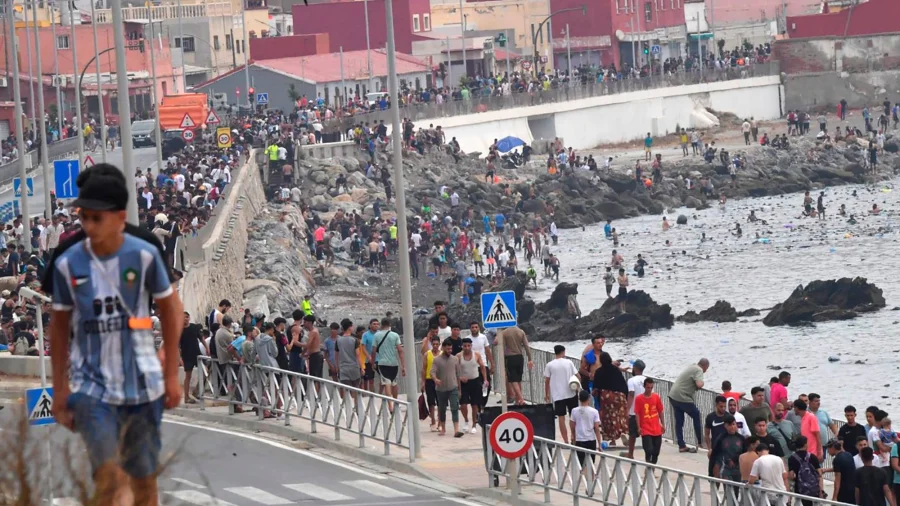
Thousands of people moved through unusually shallow waters toward the Spanish enclave of Ceuta — and the full scale of that movement is only now becoming clear. Spain says 50,000 people entered illegally, about half have already gone back, and 57 others never made it across alive.
Interior vs Ceuta: the exact number is still contested
The Interior Ministry confirmed this Friday that 50,000 people entered Spain illegally since the migration crisis began. Ceuta's president, Juan Jesús Vivas, had earlier given a higher figure of 60,000.
The 10,000-person gap is not minor. It points to how quickly the situation overwhelmed official counting on the ground.
Why this border breach became a national emergency
Ceuta is one of only two European Union land borders with Africa. A mass entry of this scale is both a humanitarian event and a territorial one.
The timing of the returns — with roughly 25,000 reportedly back in Morocco already — is central to how Spain manages the fallout.
A city that woke up on the front line
The crisis unfolded rapidly, with arrivals continuing over successive days. By Friday, the Interior Ministry was issuing updated figures and the political response was shifting into full gear.
These are the numbers as they stand now: 50,000 per Madrid, 60,000 per Ceuta's leader, 25,000 voluntary returns, 57 deaths.
57 deaths: the human cost of swimming across
Officials raised the death toll to 57 migrants who died trying to enter the enclave by swimming. Behind each number is a person, and behind each person, a family searching for information.
The visible scale of the crossers often overshadows those who never reached shore.
Sánchez in Ceuta: "a violation of Spain's territorial integrity"
Prime Minister Pedro Sánchez traveled to Ceuta as the death toll climbed. "What happened yesterday was an attack, a violation of Spain's territorial integrity," he said.
The wording signals how Madrid is framing the event — not as a migration accident, but as a deliberate act requiring a firm state response.
What explains the 10,000-person discrepancy?
Interior and Ceuta's presidency are looking at the same border, yet their totals differ sharply. One likely explanation: local authorities physically saw the scale of the crowds, while Madrid is relying on registrations and recorded crossings.
Until an official reconciliation of figures is published, the true number will remain an open question.
Confirmed facts vs what remains unclear
Confirmed: Interior's official total of 50,000 illegal entries; Vivas's stated figure of 60,000; reports of about 25,000 voluntary returns; Sánchez's trip to Ceuta; the death toll of 57.
Unclear: why the two official totals differ; how many migrants are still inside Spanish territory; whether returns were fully voluntary; and the final death count, which may rise.
All of these are open points, not settled answers.
Humanitarian and political risks on both sides of the border
For Spain, the immediate risk is another surge while the enclave is still stretched. For Morocco, the return of thousands of people creates pressure on its own border regions.
The "voluntary return" framing is also being questioned in some quarters — observers will ask how voluntary a return can be when options on the ground are so limited. Diplomatically, the episode strains relations between Madrid and Rabat.
A familiar test for Spain's African enclaves
Ceuta and Melilla have long functioned as pressure valves for migration toward Europe. This is not a new phenomenon, but the scale of this particular wave marks it as one of the most dramatic in recent history.
The bigger question for Brussels is whether border security and humanitarian protection can be managed together without another tragedy of this magnitude.
For readers: how to follow this story responsibly
Stick to official statements from Spain's Interior Ministry and the Ceuta government. Treat viral videos and unverified screenshots with caution — they often show old or unrelated footage.
Compare the numbers yourself. The gap between 50,000 and 60,000 is itself part of the story.
What happens next
Authorities are expected to continue reporting updated return figures in the coming days. The diplomatic channel with Morocco will likely determine whether the remaining migrants stay, leave voluntarily, or face deportation.
The pace of returns — and the death toll — will be the two indicators to watch. How events unfold from here depends on coordination between Madrid, Rabat, and Brussels.
Our Take
The difference between 50,000 and 60,000 tells you everything about how fast this crisis outpaced the institutions tracking it. But the most important number in this story is 57 — migrants who tried to reach Spanish soil and died in the attempt.
This is not just a border-security problem. It is a human event with diplomatic and political consequences that will be measured for weeks. The returns are a relief for Madrid, but the conditions that pushed people across the water have not disappeared.
Frequently Asked Questions
How many migrants actually entered Ceuta?
Spain's Interior Ministry says 50,000 people entered illegally since the crisis began. Ceuta's president, Juan Jesús Vivas, has given a higher figure of 60,000. The exact total is still disputed.
Why are migrants already returning to Morocco?
Around 25,000 — about half of the Interior Ministry's total — have reportedly returned voluntarily to Morocco. The conditions behind these returns have not been independently confirmed.
What did Pedro Sánchez say about the Ceuta crisis?
Sánchez traveled to Ceuta and described the mass entry as "an attack, a violation of Spain's territorial integrity," according to the original report.
Why has the Ceuta death toll risen to 57?
Officials say 57 migrants have died while trying to enter the enclave by swimming. The number may rise as searches and official counts continue, but this is the latest figure reported.