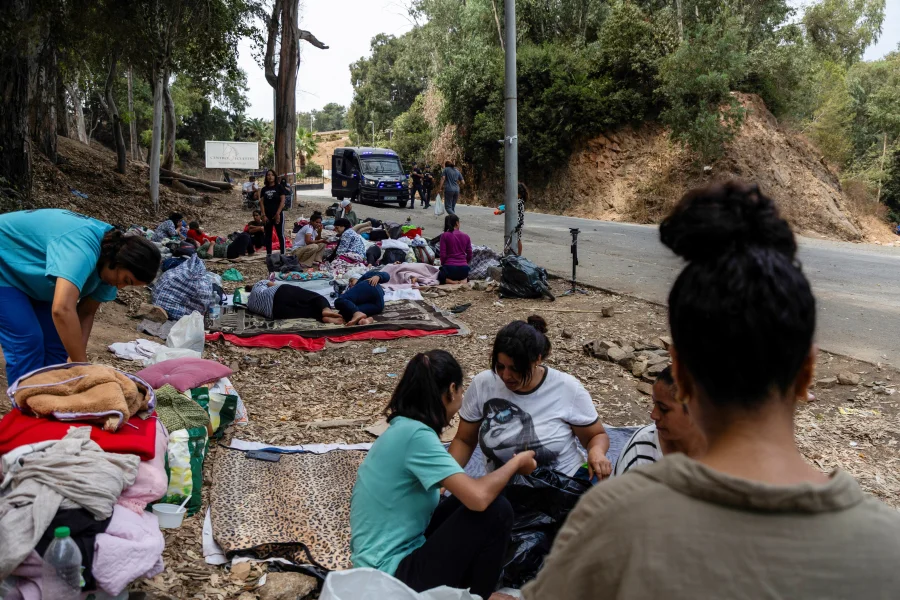
They arrived in Ceuta during the surge of July 30 — and now, hundreds of migrant girls waiting in the Spanish enclave have become the focus of an urgent government plan that could redraw how Spain shares responsibility for unaccompanied minors. Ceuta has just said yes. But the political fight is only beginning.
Ceuta green-lights government plan to move 500 girls
The autonomous city has accepted the Spanish government's proposal to transfer 500 migrant girls to the mainland, describing it as an "extraordinary measure." The decision clears the way for the Ministry of Youth and Childhood to move ahead with what it calls a comprehensive shock plan, coordinated with Ceuta's regional government.
The plan was first reported by Cadena SER. It targets girls who have remained in Ceuta since the mass entry of migrants on July 30 — a border surge that left the enclave's reception system under severe strain.
Why this transfer is more than a relocation exercise
At its core, this is not just about moving 500 people from one patch of Spanish territory to another. The ministry's plan includes a royal decree-law for "binding and supportive" reception by all of Spain's autonomous communities. That language matters: if enacted, it would make the redistribution of migrant minors a legal obligation rather than a voluntary gesture.
That shift has consequences for every region in Spain, not just Ceuta. It also touches on one of the most sensitive debates in Spanish politics — who carries the responsibility for unaccompanied migrant children when arrivals spike at the country's southern border.
From July 30 entry to extraordinary measure: how we got here
The timeline, as reported, is compressed. On July 30, a mass entry of migrants pushed Ceuta's reception infrastructure close to its limits. Among those who crossed or arrived during that surge were hundreds of unaccompanied girls, who have since been waiting in the enclave.
Days later, the Ministry of Youth and Childhood began working on urgent transfers. The proposal was then presented to Ceuta's regional authorities, who have now accepted it — while making clear they view it as an extraordinary response to an extraordinary situation.
Behind the numbers: the girls waiting for an answer
The 500 girls at the heart of this plan are unaccompanied minors, living far from their families in a city that was never equipped for a sudden influx of this scale. For them, the difference between a swift transfer and a delayed one is the difference between proper shelter and an uncertain wait.
Ministry sources said the plan includes family fostering — known in Spain as acogimiento familiar — alongside the binding reception scheme. That suggests some girls could be placed with families on the mainland rather than in institutional centres. But no concrete placement timeline has been confirmed.
What the ministry's shock plan actually includes
According to ministry sources quoted in the original report: "This plan includes the royal decree-law for binding and supportive reception by all autonomous communities or family fostering, but also other formulas that allow reception to be accelerated."
The wording is careful — "binding and supportive" — and it signals two things. First, the government wants a legal mechanism that compels all regions to participate. Second, it wants flexibility, with family fostering and other accelerated formulas positioned as alternatives to institutional care.
The political fault line opening over the transfer plan
The plan has already drawn fire from the opposition. Juan Bravo, the PP's vice-secretary for Finance, Housing and Infrastructure, has questioned the government's approach, arguing that "the best interest of the minor is..." — his full statement was not completely reproduced in the original report, leaving the remainder of his argument unconfirmed.
What is clear is that the PP is framing its criticism around child welfare, not just administrative objections. The phrase "the best interest of the minor" is the same legal principle the government is using to justify the transfer. Both sides are claiming the same moral high ground — which is precisely why this debate could get more heated before it gets resolved.
What is confirmed, and what still hangs in the air
Confirmed: Ceuta has accepted the plan as an extraordinary measure; the transfer involves approximately 500 migrant girls; the plan includes a royal decree-law and family fostering; Cadena SER first reported the development; the PP has raised questions about it.
Not yet confirmed: the exact timeline for the transfers; how many autonomous communities will receive girls and how many each; the full text of Juan Bravo's statement; and whether the royal decree-law will face legal or parliamentary challenges. All of these remain open questions, and this article makes no claim about them beyond what the original story states.
Risks and criticism: the case against moving 500 girls
The plan has supporters and critics, and both have legitimate points. Supporters argue that Ceuta's reception system is overwhelmed and that girls deserve proper accommodation on the mainland. The binding reception mechanism, they say, prevents any single region from being forced to carry the burden alone.
Critics, including elements of the PP, question whether the rush to transfer is in the minors' best interest — raising concerns about family separation, the disruption of moving children again after they have already endured a border crossing, and whether the royal decree-law is being used to bypass proper consultation with the regions. There is also an unverified but widely felt concern in Spanish politics that such plans can become a pull factor for further migration. This article does not take a position on that claim; it simply notes that it is part of the public debate.
A wider test: how Europe handles unaccompanied child migrants
Ceuta is one point on a much larger map. Across Europe, frontline states have repeatedly asked for solidarity mechanisms to redistribute unaccompanied minors within the EU. Spain's attempt to impose a binding reception scheme between its own communities is, in effect, a laboratory for a debate that is playing out at the continental level.
If the royal decree-law works, it could become a template. If it fails — through legal action or regional resistance — it could make future solidarity mechanisms harder to sell. The stakes go beyond these 500 girls.
Practical guidance: how to follow the Ceuta transfer plan
Readers following this story should track official statements from two sources: the Ministry of Youth and Childhood and the Ceuta regional government. The ministry's announcements will carry the legal details of the royal decree-law and the reception formulas. Ceuta's statements will reveal how the transfer is being executed on the ground.
For families in Spain interested in fostering — the plan explicitly includes acogimiento familiar — the relevant starting point is the official child protection department of your autonomous community. Any application process will follow regional rules, and this article does not imply otherwise. For journalists and researchers, the Cadena SER report remains the primary published source identified so far.
Where the Ceuta plan goes from here
The next phase depends on the royal decree-law. If approved and enacted, it would compel all Spanish regions to participate in the reception of migrant minors, creating a binding framework that did not exist before. If challenged — and decree-laws have been challenged before — the transfers could face legal delay.
What is foreseeable is that the 500 girls will not stay in Ceuta indefinitely. The question is not whether they will be moved, but how quickly, under what legal framework, and into what kind of care. All of that remains genuinely unresolved.
Our Take
This is a story about a number — 500 — that represents a far larger question. Spain is trying to solve a humanitarian emergency in one city with a legal mechanism that binds the entire country. That is bold, and it is also politically risky. The use of "extraordinary measure" language on both sides suggests that even the participants know this is not a normal process.
The strongest part of the plan is also its most fragile: family fostering. Moving children out of crowded reception centres and into families is widely considered the better outcome for minors — but it depends on the willingness of families to step forward and on regional systems to process them quickly. The royal decree-law can compel regions to participate; it cannot compel a family's heart. That is the honest limit of what any government plan can achieve.
Frequently Asked Questions
Why is Spain transferring 500 migrant girls from Ceuta to the mainland?
Spain is transferring approximately 500 unaccompanied migrant girls from Ceuta to the mainland because the enclave's reception system has been under severe strain since the mass entry of migrants on July 30. The Ministry of Youth and Childhood describes the transfer as an urgent measure within a broader shock plan to provide proper shelter and care for the minors.
What is the "extraordinary measure" that Ceuta has accepted?
Ceuta has accepted the Spanish government's proposal to relocate 500 migrant girls to the Peninsula, calling it an "extraordinary measure." The plan includes a royal decree-law for binding and supportive reception by all autonomous communities, family fostering, and other formulas to accelerate the reception process.
What does the royal decree-law for binding reception mean for Spain's regions?
If enacted, the royal decree-law would legally oblige all of Spain's autonomous communities to participate in receiving migrant minors, rather than leaving it to voluntary cooperation. This would create a mandatory solidarity mechanism across the country, which is a significant change from the current system.
Who reported the Ceuta migrant girls transfer plan first?
The plan was first advanced by Cadena SER, a Spanish radio network. The Ministry of Youth and Childhood subsequently confirmed the details, and the PP's Juan Bravo has publicly questioned the plan, though his full statement was not completely reproduced in the original report.