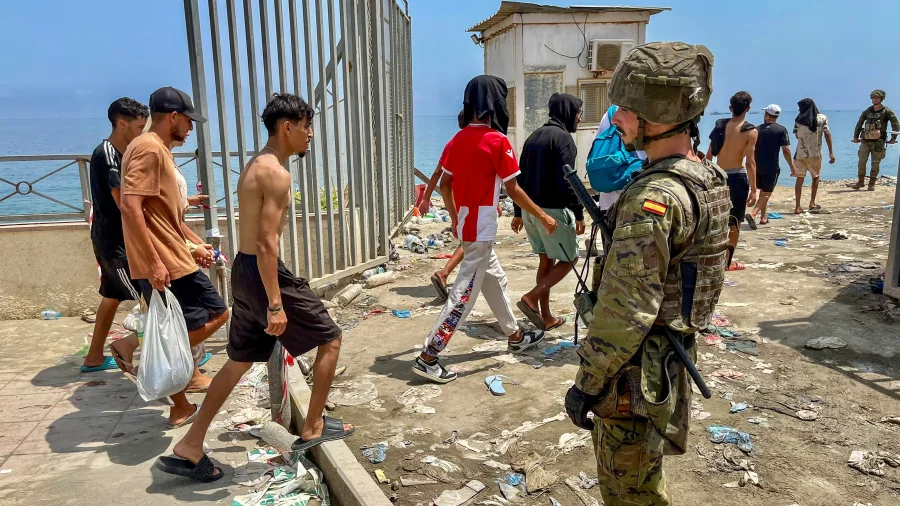
It took a surge of people on Africa's northern edge to shake one of Europe's most guarded freedoms. Thousands have entered the Spanish enclave of Ceuta from Morocco in recent days — and on Friday, Italy announced it is temporarily pulling back from the Schengen open-border pact with Spain.
Italy's Friday decision: border checks return at Spanish ports and airports
Italy has ordered the reintroduction of border controls at ports and airports on routes with Spain, according to official sources cited in the report. The decision is a direct response to the Ceuta migration crisis, which has seen thousands of people arrive from Morocco.
The move amounts to a temporary suspension of the Schengen treaty's free-circulation rules inside the European Union — one of the bloc's most symbolic commitments.
Rome's clarification: random checks, and only for non-Europeans
Shortly after the announcement, Italian authorities refined the picture. The controls, Rome said, will be random and will apply only to citizens from outside Europe — not to EU nationals.
The clarification narrows the practical impact of a decision that initially read as a sweeping border closure between two Schengen members.
The numbers dispute: Madrid says 50,000, Ceuta's leader says 60,000
Spain's Interior Ministry — the department of Interior Minister Fernando Grande-Marlaska named in the original report — has said 50,000 people entered Spain illegally since the crisis began.
But the president of the autonomous city of Ceuta, Juan Jesús Vivas, has given a substantially higher estimate: 60,000. The gap between the two figures shows how difficult it has been to count an arrival of this scale in real time.
Why Ceuta sits at the centre of Europe's border stress
Ceuta is a Spanish autonomous city on Morocco's northern coast, physically located on the African continent. Its land border with Morocco makes it one of the EU's most exposed frontiers — and the first point of contact for migrants when border pressure builds.
The crisis has turned a local border emergency into a European diplomatic test, with consequences now reaching as far as Italy.
Who is most affected: travellers, migrants and border towns
For ordinary travellers, the practical effect depends on nationality. European citizens crossing between Spain and Italy should see little change under the clarified rules. Non-European travellers — including visitors, residents and transit passengers — now face the possibility of random checks at ports and airports.
For the migrants who arrived in Ceuta, the bigger question is what happens next: how many remain, how Spain responds, and whether other EU states follow Italy's lead.
Madrid's official response so far
Spain's Interior Ministry has been the central source of official numbers during the crisis. While it has confirmed the scale of illegal entries, authorities have not yet explained the discrepancy with the figure given by Ceuta's president.
Italy, for its part, framed its measure as a precaution tied to the situation in Ceuta — then moved quickly to clarify its limits.
What is confirmed, and what still is not
Confirmed: Italy reintroduced border controls with Spain on Friday. Rome says checks will be random and limited to non-European citizens. Spain's Interior Ministry reports 50,000 illegal entries; Ceuta's president says 60,000.
Not yet clear: how long the Italian controls will remain in place, whether other Schengen states will follow, and which count — 50,000 or 60,000 — is more accurate. No official explanation has yet reconciled the two figures.
Concerns and criticism: a fragile European principle
The Schengen treaty was built on a simple promise: once inside, people can move freely across member states. Every temporary suspension chips at that promise.
The concern with Italy's decision is precedent. Even with the non-European clarification, the move signals how quickly a migration event in one corner of the EU can redraw borders elsewhere.
A wider test for Europe's open-border experiment
The Ceuta crisis is the latest stress point for Schengen, which has seen temporary internal border checks return across the bloc during security alerts and the pandemic. Italy's response fits a broader pattern: member states reaching for national controls when the EU's external frontier feels fragile.
The question is whether the system's flexibility becomes its weakness — or its way of absorbing political pressure without breaking apart.
What travellers and residents should do now
If you are travelling between Spain and Italy, carry valid identification even if you are an EU citizen — random checks mean documents can be requested at any time.
If you are a non-European traveller, expect the possibility of additional scrutiny at ports and airports. And for those following the story, treat both migrant-entry figures with caution until officials provide a reconciled total.
What happens next
Spain's priority is stabilising Ceuta and managing the people who arrived. Italy will watch whether the crisis escalates or eases — and whether its temporary controls need to be extended.
Brussels may also weigh in. Any Schengen suspension is meant to be temporary and proportionate, and Italy's clarification appears designed to keep the measure within those limits.
Our Take
This is not just a story about one border. It is a story about how quickly Europe's internal freedoms bend under external pressure. Italy's move — and its quick clarification — shows a continent trying to balance security concerns with the principles that define it.
The 50,000-versus-60,000 gap matters too: when two official figures differ so widely, better counting isn't a technicality; it is the foundation of a credible response. Watch what Madrid does next — and whether other capitals follow Rome.
Frequently Asked Questions
Why did Italy reinstate border controls with Spain?
Italy reintroduced controls at ports and airports with Spain on Friday, citing the migration crisis in Ceuta, where thousands of people have arrived from Morocco. The measure temporarily suspends Schengen free movement.
Will the Italian border checks affect all travellers?
No. Rome clarified that the controls will be random and will apply only to non-European citizens. European Union nationals travelling between Spain and Italy are not the target of the checks.
How many people entered Spain illegally in the Ceuta crisis?
Spain's Interior Ministry says 50,000. The president of Ceuta, Juan Jesús Vivas, has put the figure at 60,000. The two numbers have not yet been reconciled officially.
What is the Schengen treaty?
Schengen is the agreement that allows free movement across most EU member states without internal border checks. When a member state reintroduces controls, as Italy has done, it is a temporary suspension of that principle.