
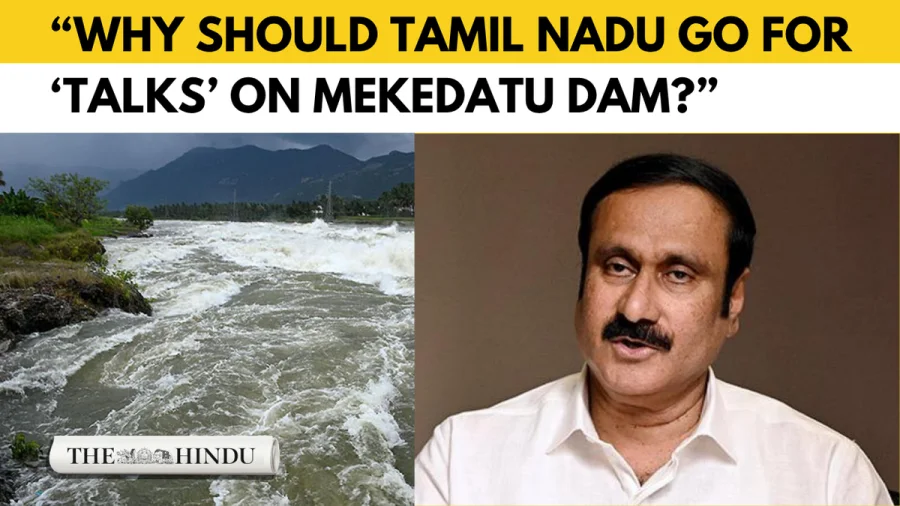
The simmering Cauvery water dispute has taken a fresh political turn. PMK leader Anbumani Ramadoss on Thursday publicly cautioned Tamil Nadu Chief Minister Vijay against holding bilateral talks with Karnataka over the controversial Mekedatu dam project. Instead, he argued for an all-party meeting within Tamil Nadu to forge a unanimous stance before any engagement with the neighbouring state.
What Anbumani Ramadoss said about the Mekedatu talks
Speaking to reporters, the former Union minister made his position clear: “Vijay should avoid going to Karnataka for talks on the Mekedatu dam.” He insisted that any negotiation should follow a unanimous decision taken in an all-party meeting in Tamil Nadu. “That decision should be carried forward,” he added, signalling distrust of a bilateral format where Karnataka could have the advantage.
Why this matters for the Cauvery water conflict
The Mekedatu dam project has been a flashpoint between Tamil Nadu and Karnataka for years. Karnataka wants to build a balancing reservoir across the Cauvery at Mekedatu, which Tamil Nadu fears will reduce its share of water and affect farming communities in the delta region. Tamil Nadu has consistently opposed the project in the Supreme Court and in the Cauvery Water Management Authority. Any direct talk carries high political and legal stakes.
Who is affected by the Mekedatu dam dispute
Millions of farmers in the Cauvery delta districts of Tamil Nadu depend on a predictable water release. In Karnataka, farmers in Mandya and surrounding areas also rely on the river. The dispute has triggered protests and bandhs on both sides in the past. A bilateral talk between chief ministers, without a pre-agreed Tamil Nadu position, could be seen as a political risk in an election-sensitive state.
Official response and political reactions
Neither the Tamil Nadu Chief Minister’s Office nor the ruling DMK has formally responded to Anbumani’s statement at the time of writing. Anbumani’s PMK is part of the opposition alliance in the state, and his remark reflects a broader caution among some political quarters that bilateral talks may weaken Tamil Nadu’s bargaining power. Karnataka’s government has not commented on Anbumani’s suggestion.
What remains unclear about the proposed talks
It is not yet confirmed whether Tamil Nadu CM Vijay had actually planned a visit to Karnataka for talks. No official announcement has been made from either state. Anbumani’s comment appears to be pre-emptive, based on speculation or internal signals. Whether the all-party meeting idea will gain traction within the ruling dispensation is uncertain.
Balanced view: concerns on both sides
Proponents of bilateral talks argue that face-to-face dialogue between chief ministers can break deadlocks and reduce legal costs. Critics, like Anbumani, counter that such talks often favour the state that controls the upstream, and that Tamil Nadu should only negotiate from a unified political position. The Cauvery Water Management Authority provides a legal framework, but political resolution remains elusive.
Wider pattern in Cauvery water politics
The Mekedatu dispute fits a recurring pattern: Tamil Nadu opposing any new structure on the Cauvery, while Karnataka pushing for storage to meet its own growing urban and irrigation needs. Interstate water disputes in India rarely get resolved through bilateral talks — they often require Supreme Court intervention or central mediation. The current statement adds another layer of political caution ahead of any such dialogue.
What should follow next
If the Tamil Nadu government decides to follow Anbumani’s advice, it would call an all-party meeting and draft a common resolution. That resolution could then be presented to the central government or directly to Karnataka in formal negotiation. For now, the ball is in Chief Minister Vijay’s court — whether to pursue direct conversation or consolidate internal opinion first.
Future outlook for the Mekedatu dam issue
The legal case on Mekedatu is pending before the Supreme Court. Any political decision may influence the timeline of the project. If Tamil Nadu adopts a harder stance, it could delay clearance further. Karnataka, on the other hand, may accelerate construction on the basis of its own clearances. Bilateral discussions, if held, could either ease tensions or escalate them — depending on the political climate in both states.
Our Take
Anbumani Ramadoss’s intervention reflects a deep-seated distrust in Tamil Nadu’s political class about one-on-one talks with Karnataka on water sharing. The suggestion to hold an all-party meeting is not new — it has been used in the past to build consensus before approaching the Supreme Court. However, the real question is whether Chief Minister Vijay is considering bilateral talks at all. Until that is confirmed, this remains a political caution rather than a concrete development. The Cauvery water conflict needs more than political posturing; it requires legal certainty and a sensitive understanding of the drought-prone region’s needs.
Frequently Asked Questions
What did Anbumani Ramadoss say about the Mekedatu dam talks?
He advised Tamil Nadu CM Vijay to avoid bilateral talks with Karnataka and instead hold an all-party meeting first to build a unanimous state position.
Why does Tamil Nadu oppose the Mekedatu dam project?
Mekedatu is a proposed balancing reservoir across the Cauvery in Karnataka. Tamil Nadu fears it will reduce the water flow available to its farmers, especially during dry seasons, and affect the Cauvery delta's agriculture.
Is Anbumani Ramadoss part of the ruling government in Tamil Nadu?
No, the PMK is an ally of the AIADMK-led opposition alliance in Tamil Nadu. His statement reflects a critical view of the ruling DMK government's approach to water issues.
What happens next in the Mekedatu dispute?
The matter is in the Supreme Court. Political talks, if any, could influence the legal outcome. For now, no bilateral meeting is confirmed, and Anbumani’s suggestion may push the state government to consolidate internal opinion first.



