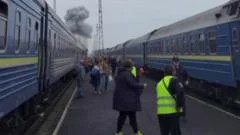
They had already left. That is the detail Boris Johnson wants people to sit with. The former UK prime minister says he and a group of senior European officials had just departed a station when a Russian strike hit a stationary Ukrainian locomotive near the Polish border — close enough in time that the two events now share a single sentence.
As Johnson tells it, the gap was minutes. That raises questions far bigger than one damaged train: how exposed are high-level visits to western Ukraine, what does a strike landing minutes behind a diplomatic delegation signal, and why a stationary locomotive at all?
A Departure, a Strike, and a Question of Timing
The account comes from Johnson himself. He described the target as "a stationary Ukrainian locomotive on the Polish border" and said the strike occurred "this morning," shortly after he and other European officials had left the station.
He did not say how many people were hurt, what weapon was used, or which other officials were present. None of those details have been independently confirmed in the material available at the time of writing.
Why Minutes Matter in a War That Runs on Railways
Ukraine's rail network has been central to the war effort since 2022 — moving troops, weapons, aid and civilians across a country whose airspace remains contested. Western stations, far from the front line, have served as both lifelines and diplomatic staging points.
A strike landing minutes after a VIP visit is not automatically an attack on that visit. But it collapses two things normally kept apart: the battlefield, and the carefully managed optics of a wartime photo opportunity.
How the Morning Reportedly Unfolded
Based strictly on Johnson's version of events, the timeline runs in three steps. Officials gather at a station near Ukraine's western frontier. The delegation departs. A stationary locomotive is struck.
What is missing is almost everything a newsroom would normally verify first — the exact location, whether the strike occurred on Ukrainian or Polish soil, the type of munition used, and the number of casualties.
The People Standing Behind the Headline
Beyond the diplomats, the people most directly exposed to a strike like this are railway workers, station staff and passengers — crews who keep trains moving through a war zone with no guarantee that any platform is safe.
Western Ukraine has long been treated as the safer half of the country. Repeated strikes on rail and energy infrastructure have steadily worn that assumption down, and incidents near the Polish border carry a second layer of risk because of how close they land to NATO territory.
What Johnson Said — and What He Left Unsaid
Johnson's language was pointed. He named Vladimir Putin directly, saying: "I don't know what warped logic drove Putin to blow up a stationary Ukrainian locomotive on the Polish border this morning."
Notably, he did not claim the delegation was the target. He did not report casualties. And he did not accuse Moscow of deliberately timing the strike around the visit. Whether that restraint reflects genuine uncertainty or diplomatic caution is not clear.
The "Polish Border" Detail Deserves Careful Reading
"On the Polish border" is not the same as "in Poland." The phrase could describe a location on the Ukrainian side of the frontier — or a strike close enough to the boundary that the distinction becomes diplomatically loaded.
If a munition crossed into Polish territory, the legal and strategic consequences would be very different from a strike on Ukrainian soil. No such confirmation has been provided, and it should not be assumed.
Confirmed Facts vs What Remains Unclear
Confirmed: Johnson publicly described a Russian strike on a stationary Ukrainian locomotive near the Polish border, said it happened that morning, and said it came shortly after he and other European officials left the station.
Unclear: the precise location; the weapon used; the casualty count; whether the locomotive was the train the delegation had travelled on; and whether the timing was deliberate. Anything beyond Johnson's account is, at this stage, speculation and should be labelled as such.
The Case for Caution — and the Case Against It
One reading is that this was a routine strike on rail infrastructure that happened to fall near a diplomatic visit — grim coincidence rather than a message meant for anyone.
The other reading is that Russia has repeatedly hit Ukraine's transport network, and that a strike this close to a visiting delegation is itself a signal, whether or not the delegation was the objective. Both readings are plausible on the available evidence. Neither has been proven.
A Pattern Worth Watching, Not Assuming
High-profile visits to Ukraine have become a routine feature of the war's diplomacy, and rail remains one of its most contested assets. Strikes near Ukraine's western borders have periodically triggered alarm in Warsaw and Brussels.
What is new here is the tightness of the gap between departure and detonation. If similar incidents recur, the question of how allied officials travel to and from western Ukraine — and what they are told about the risk — moves from the margins to the centre of the conversation.
What Readers Should Do With This Story
Treat the sequence as reported, not established. Johnson's account is a first-person claim from a senior figure, but it is not a substitute for confirmation from Ukrainian or Polish authorities.
Before sharing, check whether a location or casualty figure has been verified by an official source. Strikes in this region generate fast-moving and frequently inaccurate claims, and early numbers often turn out wrong.
What Could Happen Next
Expect Ukrainian officials to publish their own account of the