
Summary
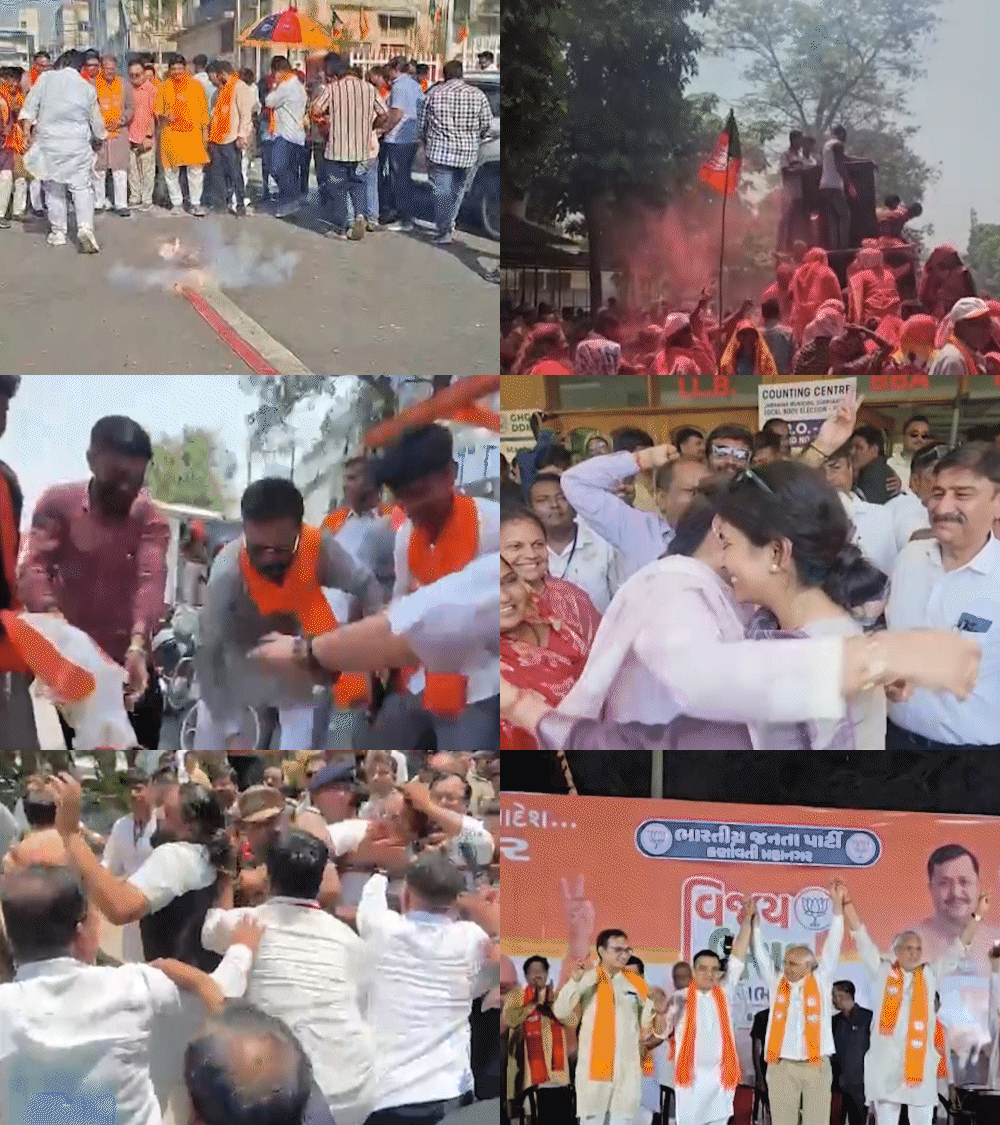
The Bharatiya Janata Party (BJP) has achieved a massive victory in the Gujarat local body elections. The party won all 15 Municipal Corporations, including six established ones and nine newly formed ones. Despite concerns about internal changes and local protests, the BJP maintained its strong grip on urban areas. The opposition parties, Congress and the Aam Aadmi Party (AAP), failed to put up a strong fight in most cities.
Main Impact
This election result confirms that the BJP remains the dominant force in Gujarat’s cities. The party decided to drop many veteran leaders and give tickets to new faces, a move that many thought would lead to a loss. However, the voters chose to stay with the ruling party. The biggest impact is the total control the BJP now holds over the local government in every major urban center in the state. This victory gives the party a clear path to implement its urban policies without much opposition.
Key Details
What Happened
The elections were held for 15 Municipal Corporations across Gujarat. This was a unique election because it included nine brand-new corporations that were recently created. Before the results, there were many rumors that the BJP might lose seats because of high summer heat and low voter turnout. There was also talk of anger in certain housing societies. However, when the votes were counted on the 28th, the BJP emerged as the winner in every single corporation. The Congress party tried a new strategy by picking what they called "racehorses" or strong candidates, but most of them failed to win their races.
Important Numbers and Facts
The voter turnout across the 15 corporations averaged around 55 percent. This was lower than expected, as over 4.9 million registered voters did not show up to cast their ballots. Vapi recorded the highest turnout at 72.29 percent, which is significant because this was its first election as a Municipal Corporation. On the other hand, Gandhidham saw the lowest participation, with only 46.03 percent of voters turning up. In terms of party performance, the Congress could not even reach double-digit seat counts in 11 out of the 15 corporations. The Aam Aadmi Party, which had 27 seats in Surat after the 2021 elections, saw its count drop to just 4 seats this time.
Background and Context
These elections were very important because they followed new rules regarding reservations. The state government had introduced a 27 percent reservation for Other Backward Classes (OBC) in local bodies. Additionally, a process called Special Intensive Revision (SIR) was used to update the voter lists. Many experts believed these changes would change the final results. For the last 20 to 30 years, the BJP has ruled the major cities of Gujarat. This election was a test to see if the opposition could break that streak, especially with the rise of the Aam Aadmi Party in recent years. The creation of nine new corporations also meant that more people were living under city-style governance for the first time.
Public or Industry Reaction
While the BJP won overall, there were some surprising local results. In Ahmedabad, the BJP lost in the Khadia ward, which has traditionally been one of its strongest areas. All four BJP candidates lost there to the Congress. This shows that even in a big victory, local issues can still cause a party to lose specific spots. The reaction from the Aam Aadmi Party was one of disappointment. Their top leaders in Surat, who were expected to win easily, lost their seats. Political experts say that the "AAP wave" seen in 2021 has faded significantly. On the other hand, BJP supporters celebrated across the state, seeing this as a sign of trust in their leadership.
What This Means Going Forward
The BJP now has a total mandate to run Gujarat’s cities. This means they can move forward with large infrastructure projects and new tax rules with very little pushback in the city councils. For the Congress, the road ahead looks difficult. Even with direct advice from national leaders like Rahul Gandhi, the party struggled to connect with urban voters. They will need to find a new way to talk to city dwellers if they want to remain relevant. The Aam Aadmi Party will also have to rethink its plans for Gujarat, as its influence seems to be shrinking back to only a few small pockets. The low voter turnout is also a concern for the future, as it shows that nearly half of the city population is not interested in local government elections.
Final Take
The Gujarat Municipal Corporation election results show a clear preference for the status quo in urban areas. The BJP’s ability to win even after changing its candidates shows the strength of its organization. While the opposition had hoped to use local complaints to win seats, the final numbers show that the majority of voters still trust the ruling party to manage their cities. The loss in Khadia serves as a small reminder that local problems still matter, but it was not enough to change the overall picture of a total BJP sweep.
Frequently Asked Questions
Which party won the Gujarat Municipal Corporation elections?
The Bharatiya Janata Party (BJP) won all 15 Municipal Corporations that went to the polls, including both old and newly formed cities.
How did the Aam Aadmi Party (AAP) perform in Surat?
The AAP performed poorly compared to the last election. Their seat count in Surat dropped from 27 seats in 2021 to only 4 seats in this election.
Which city had the highest and lowest voter turnout?
Vapi had the highest voter turnout at 72.29 percent, while Gandhidham had the lowest turnout at 46.03 percent.



