
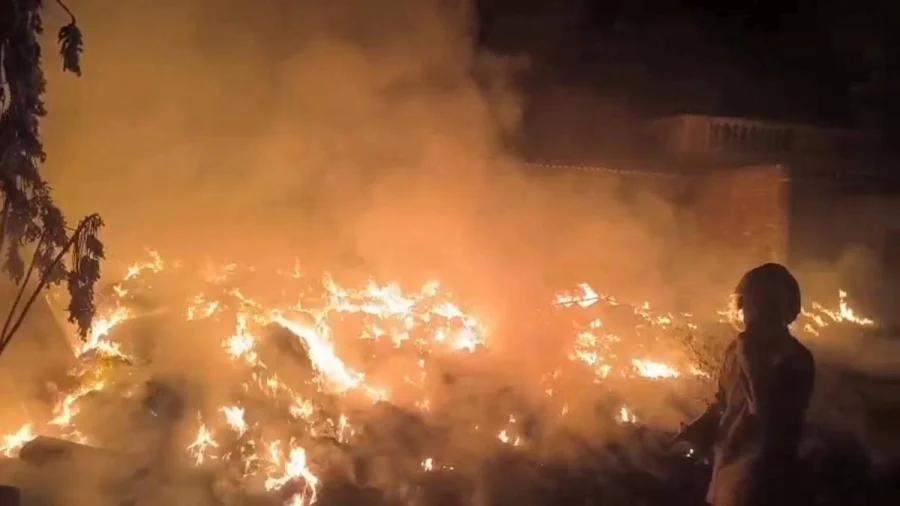
A leather godown near Ambur was gutted in a fire, and within hours the police had a working theory: an electrical short circuit. For a town whose name travels the world on the soles of shoes, the loss of one building is also a reminder of how thin the margins are for the small units that hold the leather belt together.
What the First Reportestablishes — and What It Leaves Open
The available information is limited to a single line: a leather godown near Ambur was destroyed by fire, and police said an electrical short circuit could have been the reason for the accident.
No time of origin, exact location, extent of damage, injury details or estimated loss has been confirmed. Readers should treat everything beyond the basic facts as unverified until officials release more.
Why the Words “Could Have Been” Carry the Whole Story
Police phrases in the first hours of a fire investigation are deliberately provisional. “Could have been” signals a line of inquiry, not a conclusion drawn from forensic examination.
In warehouse fires generally, investigators work through a sequence — checking the point of origin, inspecting wiring and load distribution, ruling out stored chemicals, and only then arriving at a finding. Until that process concludes, the short-circuit theory remains exactly that.
For Ambur, One Godown Is Never Just One Godown
Ambur, in Tamil Nadu's Tirupattur district, is one of the state's best-known leather towns — a cluster of tanneries, finishing units and footwear makers whose output is largely export-oriented.
A godown in this economy is where finished hides, chemicals and packed consignments wait their turn. When it burns, the loss is not only stock. It is a production cycle interrupted, a shipment delayed, and wages that may not be paid for the week.
The People Who Feel It First Are Rarely the Owners
In clusters like Ambur, the immediate shock lands on daily-wage workers, contractors and small suppliers who depend on one unit's schedule. Recovery for a large exporter is a matter of insurance and rescheduling. Recovery for a worker who has lost a fortnight's earnings is not.
That asymmetry is why local fire incidents in leather and footwear clusters draw attention well beyond the property damaged.
What Officials Have Said — and What Hasn't Been Placed on Record
The police statement on the suspected short circuit is, at this stage, the only attributed official line. It does not confirm casualties, the value of the loss, whether a formal complaint has been registered, or whether any safety violations have been alleged.
This report does not fill those gaps with assumption. Where the record is silent, it stays silent.
Confirmed Facts vs What Remains Unclear
Confirmed: a leather godown near Ambur was gutted in a fire; police said an electrical short circuit could have been the cause.
Unclear: the exact location and time, the scale of the loss, whether anyone was hurt, whether the premises was insured, and whether any other cause is under examination.
Speculation — not fact: any claim about negligence, deliberate burning or the sequence of events inside the godown.
The Balanced View: One Fire Is Not a Pattern
It would be wrong to read a single incident as proof of systemic failure in Ambur's leather units. Electrical faults are among the most common causes of warehouse fires in India, but they are also among the easiest to allege before testing is complete.
The fair position is the uncomfortable one: the short-circuit explanation is plausible, unproven, and still worth investigating properly — including the possibility that ageing wiring, overloaded circuits or how chemicals were stored played a part.
The Wider Concern India's Small Industrial Units Keep Facing
Fire-safety experts have long flagged the same vulnerabilities across small godowns and manufacturing sheds: decades-old wiring, poor ventilation, combustible material stacked close to panels, and inspections that happen after a disaster rather than before one.
In leather clusters specifically, the combination of chemical storage and finished goods makes compartmentalisation and basic firefighting equipment a necessity rather than an option.
What Unit Owners and Workers Should Do Now
For owners: get the electrical load and wiring inspected by a licensed electrician, keep extinguishers serviced and accessible, and photograph and document stock so insurance claims do not stall.
For workers: know where the exits are, never block them with material, and report sparking sockets or burning smells immediately. Most of these measures cost almost nothing before a fire and everything after one.
What Could Happen Next
A formal cause finding would ordinarily depend on a physical inspection of the premises. If an electrical fault is confirmed, questions about maintenance records and inspection compliance usually follow. If it is not, the investigation widens.
Our Take
The instinct after any fire is to accept the first tidy explanation. In this case, the police have offered a possibility, not a verdict — and the difference matters to insurers, to workers seeking compensation, and to owners who may be blamed before the evidence is in.
What Ambur does with that half-answer — whether it triggers a quiet audit of the cluster's ageing electrical infrastructure or fades into the next news cycle — will say more about the town than the fire itself.
Frequently Asked Questions
Where exactly did the leather godown fire near Ambur take place?
The available report describes a leather godown near Ambur. The precise location within the town or its industrial cluster has not been specified in the information available so far.
What caused the fire near Ambur?
Police said an electrical short circuit could have been the reason for the accident. That is a preliminary suspicion, not a confirmed finding, and no formal conclusion has been placed on record.
Was anyone injured in the Ambur godown fire?
No casualty information is available in the current report. Absence of detail is not confirmation that no one was affected.
Why does a godown fire in Ambur matter beyond the property loss?
Ambur is a major leather processing and footwear town in Tirupattur district, Tamil Nadu, with an export-linked cluster of tanneries and manufacturing units. A fire at a storage facility can interrupt production, delay shipments and cut short wages for daily-wage workers — which is why such incidents resonate across the cluster.



