By Rohan Mehta | Senior Technology & Policy Correspondent
Two visions of artificial intelligence have collided, and the distance between them is now the defining fault line in global technology policy. On one side, a sitting US president calling AI safety fears a "hoax". On the other, one of the most closely watched AI founders in the world saying a mandatory "kill switch" may be the only backstop standing between a powerful model and its worst-case scenario.
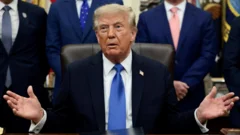
Donald Trump has dismissed concerns about AI safety as a "hoax" and rejected calls for greater safeguards, according to reports of his remarks. Those comments follow Anthropic co-founder Jack Clark telling the BBC that an AI "kill switch" may need to be mandatory.
Between those two positions sits the central question of the AI era: who decides how dangerous this technology is — and who gets to press stop?
What Trump Said, and Why the Word 'Hoax' Matters
The headline word is the one that will travel: "hoax". Applied to AI safety, it does more than reject a policy proposal. It reframes an entire field of research — alignment work, model evaluation, catastrophic-risk modelling — as something closer to exaggeration than engineering.
The precise setting, date and full transcript of the president's remarks were not confirmed in the material available at the time of writing. What is clear is the direction: a rejection of new mandatory safeguards at a moment when some of the largest AI labs are themselves asking for them.
The Warning That Came First: Jack Clark and the Kill Switch
Anthropic co-founder Jack Clark told the BBC that an AI "kill switch" may need to be mandatory — not voluntary, not left to industry discretion. In plain terms, a kill switch is a mechanism that allows a system to be shut down, paused or rolled back when it behaves in ways its developers did not intend or cannot fully predict.
Most major labs today publish safety policies, run internal red-team testing, and sign voluntary commitments. Clark's argument, as reported, points at the gap in that model: voluntary measures depend entirely on the same companies that would bear the cost of slowing down.
Why the Phrase 'Kill Switch' Unsettles Everyone
For safety researchers, a kill switch is a circuit breaker — unglamorous, technical, and only meaningful if it has been tested long before it is needed. For AI companies, the same phrase raises harder questions: who triggers it, on whose authority, at what threshold, and who carries liability if the switch is pulled too late or too early.
Mandatory shutdown capability also implies mandatory monitoring. That is where an engineering question quietly turns into a governance question.
Who Actually Feels This Debate
Developers building on top of American models will inherit whichever rules survive. Startups worry that compliance costs quietly favour incumbents. Investors already price regulatory risk into every AI valuation. And ordinary users — students, job seekers, patients, small business owners — are the ones whose data and decisions increasingly run through these systems.
The Regulatory Vacuum Washington Keeps Widening
Broadly speaking, US AI policy has so far been assembled from a patchwork: executive action, a growing set of state-level laws, and voluntary commitments from major labs. That mix has produced speed without consistency, and it has left the question of binding national safety requirements unresolved.
When the federal government steps back, the rules do not disappear. They move — to state legislatures, to courts, and to Brussels, Beijing and New Delhi.
Confirmed Facts vs What Remains Unclear
Confirmed: Trump has described AI safety fears as a "hoax" and pushed back on calls for greater safeguards, as reported. Anthropic co-founder Jack Clark told the BBC a mandatory AI "kill switch" may be needed. The two positions are publicly opposed on whether safeguards should be legally required.
Unclear: The exact venue, date and full wording of the president's remarks; whether the comments signal a formal policy shift or a rhetorical position; whether any legislation or executive order is being prepared; and how other governments will respond. Everything beyond the reported statements above should be treated as speculation,