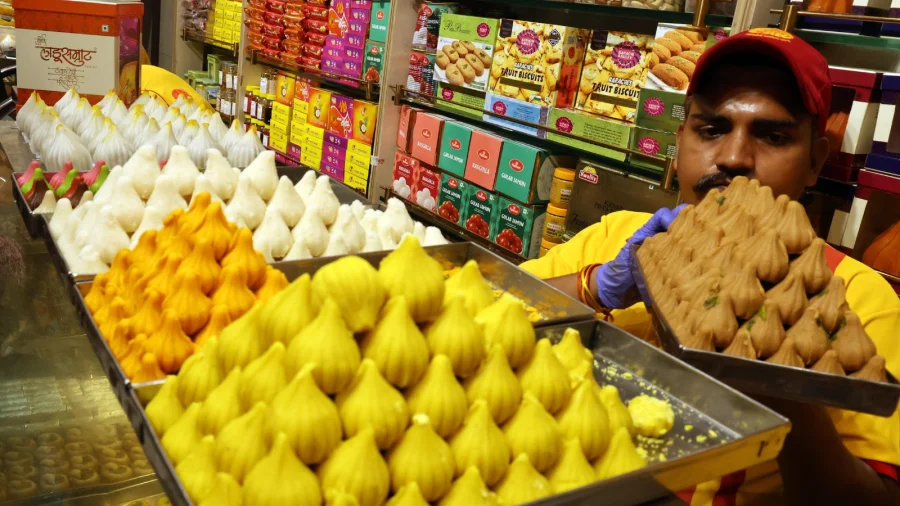
By the time the lights come on across Lalbaug, the kitchens behind the neighbourhood's sweet counters have already stopped keeping time. Sugar syrup is on the boil, khoya is being kneaded, and the thing everyone is queuing for is small, white and neatly pleated. For Ladu Samrat, the Lalbaug name at the centre of this Around Town report, the Ganpati season is the heaviest stretch of the year — put at roughly 10,000 kg of modaks.
That number is doing a lot of work. It is a shop figure, reported in the original piece, and it is the kind of figure that tells you more about Mumbai in September than most market reports do.
In Lalbaug, Ganpati Is Measured in Kilos of Khoya
The preparation is not glamorous. It is milk, rice flour, jaggery, coconut, ghee and repetition — scaled up until a family kitchen becomes something closer to a small factory.
Staff move in shifts. Filling is cooked in large batches, then cooled, then folded into dough by hand. Trays stack faster than they can be wiped down. Somewhere in the middle of all this, the modak — of all shapes and sizes — is steamed, packed and handed over a counter to someone standing in a queue that has not moved.
Why One Modak Counter Matters More Than Any Ad Campaign
Ganpati is Mumbai's most purchase-heavy festival. Homes order sweets for the sthapana, offices send boxes to clients, and families that cook everything else at home still buy modaks because making them well takes time nobody has in a festival week.
That is the demand Ladu Samrat is reportedly walking into. In a neighbourhood like Lalbaug, where the streets fill for the pandal season anyway, a shop's reputation is built entirely on whether last year's modak was worth the wait.
How the Modak Became Ganpati's Most Loaded Sweet
Tradition holds that modak is Lord Ganesha's favoured offering, which is why the sweet appears on almost every Ganpati thali in Maharashtra — most often as the steamed ukadiche modak, with a rice-flour shell and a coconut-jaggery centre.
The version sold in mithai shops is usually the fried one, which holds shape better, travels further and survives a day of gifting. Neither travels very well. Both are why festival sweet counters operate on such tight margins of time.
Who Actually Feels the Ganpati Kitchen Rush
The people who feel it first are the ones least visible in the coverage: the karigars who pleat hundreds of modaks a day, the packers, the counter staff, the delivery riders threading through pandal traffic with boxes that cannot be dropped.
Then there are the buyers. A family ordering modaks for the first day is not just buying dessert; they are buying a formality, a gift, an expectation. When a shop sells out, it is not a small inconvenience — it is someone's Ganpati plan collapsing at 9 pm.
What the Shop Has Confirmed — and What It Hasn't
To be clear about sourcing: this is a neighbourhood feature, not a company disclosure. The 10,000 kg figure comes from the report, and no statement from Ladu Samrat's management was available in the source material, nor has any food regulator commented.
Pricing, staff strength, daily output, number of varieties and whether the modaks are made on-site have not been independently verified. Anyone quoting those details as established fact is going beyond what the reporting supports.
Why Scaling Modak Is Harder Than It Looks
Most Indian sweets tolerate a bad day. Khoya-based modak does not. Milk solids are perishable, jaggery fillings ferment, and a fried shell loses its snap within hours of leaving the kadhai.
That means the business cannot simply "produce more." It has to produce more at the right time, in a kitchen that is already physically full, with labour that cannot be trained overnight. Festival sweet-making is a logistics problem disguised as a recipe.
Confirmed Facts vs What Remains Unclear — A Fair Reading
Reported and broadly consistent: Ladu Samrat is a Lalbaug sweet shop associated with Ganpati-season modak sales, and the reported seasonal volume is around 10,000 kg.
Unclear or unverified: exact kilograms sold per day, the split between fried and steamed modaks, retail and wholesale pricing, staffing, and any supply arrangements with pandals or corporates. Anything beyond the reported figure should be read as speculation, not reporting.
What Gives a Lalbaug Sweet Shop Its Real Edge
Any mithai shop can make a modak. Very few can make them at festival scale and still be the name people queue for. That gap is the actual business.
The advantage stacks up in three ways. Location: a shop inside a neighbourhood that already swells with Ganpati crowds gets walk-in demand that no online brand can buy. Repetition: a counter that has done this for years has its moulds, batches and staff timings already tuned. Trust: during a festival, buyers default to the shop they have eaten from before, because a bad box is not something anyone wants to hand over as a gift.
None of that is patented. But it is also not something a new entrant can assemble in one season.
Risks and Balanced View — Where the Story Gets Complicated
The flip side of festival scale is that everything that can go wrong happens in the same ten days.
Food safety is the obvious risk: high-volume kitchens running long shifts are where hygiene lapses become visible. Labour is the second — festival work is seasonal and punishing, and skilled modak-makers are not easy to replace mid-rush. Then there is competition, which has changed shape. Home cooks sell modaks on WhatsApp and delivery apps, premium patisseries have entered the gifting market, and the pandemic years taught Mumbai to order sweets online.
There is also a structural issue that rarely gets discussed: this is overwhelmingly seasonal revenue. A shop that earns the bulk of its modak money in one festival window absorbs a lot of risk in a short period — a bad batch, a bad review, or a bad week of rain can dent an entire year's headline number.
The Wider Pattern: India's Festival Economy Runs on Counters Like This
Lalbaug is not unusual; it is just visible. From Modak in Pune's sweet lanes to kozhukattai in Chennai and theras in parts of Gujarat, the same model repeats — one highly perishable item, one compressed calendar, and a neighbourhood that decides which shop is worth the queue.
It is also increasingly a digital story. Advance orders now arrive through messaging apps and aggregators weeks before the festival, which changes how far a single shop can reach without opening a second outlet. The modak travels further than it used to.
Practical Reader Guidance — Before You Order This Season
If you are buying modaks for Ganpati, a few things genuinely matter. Check for a displayed FSSAI licence number, ask when the batch was made rather than assuming it is same-day, and prefer sealed, dated boxes if the sweets are for gifting.
Khoya-based modaks should be refrigerated and eaten within a day or two; steamed rice-flour ones are best the same day. If you have nut, dairy or gluten concerns, ask directly what the filling contains — traditional recipes vary by shop. And order early. Every year, the last two days before the main festival are when the good counters stop accepting fresh orders.
Future Outlook — What Could Change in the Next Few Seasons
Nothing suggests the demand for festival modaks is fading. If anything, gifting volumes and online pre-orders are pushing shops to plan earlier and further ahead.
The more likely shifts are practical: more shops publishing fixed pre-order windows, more investment in cold storage and packaging that can survive a delivery ride, and a clearer split between counter sales and bulk corporate orders. Whether a single Lalbaug kitchen keeps carrying 10,000 kg on its own is an open question — and one the shop itself has not publicly answered.
Our Take
This is a small story with a useful shape. A report about a Lalbaug sweet shop selling 10,000 kg of modaks is really a report about how Indian festivals convert tradition into throughput — and how fragile that throughput is when the product refuses to cooperate.
What deserves attention is not the number itself but the labour behind it: seasonal workers, hand-pleated modaks, and a neighbourhood economy that peaks for a week and then goes quiet. That is the part worth reporting properly. And that is also the part that cannot be verified from a headline alone — which is why this piece flags clearly what is reported and what is not.
Frequently Asked Questions
How many modaks does Ladu Samrat sell during Ganpati?
The Around Town report puts seasonal sales at around 10,000 kg of modaks. The shop has not publicly confirmed this figure, and no independent verification was available at the time of writing.
What is a modak, and why is it offered to Ganesha?
A modak is a sweet dumpling, traditionally made with a rice-flour shell and a coconut-jaggery filling, and steamed (ukadiche modak). Fried versions are common in sweet shops. Tradition holds that it is Lord Ganesha's favourite offering, which is why it dominates Ganpati thalis in Maharashtra.
Why is modak difficult to make at a large scale?
Because the ingredients are perishable and the process is manual. Milk solids and jaggery fillings spoil quickly, fried shells lose texture within hours, and pleating hundreds of modaks a day requires trained hands that cannot be hired mid-festival.
When should you place a modak order in Mumbai for Ganpati?
As early as possible — ideally before the festival week. Demand peaks in the final days, counters cap same-day orders, and the most sought-after shops stop taking fresh bookings once their kitchen capacity is full.