
Summary
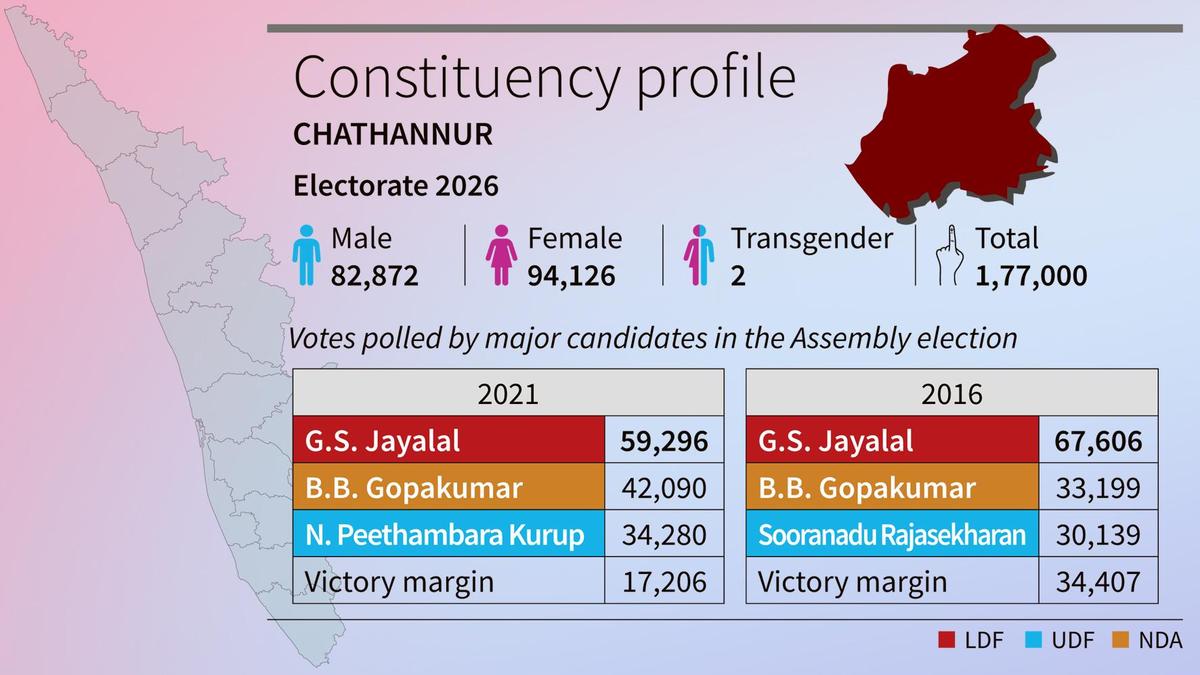
The Chathannur Assembly seat in Kerala is seeing a major change in its political story as the 2026 elections approach. For many years, this area was a strong base for the Left Democratic Front (LDF), with the United Democratic Front (UDF) as the only real challenger. However, the rise of the National Democratic Alliance (NDA) has turned this into a tight three-way race. This shift is changing how parties campaign and how voters decide their future.
Main Impact
The most significant impact of this change is the end of the traditional two-party system in Chathannur. In the past, voters mostly chose between the Left and the Congress-led alliance. Now, the NDA has gained enough support to become a serious contender. This means that the total votes will be split three ways instead of two. For the leading parties, this creates a high-risk situation where even a small shift in voter loyalty could lead to a surprise result. It also forces all three groups to work harder to win over neutral voters who are looking for new options.
Key Details
What Happened
Chathannur was once known as a "red bastion," a term used for places where the Left parties have deep roots and steady support. Over the last few election cycles, the political mood has started to shift. The NDA has steadily increased its presence by focusing on local issues and reaching out to groups that felt ignored by the two main alliances. As the 2026 polls draw near, the campaign ground is more crowded than ever. Each party is now fighting for every single vote, knowing that the old rules of Kerala politics may no longer apply in this constituency.
Important Numbers and Facts
In previous elections, the LDF maintained a comfortable lead, often winning by thousands of votes. However, recent data shows that the NDA’s vote share has grown significantly, sometimes doubling in specific local areas. In the last major election, the gap between the winner and the runners-up began to shrink. Political observers note that if the NDA continues to grow at this rate, the 2026 result could be decided by a very thin margin. There are over 180,000 registered voters in the segment, and the turnout is expected to be high as the competition heats up.
Background and Context
To understand why Chathannur is changing, one must look at its history. The area has a large population of workers, particularly those involved in the cashew industry. For decades, these workers were the backbone of the Left's support. They relied on the party for labor rights and social welfare. However, the cashew industry has faced many problems lately, including factory closures and low wages. This has led to some frustration among the traditional voting base. At the same time, younger voters are looking for different types of development and job opportunities. The NDA has used this opening to present itself as a fresh alternative to the long-standing rivalry between the LDF and the UDF.
Public or Industry Reaction
Local residents have mixed feelings about the new three-way battle. Some voters feel that having more choices is good for democracy because it makes the parties work harder. Others worry that a split vote might lead to a winner who does not have the support of the majority. Within the political parties, there is a sense of urgency. The LDF is trying to remind voters of its past work and social programs. The UDF is focusing on criticizing the current government’s record. Meanwhile, the NDA is highlighting central government schemes and promising a new direction for the state. Political experts say that Chathannur is now a "litmus test" for how the rest of Kerala might vote in the future.
What This Means Going Forward
As the election date gets closer, the pressure on all three alliances will grow. The LDF needs to protect its home ground to show it still has the trust of the working class. The UDF needs to prove it is still the main alternative to the Left. For the NDA, a strong showing or a win in Chathannur would be a historic moment that could change their status across the entire state. The next few months will see intense campaigning, with a focus on door-to-door meetings and local rallies. The outcome will likely depend on which party can best address the daily struggles of the people, such as the cost of living and local infrastructure.
Final Take
The transformation of Chathannur from a safe seat into a fierce battleground shows that no political party can take its supporters for granted. The 2026 election will be a turning point that determines if the traditional powers can hold on or if a new force will take charge.
Frequently Asked Questions
Why is Chathannur considered a tri-cornered battle?
It is called a tri-cornered battle because three major groups—the LDF, UDF, and NDA—all have a strong chance of winning, unlike in the past when only two parties competed for the top spot.
What was the historical political trend in Chathannur?
Historically, Chathannur was a strong area for the Left parties (LDF). They often won with the support of the local working class, especially those in the cashew industry.
What is driving the rise of the NDA in this area?
The NDA has grown by focusing on voters who are unhappy with the traditional parties and by highlighting new development goals and central government projects.



