Summary
Iran has launched targeted strikes against two of the most important locations in the United Arab Emirates. The attacks hit the oil port of Fujairah and the Dubai International Airport, causing immediate disruptions to global trade and travel. These events represent a major increase in tension in the Middle East. Because these sites are central to the world's energy supply and international flight paths, the impact is being felt far beyond the region.
Main Impact
The primary impact of these strikes is the sudden threat to global energy security. Fujairah is a vital hub that allows oil to reach the world market without passing through the dangerous Strait of Hormuz. By hitting this port, the safety of the world's oil supply is now in question. Furthermore, the attack on Dubai’s airport has halted one of the world's busiest transit points, leaving thousands of travelers stranded and stopping the flow of international air cargo.
Key Details
What Happened
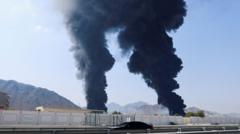
Early reports indicate that multiple explosions occurred at the Fujairah port facility and near the main terminals of Dubai International Airport. Witnesses reported seeing smoke rising from oil storage areas in Fujairah. In Dubai, flight operations were stopped immediately as security teams moved in to secure the area. While the exact number of casualties is not yet clear, the physical damage to infrastructure appears to be significant.
Important Numbers and Facts
Fujairah is the second-largest refueling hub for ships in the world. It handles millions of barrels of oil and refined products every month. The port is connected to a 230-mile pipeline that brings oil directly from fields in Abu Dhabi, allowing it to bypass the narrow water paths controlled by Iran. Dubai International Airport serves more than 80 million passengers annually and is a primary link between Europe, Asia, and the Americas. Even a short closure of this airport can cause delays for hundreds of flights globally.
Background and Context
To understand why this attack is so serious, it is important to look at how oil moves around the world. Most oil from the Persian Gulf must travel through the Strait of Hormuz, a narrow waterway that Iran has often threatened to close. To protect the economy, the United Arab Emirates built the Fujairah port on its eastern coast. This allows oil to be loaded onto ships in the Indian Ocean, completely avoiding the Strait of Hormuz. This port was seen as the ultimate safety net for the global oil market. By attacking it, Iran has shown that the backup plan for global energy is also at risk.
Public or Industry Reaction
The global reaction was almost instant. Oil prices rose sharply within minutes of the news, as traders feared a long-term shortage. Shipping companies are now reconsidering their routes, and many are waiting for new security instructions before entering the region. Aviation experts have expressed deep concern, noting that Dubai is a cornerstone of international travel. Several major airlines have already announced that they will reroute flights to avoid UAE airspace entirely until the situation is stable. Government leaders from around the world have called for an end to the violence, fearing that this could lead to a much larger war.
What This Means Going Forward
The next steps will depend on how the United Arab Emirates and its international partners choose to respond. There is a high risk of military retaliation, which could lead to a cycle of violence across the region. For the average person, this event will likely lead to higher prices at the gas pump and more expensive airline tickets. Companies that rely on shipping will also face higher costs for insurance and security. In the long term, this attack may force countries to look for even more ways to move energy that do not rely on the Middle East.
Final Take
The strikes on Fujairah and Dubai have changed the security situation in the Middle East. These were not just attacks on a single country, but hits against the systems that keep the global economy running. The world is now entering a period of high uncertainty, where the safety of trade routes and international travel can no longer be taken for granted. How global powers handle this crisis in the coming days will determine the stability of the global market for years to come.
Frequently Asked Questions
Why is the Fujairah port so important for oil?
Fujairah is located on the Indian Ocean, allowing oil to be shipped without going through the Strait of Hormuz. This makes it a critical backup route if the main waterways in the Persian Gulf are blocked or dangerous.
How does the attack on Dubai Airport affect travelers?
Dubai is one of the world's largest transit hubs. An attack there causes a chain reaction of canceled and delayed flights across the globe, affecting millions of people who use the airport to connect between different continents.
Will this cause gas prices to go up?
Yes, oil prices usually rise when there is conflict in the Middle East. Because Fujairah is a major oil hub, any damage to its ability to ship oil creates a fear of supply shortages, which leads to higher prices for consumers.