Summary
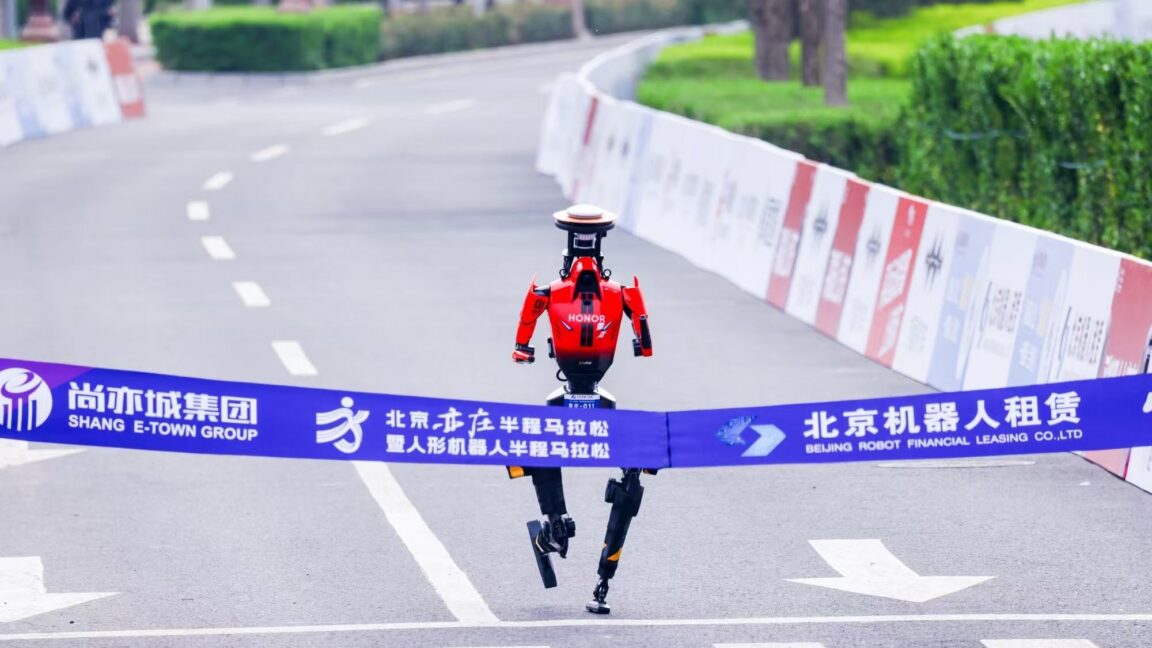
A humanoid robot recently made history by winning a half-marathon in Beijing, finishing the race faster than any human ever has. The robot, created by the technology company Honor, completed the 13-mile course in just over 50 minutes. This event shows how quickly robotic technology is advancing, especially in China where companies are working to build robots for everyday use. By beating the human world record, this machine has proven that robots are becoming more capable of performing physical tasks that were once thought to be only for people.
Main Impact
The most significant result of this race is the proof that robots can now outrun the fastest human athletes over long distances. For a long time, robots were slow and had trouble keeping their balance on uneven ground. This race changes that view. It shows that machines can handle the physical stress of a long run while moving at high speeds. This success is not just about sports; it signals that robots are ready for more difficult jobs in the real world. If a robot can run a half-marathon faster than a professional athlete, it can likely handle many other physical tasks in factories, delivery services, or emergency situations.
Key Details
What Happened
The event took place in Beijing on April 19. Several humanoid robots competed against human runners in a standard half-marathon, which covers 21 kilometers or about 13 miles. The robot from Honor did not just win the race; it did so while moving entirely on its own. It had to navigate the path, avoid obstacles, and maintain its pace without a human steering it. This type of independent movement is a major step forward for artificial intelligence and mechanical engineering.
Important Numbers and Facts
The robot finished the race in 50 minutes and 26 seconds. To understand how fast this is, we can look at the current human world record. The fastest a human has ever run a half-marathon is 57 minutes and 20 seconds, a record set by Jacob Kiplimo. The robot was nearly seven minutes faster than the best human runner in history. The machine stands on long legs that are about 37 inches long, which helps it take large strides. It also uses a special liquid-cooling system to keep its parts from getting too hot during the run. This cooling technology is similar to what the company uses in its high-end smartphones and computers.
Background and Context
Building a robot that can run like a human is very difficult. Humans have complex joints and a natural sense of balance that is hard to copy with metal and motors. In the past, most robots that could run were kept in labs and attached to safety wires. In recent years, companies in China and the United States have been racing to create "humanoid" robots—machines that look and move like people. China’s tech industry is currently pushing to mass-produce these robots. They want to make them cheap enough and reliable enough to work in places like warehouses or to help elderly people in their homes. Testing these robots in a public race is a way to show the world that the technology is ready for the public.
Public or Industry Reaction
The reaction to the race has been a mix of surprise and excitement. Many people who watched the event were shocked to see a machine move with such speed and grace. Within the tech industry, experts are looking closely at the robot's cooling system. Keeping a robot cool is a major challenge because the motors generate a lot of heat when they work hard. Du Xiaodi, an engineer for the winning team, explained that the cooling system used in the robot could eventually be used for robots that work in hot factories. While some sports fans feel that robots should not be compared to humans, many scientists see this as a necessary test of what machines can do.
What This Means Going Forward
This record-breaking run is likely just the beginning. As companies learn how to make robots more efficient, we will see them appearing in more parts of our lives. The next step for these engineers is to make the robots stay powered for longer periods. While the robot was fast, it still needs a lot of energy to move its heavy metal body. In the future, we might see these robots used for search and rescue missions where they need to travel over long distances quickly to save people. There is also a push to make these robots safer so they can work side-by-side with humans without causing accidents. The success in Beijing proves that the mechanical side of the technology is catching up to the software side.
Final Take
The day when robots can outperform humans in physical tasks has arrived. By running 13 miles faster than any person in history, this robot has set a new standard for what machines can achieve. It is a clear sign that the gap between human ability and robotic power is closing fast. As these machines become more common, they will change how we think about work, sports, and the limits of technology.
Frequently Asked Questions
How fast did the robot run the half-marathon?
The robot finished the 13-mile race in 50 minutes and 26 seconds, which is about seven minutes faster than the human world record.
Who built the winning robot?
The robot was built by Honor, a Chinese company that is well-known for making smartphones and other electronic devices.
How does the robot stay cool while running?
The robot uses a custom liquid-cooling system. This system is based on the technology used to keep small electronics like phones from overheating during heavy use.