
Summary
Two passenger planes collided on the ground at Delhi’s Indira Gandhi International Airport on Thursday afternoon. The incident involved aircraft from Akasa Air and SpiceJet, both of which suffered visible damage during the contact. While no injuries were reported among passengers or crew, the aviation regulator has launched a full investigation to find out how the accident happened. Both planes have been removed from service for repairs and safety checks.
Main Impact
The immediate result of the collision is the grounding of two Boeing 737 aircraft, which disrupts flight schedules and costs the airlines money. More importantly, the Directorate General of Civil Aviation (DGCA) has taken strict action by removing the pilots and the air traffic controller from their duties while they investigate. This event highlights the risks of ground movements at busy airports and has led to a review of how planes are guided to their parking spots.
Key Details
What Happened
The accident took place while one plane was preparing to leave and the other was arriving. The Akasa Air plane, a Boeing 737 MAX 8, had just been pushed back from its gate and was sitting still on a taxiway. It was getting ready to start its engines for a flight to Hyderabad. At the same time, a SpiceJet Boeing 737-700, which had just landed from Leh, was moving toward its parking area.
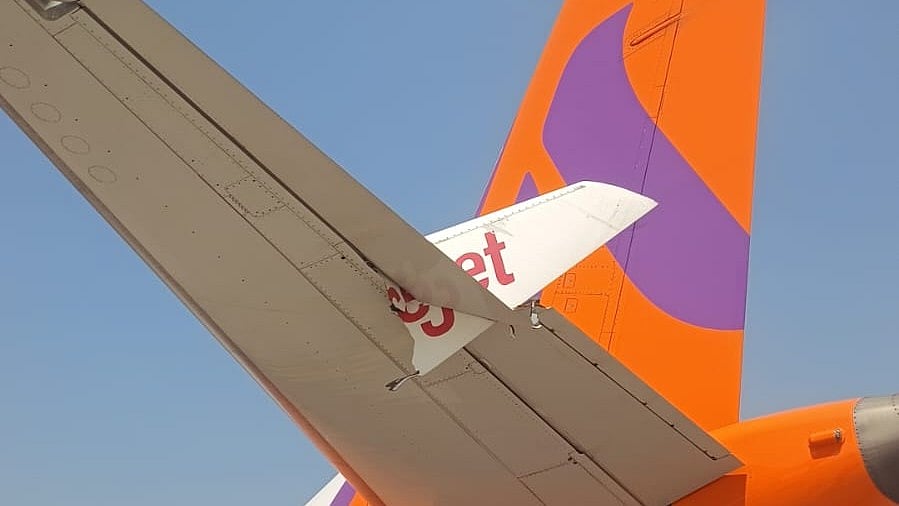
As the SpiceJet plane moved, its right-hand winglet—the tipped-up part at the end of the wing—hit the tail section of the Akasa Air plane. Specifically, it struck the horizontal stabilizer, which is the small wing-like part on the back of the plane used for balance. The impact was strong enough to cause clear damage to both parts of the aircraft.
Important Numbers and Facts
The incident involved Akasa Air flight QP 1406. Both aircraft are part of the Boeing 737 family, which is one of the most common types of planes used in India. Following the collision, the DGCA immediately de-rostered the SpiceJet pilots and the air traffic controller who was managing the ground traffic at the time. De-rostering means they are not allowed to fly or work until the safety board finishes its report.
Background and Context
Ground safety is a major part of airport operations. Even though planes move slowly on the ground, they are very large and have wide wingspans that are hard for pilots to see perfectly from the cockpit. To prevent hits, airports use "wing walkers." These are ground crew members who walk near the wingtips and use hand signals or flags to tell the pilot if there is enough space to turn.
In this case, early reports suggest that the SpiceJet pilot may have turned the plane without getting the okay from a wing walker. Even though the air traffic control tower gave the pilot permission to move to the parking bay, the pilot is still responsible for making sure the path is clear before making a turn.
Public or Industry Reaction
Both airlines released statements shortly after the event. Akasa Air confirmed that all passengers and crew members got off the plane safely and were moved back to the terminal. They emphasized that they followed all safety rules after the bump. SpiceJet described the event as a "ground incident" and confirmed the specific parts of the plane that were damaged.
The Ministry of Civil Aviation has stated that it is watching the investigation closely. They want to ensure that Delhi airport remains safe for the thousands of travelers who use it every day. Industry experts are looking at whether the ground crew and the pilots communicated properly during the busy afternoon period.
What This Means Going Forward
The DGCA investigation will look at flight data recorders and talk to everyone involved. They will check if the air traffic controller gave clear instructions and if the SpiceJet crew followed the correct path. This could lead to new rules for how planes move in Delhi, especially in tight spaces between gates.
For the airlines, this means expensive repairs. Replacing a winglet or a tail stabilizer takes time and specialized parts. For passengers, it serves as a reminder that safety checks are constant, and even small mistakes on the ground are taken very seriously by the government to prevent bigger accidents in the air.
Final Take
While it is fortunate that no one was hurt, this collision shows that safety requires perfect coordination between pilots, ground staff, and controllers. The quick decision to ground the planes and suspend the staff involved shows that the authorities are not taking any chances. As the investigation continues, the focus will remain on improving ground signals to ensure that wings and tails never touch again.
Frequently Asked Questions
Was anyone injured in the Delhi airport collision?
No, there were no injuries reported. All passengers and crew members on both the Akasa Air and SpiceJet planes were able to leave the aircraft safely and return to the airport terminal.
What parts of the planes were damaged?
The right winglet of the SpiceJet plane hit the horizontal stabilizer (the small rear wing) of the Akasa Air plane. Both aircraft suffered visible damage and require repairs before they can fly again.
Why were the pilots and the air traffic controller suspended?
The DGCA de-rostered them as a standard safety procedure. This allows the regulator to conduct a fair investigation into whether human error or a failure in communication led to the two planes hitting each other.

