
Summary
A major DNA study has uncovered a mystery involving ancient people who lived near Paris, France. Scientists found that a specific group of humans who lived in the area suddenly disappeared about 3,000 years ago. By studying old bones found in a large burial site, researchers were able to track a massive family tree that lasted for several generations before it came to an end. This discovery helps us understand how the population of Europe changed during the transition from the Stone Age to the Bronze Age.
Main Impact
The most important part of this discovery is the proof of a total genetic shift in the region. For a long time, people thought that ancient populations stayed in one place and slowly grew into the modern societies we see today. However, this study shows that entire groups of people could vanish or be replaced by new groups moving into the area. This means the people living in France today might not be directly related to the people who built these ancient tombs. It highlights how migration and social changes completely reshaped the history of Europe.
Key Details
What Happened
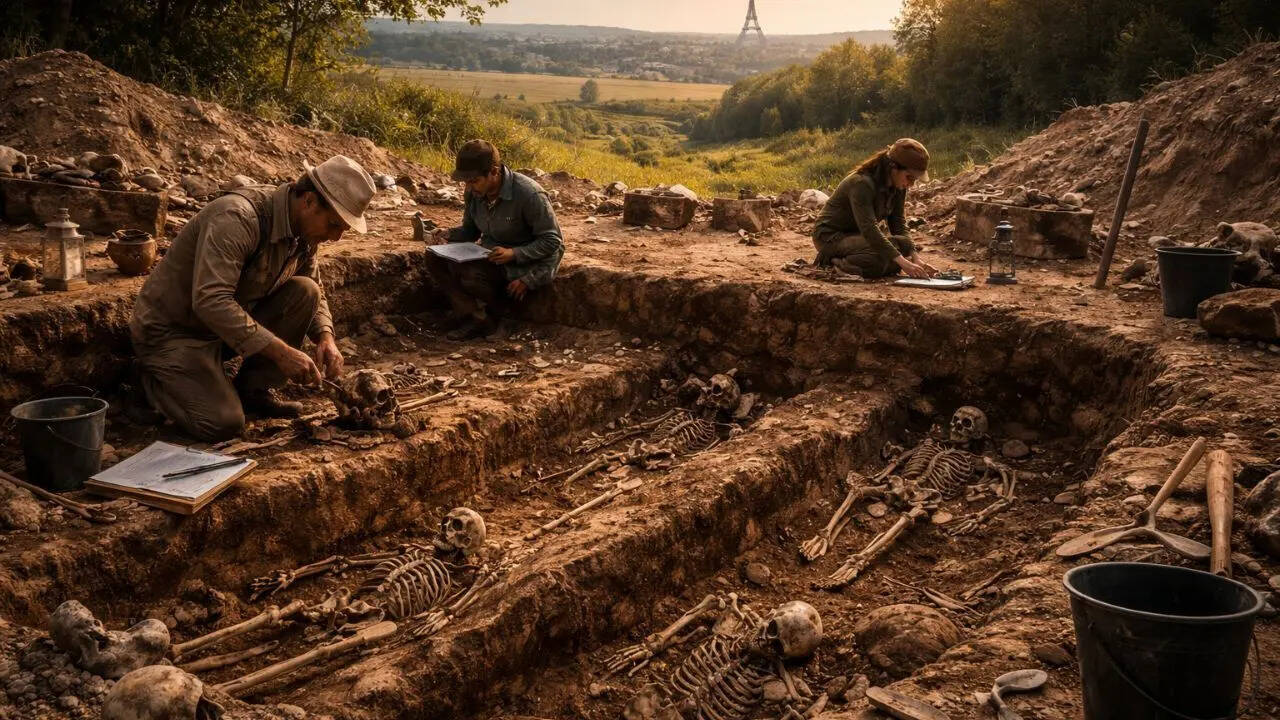
Scientists focused their research on a famous burial site known as Gurgy "Les Noisats," located in the Paris Basin. They used advanced technology to extract DNA from the teeth and bones of people buried there. The results were surprising. They found a huge family tree that included 128 different people. This family lived in the same spot for about 200 years. They had a very organized way of living, where men stayed with their families and women moved in from other groups to start new families. But after a few centuries, this specific genetic line stopped appearing in the records. About 3,000 years ago, these people were no longer there, and a different group of people with different DNA took their place.
Important Numbers and Facts
The study looked at remains that are roughly 4,500 to 5,000 years old, but the disappearance happened as the region moved toward the year 1000 BCE. The family tree discovered by the team is one of the largest ever reconstructed from ancient DNA, spanning seven full generations. Researchers found that the group was very healthy and had plenty of food, which makes their eventual disappearance even more of a mystery. There were no signs of a massive war or a deadly disease that killed everyone at once. Instead, they simply seem to have been replaced by a new wave of people moving across Europe.
Background and Context
To understand why this matters, we have to look at how humans lived back then. This was a time when people were moving away from being simple hunters and were starting to build permanent farms and social structures. The site near Paris shows that these people were very good at keeping their family history alive. They buried their dead in a way that showed who was related to whom. The fact that they disappeared suggests that Europe was a very busy place with many different groups moving around. When a new group arrived with better tools or different ways of farming, the older groups often moved away or merged with the newcomers until their original DNA was gone.
Public or Industry Reaction
Experts in history and science are very impressed by the level of detail in this study. In the past, we could only guess how ancient families were structured by looking at the items buried with them, like pots or jewelry. Now, DNA gives us a clear picture of who was the father, the mother, and the child. Many historians say this is like having a "time machine" that lets them see the social rules of a world that existed thousands of years ago. Some researchers are now calling for similar studies to be done across all of Europe to see if other "lost" populations can be found.
What This Means Going Forward
This discovery opens up new questions about what happened to the people of ancient France. Scientists now want to find out where the "new" people came from and why the original family left or died out. It also shows that DNA testing is the best tool we have for rewriting history books. In the future, we might find that many other ancient cities and groups also disappeared suddenly. This helps us realize that human history is full of movements and changes, rather than just people staying in one place for thousands of years. It also reminds us that the environment and social changes can have a huge effect on whether a group of people survives or vanishes.
Final Take
The mystery of the Paris tomb shows us that the past is much more complicated than we once thought. Even a large, healthy, and successful family could see its lineage come to an end as the world changed around them. This study proves that our ancestors lived through periods of massive change that we are only just beginning to understand. By looking at the DNA of those who came before us, we get a better sense of the long and winding path that led to the world we live in today.
Frequently Asked Questions
How did the scientists find the family tree?
They took DNA samples from the bones and teeth of people buried in a large cemetery. By comparing the genetic markers, they could see who was related and build a map of the family over seven generations.
Why did the people disappear 3,000 years ago?
Scientists are not exactly sure, but they believe it was caused by new groups of people moving into the area. These newcomers brought different cultures and genetics, which eventually replaced the original population.
Was there a war that killed them?
There is no evidence of a violent war or a sudden disaster. The bones do not show signs of battle injuries, suggesting that the change was likely a slow process of migration and social shifting rather than a single violent event.

